
Office relocation is defined as the full operational transition of a business from one premises to another, covering planning, technology migration, staff coordination, and compliance with building and security protocols. It is far more than moving desks and chairs. Corporate relocations require 6–12 months of advance preparation, and compressing that timeline leads directly to rush costs and operational failures. What does office relocation involve at its core? It involves managing complex dependencies across vendors, departments, IT infrastructure, and people, all at the same time. Get any one of those wrong, and the entire move date is at risk.
What are the key phases involved in an office relocation?
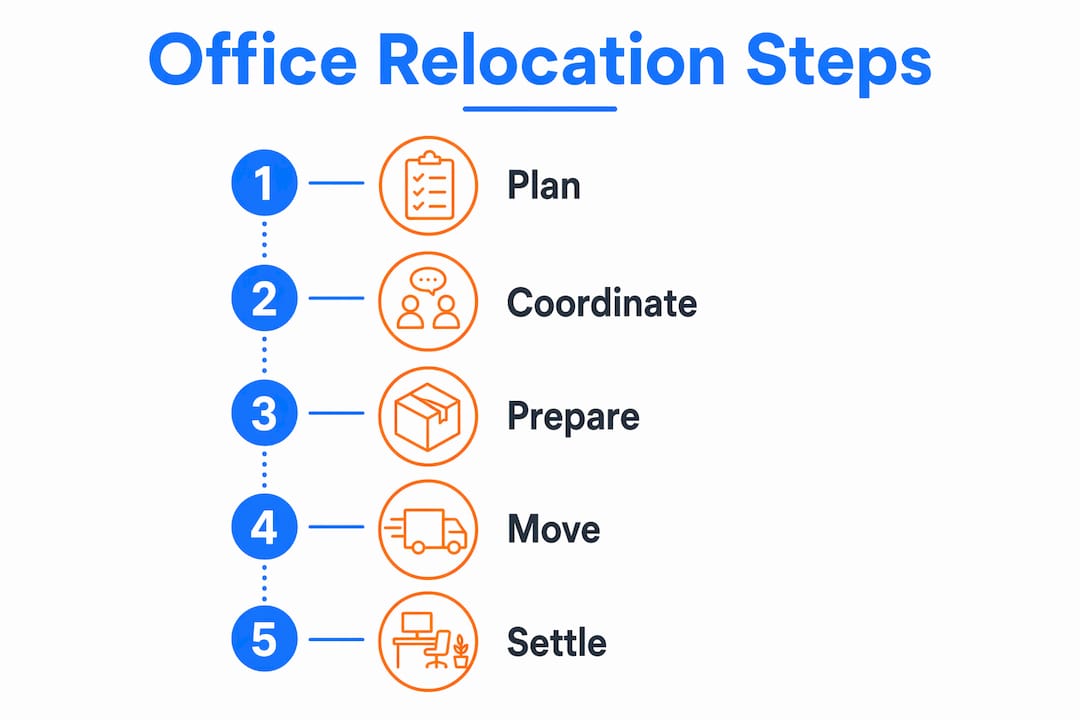
Office relocation follows a clear sequence of phases, and skipping any one of them creates problems that compound quickly.
Initial planning and site selection (6–12 months out). This phase covers budget setting, lease negotiations, and selecting the new premises. Decisions made here set the constraints for everything that follows, including floor layout, IT infrastructure capacity, and access arrangements with building management.
Workspace design and layout. Once the new space is confirmed, the fit-out design begins. This covers desk allocation, meeting room configuration, storage, and accessibility. Poor layout decisions made at this stage are expensive to reverse after move-in.
Vendor coordination and IT setup. This is where most businesses lose time. Fibre internet installation carries lead times of 2–3 weeks, and AV and technology installation costs rose 8.3% year-on-year in 2026. Booking vendors late pushes back the entire move date.
Physical move logistics and execution. Packing, labelling, transport, and unpacking at the new site. This phase feels like the main event, but physical transport accounts for only about 30% of total move effort. The other 70% sits in vendor coordination, IT timing, access agreements, and stakeholder management.
Post-move support and operational readiness checks. Testing phones, internet, access control, and security systems on Day One. Completing a snag list of outstanding issues before staff settle in. This phase is the most commonly skipped and the most consequential.
Pro Tip: Assign a single project owner for the entire relocation before any other decision is made. Moves fail when responsibilities are unclear, and no single accountable owner leads to stalled decisions and execution breakdowns.
Why does effective coordination matter so much during an office move?

The physical move is the easy part. The hard part is managing the web of dependencies between vendors, departments, and building management that all need to align on the same date.
Move failures happen when one dependency slips and triggers a cascade. If the IT contractor cannot access the new building until a week after the removal team, the entire network setup is delayed. If telecoms are not tested before staff arrive, the business operates without phones on Day One.
The most common coordination failures include:
- No clear communication plan. Teams find out about move details too late to prepare, leading to confusion and resistance.
- Vendor scheduling conflicts. IT, AV, and furniture suppliers all need access to the new space at different times. Without a master schedule, they clash.
- Building management bottlenecks. Lift bookings, loading bay access, and out-of-hours permissions all require advance notice. Missing these causes delays on move day.
- Unclear executive ownership. Moves without a single accountable owner stall at every decision point.
- No contingency buffer. A single supplier delay with no fallback plan can push the move date back by days.
Pro Tip: Build a master dependency tracker that lists every vendor, their required access date, and who owns the relationship. Review it weekly in the final two months before the move.
What are common mistakes businesses make during office moves?
Most office move failures are predictable. The same mistakes appear repeatedly, and they are all avoidable with early planning.
Underestimating technology lead times. Fibre broadband, structured cabling, and AV systems all require booking weeks in advance. Businesses that treat IT setup as a last-minute task routinely find themselves operating without connectivity on Day One.
Treating the move as a logistics exercise. Office moves must be treated as operational cutovers, not just a physical transport job. Every business function, from internet connectivity to access control, needs to be fully tested before staff arrive.
Ignoring employee communication. 67% of employees find office moves challenging primarily because of poor communication and unclear expectations, not the physical disruption. Neglecting this risks attrition and a lasting drop in productivity.
No single accountable owner. When the move is managed by a committee with no clear lead, decisions stall. Every escalation becomes a debate. Execution suffers.
Skipping post-move audits. Businesses that declare the move complete on move day and return to normal operations without a readiness check discover problems days later, when they are far harder to fix.
Underestimating relocation costs. Infrastructure, IT, and fit-out costs are routinely left out of initial budgets, creating financial pressure mid-project.
How do infrastructure and technology requirements shape relocation planning?
Technology setup is the longest lead-time item in any office move. It must be planned first, not last.
| Infrastructure item | Typical lead time | Key risk if delayed |
|---|---|---|
| Fibre broadband installation | 2–3 weeks | No internet on Day One |
| Structured cabling and patching | 1–2 weeks | Network cannot go live |
| AV and conferencing systems | 2–4 weeks | Meeting rooms non-functional |
| Access control and security | 1–3 weeks | Building security gaps |
| Telephony and VoIP cutover | 1–2 weeks | No phone lines on Day One |
Data security adds another layer of complexity. Office relocation is a significant security and compliance event requiring documented chain-of-custody tracking and IT asset management to mitigate data risks. NIST frameworks recommend full data risk assessments for any physical office move involving IT and sensitive information. Businesses that skip this step create vulnerabilities that are difficult to detect until a breach occurs.
The cutover itself requires careful timing. Switching off systems at the old site and bringing them live at the new one must happen in a controlled sequence. Testing each system independently before staff arrive is the only way to confirm operational readiness.
Pro Tip: Schedule a full IT dry run at the new site at least one week before move day. Test every system under realistic load conditions, not just a basic connectivity check.
What post-move actions ensure a successful transition?
The move day is not the finish line. What happens in the first 48 hours after the physical move determines whether the business returns to full productivity quickly or spends weeks managing disruption.
Complete a snag list on Day One. A post-move snag list captures every outstanding issue, from missing furniture to IT faults, and assigns ownership for resolution. Completing this on the first business day prevents problems from being forgotten and dragging on for weeks.
Test all critical systems before staff arrive. Phones, internet, access control, and security cameras must all be confirmed as live. Do not assume a system works because it was installed. Test it under real conditions.
Support employees in adapting to the new space. New floor layouts, different commute routes, and unfamiliar technology all create friction. A brief orientation session on Day One reduces confusion and signals that the business has planned the transition properly.
Plan for minor fixes and adjustments. Furniture positions will need tweaking. Cable management will need tidying. Some equipment will need repositioning. Allocating a small budget and a responsible person for these tasks in the first two weeks prevents them from becoming ongoing irritants.
Conduct a formal operational readiness review at the end of week one. Gather feedback from department heads, confirm all systems are stable, and close out the snag list. This review marks the true end of the relocation process.
Key takeaways
Office relocation is an operational project, not a logistics task, and its success depends on early planning, clear ownership, and rigorous post-move testing.
| Point | Details |
|---|---|
| Plan 6–12 months ahead | Corporate moves require long lead times; compressing them causes rush costs and failures. |
| Assign a single owner | Moves without one accountable person stall at every decision point. |
| Prioritise IT and infrastructure | Technology setup carries the longest lead times and must be booked first. |
| Communicate with employees | 67% of staff find moves hard due to poor communication, not physical disruption. |
| Complete a Day One snag list | Post-move audits on the first business day prevent problems from dragging on for weeks. |
What most businesses get wrong about office moves
Office moves are consistently underestimated, and I have seen the same pattern repeat across businesses of every size. The project starts with a focus on the physical: how many desks, which van, what date. The operational side, the IT cutover, the access agreements, the employee communication, gets treated as detail to sort out later. By the time “later” arrives, there is no time left to do it properly.
The single most important shift a business can make is to treat the move as an operational cutover from the start. That means asking, on day one of planning: what does every business function need to be fully operational at the new site, and when does each dependency need to be in place to make that happen? That question reorders the entire project plan.
I also think employee communication is the most consistently undervalued part of the process. Businesses spend months on floor plans and IT specs, then send staff a single email two weeks before move day. 67% of employees find office moves difficult primarily because of poor communication. That is a fixable problem, and it costs nothing to fix early.
The businesses that handle moves well share one trait: they appoint a single, senior, accountable owner before any other decision is made. That person has authority to make decisions, resolve conflicts, and hold vendors to account. Without that, every problem becomes a committee discussion.
— London
How Westlondonremoval supports your office move
Planning an office relocation in West London is a significant undertaking, and having the right removal partner makes a real difference to how smoothly it goes.

Westlondonremoval provides reliable, fully insured office relocation services across West London, covering everything from man and van support for smaller offices to full removal services for larger commercial moves. We work around your schedule, including evenings and weekends, to minimise disruption to your business. Not sure which service level suits your move? Our guide on man and van vs full removal helps you decide based on your office size and complexity. Get in touch with Westlondonremoval today for a transparent, no-obligation quote.
FAQ
What does office relocation involve at a basic level?
Office relocation involves planning, technology setup, physical transport, staff coordination, and post-move readiness testing. It is an operational transition, not just a logistics exercise.
How far in advance should you plan an office move?
Corporate relocations require 6–12 months of advance planning. Mid-size office moves need at least a 10–12 week planning runway once the new site is confirmed.
Why do office moves fail?
Moves most commonly fail due to unclear ownership, poor employee communication, and underestimated IT lead times. No single accountable owner is the most frequent root cause of execution breakdowns.
What is a post-move snag list?
A snag list is a record of all outstanding issues captured on the first business day after the move, covering missing items, IT faults, and unresolved fit-out tasks. Completing it immediately prevents problems from lingering for weeks.
How does IT setup affect the office moving process?
IT infrastructure, including fibre broadband and structured cabling, carries lead times of 1–3 weeks. Booking these late is the most common cause of businesses having no internet or phone connectivity on Day One.