
A self-pack move is when you pack your own belongings and a professional crew handles the loading, transport, and unloading. Alternatively, the removal company delivers a container to your door, you fill it at your own pace, and they collect and transport it when you’re ready. Either way, the packing labour stays with you. This suits cost-conscious movers who have the time, physical ability, and a bit of help from friends or family. The main trade-off is straightforward: you save on labour costs, but you take on the effort and carry more responsibility for how well your items are protected.
At a glance:
- You pack all boxes and prepare your belongings before the crew arrives
- Professionals load, secure, drive, and unload
- Options include portable containers, hire trucks, or a man-and-van service
- Owner-packed boxes are typically noted as ‘PBO’ (packed by owner) on the inventory, which affects liability
- A hybrid approach lets you pack most rooms while pros handle fragile or high-value items
Table of Contents
- How does a self-pack move actually work, step by step?
- What types of self-pack move are available in the UK?
- What are the pros and cons of self-packing?
- What drives the cost of a self-pack move?
- Practical packing and safety tips for a self-pack move
- Can you place a container in your garden or on the street in the UK?
- When does a hybrid approach make more sense?
- What to expect on moving day and your checklist
- Is a self-pack move the right choice for you?
- Key takeaways
- Why the hybrid model is often the smartest choice
- How Westlondonremoval supports self-pack and hybrid moves
- Useful sources and further reading
How does a self-pack move actually work, step by step?
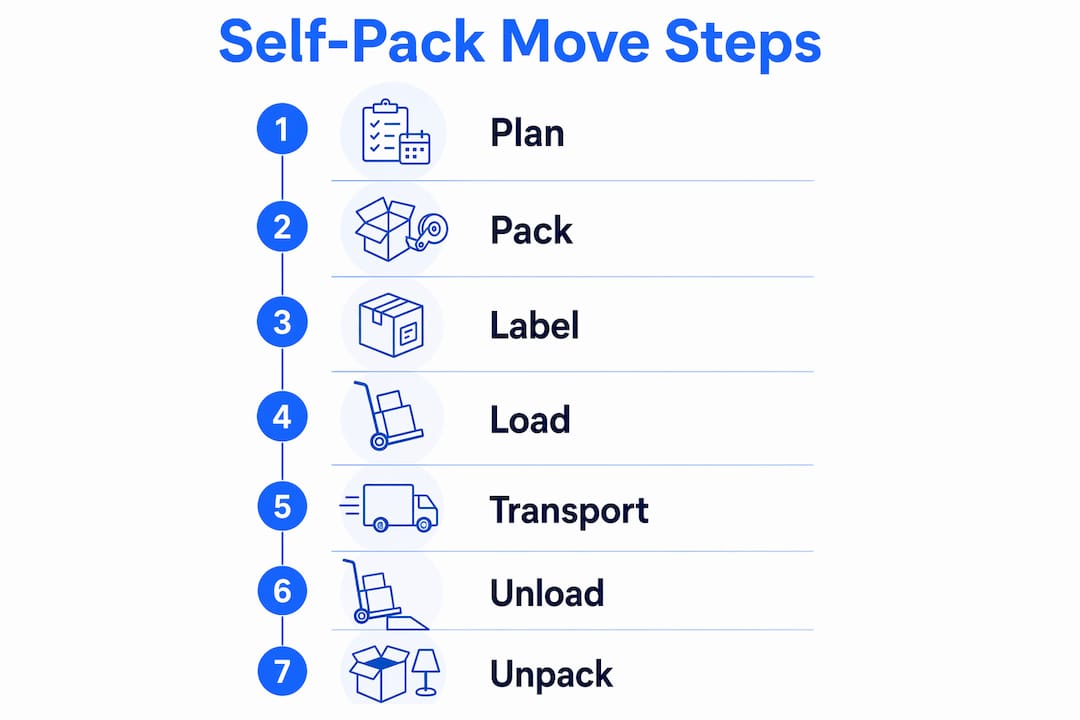
The process follows a clear sequence, and understanding it helps you plan your time and avoid surprises on the day.
- Get quotes and book. Request written quotes from at least three removal companies. Ask specifically about owner-packed box liability, loading windows, and any charges for parking or traffic management.
- Receive your container or confirm crew arrival time. For portable container services, the unit is delivered to your property. For van-based services, you agree a start time with the crew.
- Pack during your window. You have a set period to pack everything. Start packing at least 2–3 weeks before your move date to avoid last-minute rushing and common mistakes.
- Seal and label all boxes. Every box should be clearly marked with the destination room and a brief contents description. Owner-packed boxes are noted on the inventory as PBO.
- The crew loads and secures. Professionals load the vehicle or seal the container, stacking and securing items to minimise movement in transit.
- Transport. The crew drives to your new address, or the container is collected and delivered.
- Unloading and placement. The crew unloads and places items in the rooms you specify. You direct; they carry.
What you’re responsible for: the quality of your packing, the labelling, and the protection of fragile items inside your boxes. The crew is responsible for safe loading, transit, and unloading.
Pro Tip: Stage your packed boxes by room and by unloading sequence — heaviest and least fragile first, fragile and bedroom boxes last. This speeds loading and means the crew isn’t hunting for the right box at the other end.
Good planning prevents the majority of common problems on moving day. The packing itself often represents the bulk of the pre-move workload, so building a realistic multi-week packing schedule is one of the most practical things you can do.
What types of self-pack move are available in the UK?
Not all self-pack moves look the same. The format you choose depends on your volume, distance, and whether you need storage in between.
Portable moving containers

A steel or timber container is delivered to your driveway or kerbside. You load it over one or several days, then the company collects and transports it. This is the most flexible option for families with a lot to move or those who need a short storage window between properties. The loading window is typically 24–72 hours, though some providers offer longer. The cost shape is predictable: you pay for the container, delivery, collection, and transport, with storage charged separately if needed.
Shipping containers
Used mainly for international moves or long-term storage, a full 20ft or 40ft shipping container gives you maximum volume. Loading windows are longer, but the logistics are more complex and costs are higher. For most UK domestic moves, this is overkill unless you’re moving a large household or storing belongings for several months.
Hire truck (self-drive)
You hire the vehicle and drive it yourself. This is the lowest-cost option on paper, but it requires a suitable driving licence, confidence with a large vehicle, and a second person to help load and unload. It suits single-trip local moves with a small volume of belongings.
Man-and-van hybrid
A driver and one or two crew members arrive with a van. You’ve packed everything; they load, drive, and unload. This is the most common self-pack format for UK house moves and works well for local removals in West London where distances are short and volumes are manageable. It combines professional loading with your own packing effort.
| Format | Best for | Loading window | Storage option | Cost shape |
|---|---|---|---|---|
| Portable container | Families, flexible timing | 24–72 hours+ | Yes | Container + transport fee |
| Shipping container | International / long-term | Days to weeks | Yes | Higher, logistics-heavy |
| Hire truck | Small local moves, confident drivers | Same day | No | Vehicle hire only |
| Man-and-van hybrid | Most UK house moves | Half to full day | Rarely included | Labour + van hire |
What are the pros and cons of self-packing?
Self-packing suits many households, but it’s not the right choice for everyone. Here’s an honest look at both sides.
Advantages
- Lower cost. You’re not paying for packing labour, which is often a significant portion of a full-service quote. The savings can be meaningful for a typical UK house move.
- Control. You decide how each item is wrapped and packed. If you’re particular about your belongings, this matters.
- Flexible timing. You pack at your own pace over days or weeks rather than having a crew arrive and pack everything in a single session.
- Hybrid savings. You can choose to self-pack most rooms and pay only for professional packing of the kitchen or fragile items, keeping costs down while protecting the highest-risk pieces.
Disadvantages
- Time and effort. Packing a typical two or three-bedroom home takes considerably longer than most people expect. If you underestimate this, you’ll be scrambling the night before.
- Owner-packed liability. Carriers commonly limit their liability for the contents of owner-packed boxes. If something breaks inside a box you packed, the removal company may not be liable. Always check the valuation options and claims process before you sign.
- Physical demands. Packing is physically tiring. Without proper technique, there’s a real risk of back strain or injury, particularly with heavy items.
- Hidden costs. Packing materials (boxes, tape, bubble wrap, paper) add up. Poor packing that causes damage can cost more than the labour saving.
A note on insurance: owner-packed boxes are typically noted as PBO on the inventory. Before you book, ask the removal company exactly what their liability covers for PBO items and whether you can purchase additional valuation cover. Check your home contents insurance too, as some policies extend to goods in transit.
What drives the cost of a self-pack move?
The headline saving of self-packing is real, but several factors shape the final figure.
Key cost drivers:
- Labour hours for loading and unloading. The crew’s time on site is the biggest variable. A well-staged, clearly labelled load moves faster and costs less.
- Travel distance. Longer journeys mean higher fuel and time costs. For local West London moves, this is usually modest.
- Container or van hire. The vehicle or container itself carries a base cost regardless of distance.
- Parking and traffic management. In areas with restricted parking or permit zones, you may need a kerbspace permit or a parking suspension. This is a real cost in many London boroughs.
- Packing materials. Budget for boxes, tape, bubble wrap, and packing paper. Buying these yourself is cheaper than purchasing through the removal company, but factor it in.
- Storage. If there’s a gap between leaving one property and entering another, storage charges apply.
- Insurance and valuation. Upgrading from basic carrier liability to full replacement value cover adds to the cost but protects you on owner-packed items.
Pro Tip: When comparing quotes, ask each company to break out the packing materials line separately. Some companies bundle materials into a flat rate; others charge per item. A line-item quote makes it far easier to compare like for like and spot where savings are actually coming from.
What can erode your savings? Poor packing that causes damage is the most common culprit. A broken television or cracked mirror quickly wipes out the labour saving. Investing in good-quality moving boxes and packing materials is not where to cut corners.
Questions to ask when getting quotes:
- What is your liability for owner-packed (PBO) boxes?
- What are the delivery and collection windows for containers?
- Are parking permits or traffic management charges included?
- What storage options are available and at what daily or weekly rate?
- Can I add valuation cover for owner-packed items?
Practical packing and safety tips for a self-pack move
Good packing is more about method than muscle. Follow these rules and your belongings will arrive safely.
Core packing rules:
- Pack heavy items in small boxes — books, tools, and tins go in small cartons. Large boxes are for light, bulky items like duvets and pillows.
- Keep individual boxes under 20–25kg. Above this, boxes become unsafe for the crew to lift and risk injury.
- Fill every box fully. Empty space lets items shift and break in transit. Use scrunched packing paper or bubble wrap to fill gaps.
- Use double-walled boxes for dense or fragile items that will sit at the bottom of a stack. Used boxes can lose structural strength, so invest in new ones for anything heavy or breakable.
- Wrap fragile items individually in tissue paper or plain newsprint before placing them in a box. Avoid using printed newspaper, as ink transfers.
- Label every box clearly: destination room, brief contents, and “FRAGILE” or “THIS SIDE UP” where needed.
- Use wardrobe boxes for hanging clothes and dish-pack boxes for plates and glassware.
Manual handling guidance:
Keep boxes to a safe, liftable weight. The Health and Safety Executive’s manual handling guidance recommends assessing load weight, shape, and grip before lifting. In moving practice, 20–25kg per box is the practical ceiling for a single person. Anything heavier should be split across two boxes.

Pack-quality checks:
Run the shake test before sealing each box: lift it gently and listen. If you hear items moving, add more padding. A correctly packed box makes no sound when shaken. A box is packed correctly when the lid lies flat and can be taped shut without bowing in or out.
Pro Tip: Pack an essentials box last and load it first so it comes off the van first at the other end. Include chargers, bedding, basic crockery, toilet paper, and kettle and tea supplies. A clearly labelled essentials box significantly reduces first-day stress for families.
| Home size | Approximate box count | Notes |
|---|---|---|
| Studio / 1-bed | 20–40 boxes | Mostly small and medium |
| 2-bed | 40 boxes | Add wardrobe boxes |
| 3-bed | — | Include dish-pack and picture boxes |
| 4-bed+ | — | Plan for specialist boxes (artwork, mirrors) |
Box counts are approximate and vary with how much you declutter before packing.
Can you place a container in your garden or on the street in the UK?
This is one of the most overlooked practical questions in a self-pack move. Getting it wrong can mean fines or delays.
On private land (your garden or driveway):
Placing a container on your own property generally does not require planning permission for a short-term stay, typically a few weeks. However, you should always confirm landowner consent if you’re a tenant. Check your tenancy agreement and ask your landlord in writing. If the container affects sightlines for traffic or blocks a public footpath, your local council may have grounds to require its removal.
On the public highway or footway:
This is where you need a permit. Placing a container, skip, or any obstruction on the public highway requires a licence from your local authority, similar to a skip licence. Contact your local council’s highways department well in advance. In London, this typically means applying through the relevant borough council. Processing times vary, so apply at least two weeks before your move date.
For tenanted properties:
Always get written permission from your landlord before arranging a container delivery. Some leases restrict what can be placed on communal or shared land.
Pro Tip: If kerbside space is limited or a permit is taking time, ask your removal company whether they can arrange a short-duration parking suspension on your behalf. Many experienced removal firms handle this routinely and know the local borough requirements.
Legal permission checklist:
- Confirm whether the container will sit on private land or the public highway
- If on private land: get written landlord consent if you’re a tenant
- If on the highway: apply to your local council’s highways department for a licence
- Check whether the container will obstruct sightlines, footpaths, or dropped kerbs
- Confirm the container company’s insurance covers any highway damage
- Keep a copy of your permit on the day of delivery
When does a hybrid approach make more sense?
A hybrid self-pack move splits the work: you pack the straightforward rooms, and professionals handle the high-risk ones. For many UK households, this is the most sensible middle ground.
Common hybrid combinations:
- You pack clothes, books, linen, and general household items; the crew packs the kitchen, glassware, and china.
- You box up non-fragile items in every room; the crew wraps and crates artwork, mirrors, and electronics.
- You handle the bedroom and living room; professionals pack the home office with its equipment and cables.
Who benefits most from a hybrid approach:
- Households with a kitchen full of fragile items and limited time to pack it carefully
- Anyone moving long-distance where damage in transit is more likely due to road time
- Families with high-value items (artwork, antiques, specialist equipment) where the cost of damage outweighs the packing labour saving
- People who are confident packers for most items but genuinely unsure about wrapping fragile pieces correctly
The hybrid model delivers most of the damage protection of a full-service pack at a fraction of the cost, because the kitchen and fragile rooms are typically where breakages happen. You can read more about exactly what a packing service includes to understand which line items you’d be adding.
Pro Tip: When requesting a hybrid quote, ask the company to price the partial packing as a separate line item rather than a bundled rate. This makes it easy to compare the cost of adding professional fragile packing against the risk of doing it yourself, and gives you a clear figure to weigh up.
What to expect on moving day and your checklist
Moving day runs more smoothly when you know what the crew will do and what you need to have ready.
What the crew does on arrival:
- Introduces themselves and confirms the job details with you
- Walks through the property to assess the load and note any access issues
- Records owner-packed boxes on the inventory as PBO
- Loads the vehicle systematically, heaviest items first, fragile items last and secured
- Asks you to sign the inventory before departure
- Unloads at the destination and places items in the rooms you direct
Morning of the move checklist:
- Confirm the crew’s arrival time and your contact number
- Take meter readings (gas, electricity, water) and photograph them
- Arrange childcare or pet care for the day
- Keep valuables, documents, and medications with you personally, not in the removal van
- Have cash or card ready for any last-minute charges
- Do a final walk-through of every room, loft, shed, and garage before the van leaves
Essentials box contents (for the first 48–72 hours):
- Phone and laptop chargers
- Bedding and pillows (or sleeping bags)
- Basic crockery: two mugs, two plates, cutlery
- Kettle and tea, coffee, and milk
- Toilet paper and hand soap
- Towels
- Any prescription medication
- Important documents (tenancy agreement, passports, insurance)
- A change of clothes for each person
A moving checklist can also help you track costs and avoid the small forgotten expenses that add up on the day.
Is a self-pack move the right choice for you?
Work through these prompts honestly. Most “yes” answers point toward self-packing; most “no” answers suggest a full-service or hybrid approach.
Decision prompts:
- Do you have at least two to three weeks to pack before the move date?
- Do you have at least one other person to help you pack and prepare?
- Are your most valuable items robust enough to survive owner-packed transit?
- Are you comfortable accepting reduced liability for the contents of your own boxes?
- Is your move local or short-distance, keeping road time and transit risk low?
- Do you have the physical ability to pack and lift boxes safely?
- Have you budgeted realistically for packing materials?
What your answers suggest:
- Mostly yes: A self-pack move is likely a good fit. Get at least three written quotes and compare the owner-packed liability terms carefully before committing.
- Mixed answers: A hybrid approach is probably the right call. Self-pack the straightforward rooms and pay for professional packing on the kitchen and fragile items.
- Mostly no: A full-service pack and removal is worth the extra cost. The labour saving is real, but not if it comes with damaged belongings or physical injury.
Get at least three written quotes from insured removal companies. Ask each one specifically about their liability for owner-packed boxes and whether valuation cover is available. Compare the terms, not just the headline price.
Key takeaways
A self-pack move saves money on packing labour but puts the responsibility for box quality, labelling, and fragile item protection squarely on you.
| Point | Details |
|---|---|
| Start packing early | UK removal specialists recommend starting at least 2–3 weeks before your move date. |
| Match box size to item weight | Heavy items go in small boxes; keep each box under 20–25kg for safe lifting. |
| Check owner-packed liability | PBO boxes carry limited carrier liability — always ask about valuation cover before signing. |
| Consider a hybrid approach | Professional packing for the kitchen and fragile rooms delivers most of the protection at a fraction of full-service cost. |
| Westlondonremoval for West London moves | Westlondonremoval offers professional loading, partial packing, and transparent pricing for self-pack and hybrid moves across West London. |
Why the hybrid model is often the smartest choice
The conventional wisdom around self-pack moves tends to frame it as a binary: either you pack everything yourself and save money, or you pay for a full-service pack and hand over control. Most households, in our experience, fall somewhere in the middle, and that’s exactly where the hybrid model earns its place.
A two or three-bedroom home in West London typically contains one genuinely difficult room: the kitchen. Plates, glasses, mugs, and baking dishes require careful wrapping, the right box types, and a methodical approach to stacking. Get it wrong and the breakage cost quickly overtakes the labour saving. The rest of the house, the bedrooms, the living room, the linen cupboard, is usually straightforward for a careful, organised person to pack themselves.
The hybrid approach also gives you something the full self-pack doesn’t: a professional eye on the items most likely to cause a claim. Removal crews see the same fragile-packing mistakes repeatedly, and having them handle just the kitchen and any artwork or mirrors removes the highest-risk element from your plate without adding much to the overall cost.
Our advice: be honest about your time, your physical capacity, and the value of what you’re moving. If you have three weeks, good help, and a house full of robust everyday items, self-packing makes real sense. If you’re short on time or have a kitchen full of things you’d genuinely miss, add the partial packing line to your quote and compare the figure against the risk.
How Westlondonremoval supports self-pack and hybrid moves
Packing yourself doesn’t mean going it alone on every part of the move. Westlondonremoval offers professional house removals in West London with clear, line-item pricing so you can see exactly what you’re paying for and choose only the services you need.

Whether you want a crew to load and unload while you handle all the packing, or you’d like professionals to take care of the kitchen and fragile items while you pack the rest, we can build the right combination for your move. All our work is fully insured, and we’re happy to advise on owner-packed box liability and valuation options before you commit. With over 1,000 satisfied clients and consistently high ratings for reliability, we know what a smooth West London move looks like.
To get started, request a written quote for your Chiswick removal or speak to the team about your specific requirements. When you call, ask us about partial packing options, kerbspace permits for your street, and storage if you need a gap between properties. We’ll give you a clear, honest answer on all of it.
Useful sources and further reading
The following sources were used in preparing this article. Each one is worth bookmarking if you want to go deeper on a specific aspect of your move.
| Source | What it covers |
|---|---|
| Moving Homes: self-pack guide | Pros, cons, and service structure of self-pack moving companies |
| MCR Removals: DIY packing guide | UK-specific timeline guidance and packing lead-time recommendations |
| MovingRated: how to pack for a move | Practical packing rules including box sizing and weight guidance |
| Victory Van: how to self-pack | Essentials box contents and specialist box types |
| STI Movers: DIY packing tips | Detailed room-by-room packing tips and materials checklist |
A note on permissions: for container placement on the public highway, always check directly with your local council’s highways department. Rules vary by borough, and processing times for permits can be longer than you expect. Apply early.
For insurance: check your home contents policy for goods-in-transit cover before your move date, and ask your removal company in writing about their liability terms for owner-packed boxes. Don’t assume cover exists until you’ve seen it confirmed in writing.