
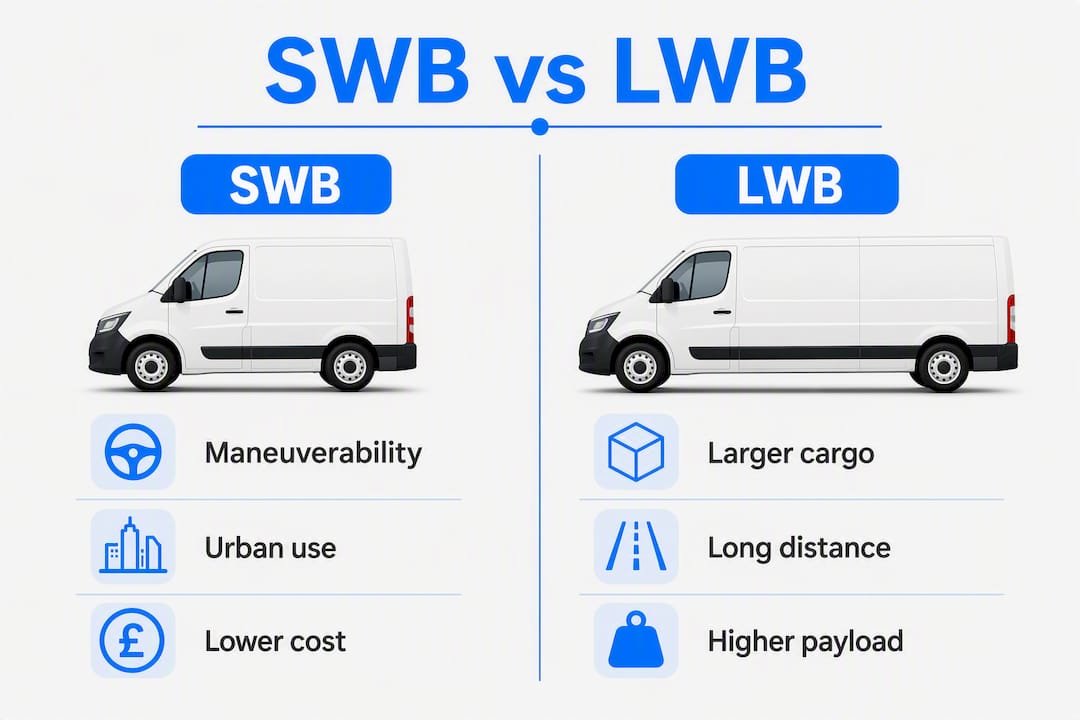
Pick SWB for tight urban work and daily driving. Pick LWB when you regularly carry long or bulky loads, plan a camper conversion, or need maximum cargo volume. That is the short answer for most UK buyers and hirers.
For the most common jobs, here is where each wheelbase fits:
- City courier or urban tradesperson: SWB wins. Easier to park, tighter turning circle, lower running costs on stop-start routes.
- Tradesperson carrying long materials (timber, pipes, plywood): LWB or MWB. Internal load length is the deciding factor, not the wheelbase number itself.
- Weekend campervan conversion: LWB gives you a few hundred extra millimetres for storage and a longer kitchen run. SWB works for solo or couple builds where space is managed carefully.
- House removals or one-bedroom flat move: LWB or a Luton van. For a single-trip move, volume and payload matter more than manoeuvrability.
If van choice is becoming a blocker, the simplest fix is to skip the decision entirely and book a trusted removal team who already has the right vehicle for your job.
Table of Contents
- What does wheelbase actually mean, and how do SWB and LWB differ?
- How do SWB and LWB compare across the dimensions that matter?
- When does LWB make sense, and what are the trade-offs?
- When does SWB work better, and where does it fall short?
- Real UK model numbers: Transporter, Transit Custom, and Sprinter
- How to decide: a practical checklist before you buy or hire
- Key takeaways
- The wheelbase decision most people get wrong
- Westlondonremoval: the reliable alternative to choosing the wrong van
- Useful sources and documents to request
What does wheelbase actually mean, and how do SWB and LWB differ?
Wheelbase) is the distance between the centre of the front axle and the centre of the rear axle. That is it. It is not the bumper-to-bumper length of the vehicle, and confusing the two is one of the most common mistakes buyers make when checking whether a van will fit their garage or driveway.
Overall vehicle length is always longer than the wheelbase because of the front overhang (the bonnet ahead of the front axle) and the rear overhang (the load bay behind the rear axle). On a typical panel van, those overhangs add approximately 900 mm on top of the wheelbase figure.
The VW Transporter T6.1 illustrates this clearly. Its SWB variant has a wheelbase of 3,000 mm and an overall length of 4,900 mm; the LWB variant measures 3,400 mm in wheelbase and 5,300 mm overall length — a difference of 400 mm in wheelbase and 400 mm in overall vehicle length. That gap flows through into the usable internal load length, which is what actually determines whether your sofa, sheet materials, or bed frame will fit.
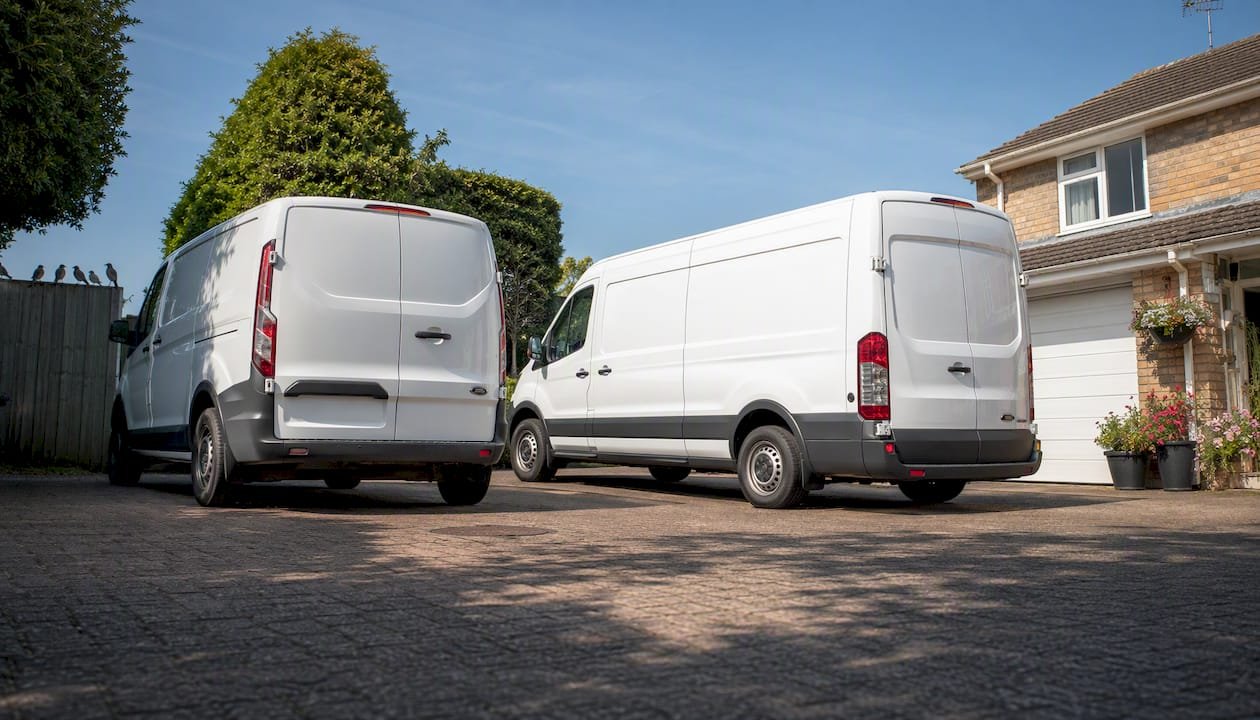
Always check two figures before committing to a van: total vehicle length (for parking and garage fit) and internal load length (for what you can actually carry). Wheelbase alone tells you neither with enough precision.
How do SWB and LWB compare across the dimensions that matter?
The table below compares the two wheelbase categories across the practical dimensions most buyers care about. Figures are directional because manufacturers offer different roof heights, body styles, and payload tiers within each wheelbase category. Always verify against the specific model’s spec sheet.
| Dimension | SWB | LWB |
|---|---|---|
| Turning circle / manoeuvrability | Tighter, easier in narrow streets | Wider circle, higher cognitive load in tight spaces |
| Cargo volume (typical) | 5–6 m³ | — |
| Usable floor length (typical) | 2.0–2.4 m | — |
| Payload (kg) | Varies; often 800–1,000 kg | Varies; often 1,000–1,500 kg+ |
| Fuel economy / running costs | Marginally better; lighter chassis | Slightly higher fuel use; more maintenance inputs on longer chassis |
| Parking / garage fit | Fits most standard bays with care | Often requires commercial bays; check driveway length |
| Motorway stability | Adequate; lighter feel | Smoother, more stable at speed; weight distributed over longer span |
| Typical suitability | Urban deliveries, small trades, compact conversions | Removals, long-haul trades, full camper conversions |
| Hire / purchase cost | Generally lower | Generally higher |
A note on MWB and XLWB: some manufacturers, including Ford with the Transit Custom, offer a medium wheelbase (MWB) variant that sits between SWB and LWB. Wheelbase categories are not standardised across brands, so a Ford MWB and a VW LWB may have overlapping dimensions. When a model family offers more than two lengths, treat the table above as a spectrum rather than a binary, and always pull the specific spec sheet.
For removals work specifically, payload is often more important than cubic metres. A van that is large enough to hold a sofa but cannot legally carry the combined weight of the furniture, crew, and fuel is a problem. Compare payload (kg) against your expected loaded weight before you book or buy.
When does LWB make sense, and what are the trade-offs?
LWB vans suit buyers whose primary concern is volume, load length, or long-distance comfort. The core strengths are straightforward: more cargo space, the ability to carry longer items without cutting diagonally, and a noticeably smoother motorway ride because the longer wheelbase distributes weight over a greater span and reduces pitch on uneven roads.
LWB pros:
- Carries longer items flat (2.4 m sheet materials, double mattresses, full-length sofas)
- Higher cargo volume suits one-bedroom flat moves or regular high-volume deliveries
- Smoother, more stable feel on motorways and A-roads
- More conversion space for campervan builds, including deeper under-bed storage and a longer kitchen run
- Higher payload tiers available on larger models such as the Mercedes-Benz Sprinter
LWB cons:
- Wider turning circle makes tight London streets and multi-storey car parks genuinely harder
- Longer overall length means many standard 4.8 m parking bays are too short
- Slightly higher fuel consumption and, over time, greater maintenance inputs on the extended chassis
- Higher purchase and hire costs
- Less suitable as a daily driver in dense urban areas
Typical LWB use cases: long-distance removals, trades carrying timber or pipe runs, full campervan conversions, regular high-volume courier routes between depots.
For camper conversions, conversion specialists note that the extra length typically translates into deeper under-bed storage or a longer kitchen run rather than a wholesale change in living layout. The gain is real but measured in hundreds of millimetres, not metres.
Pro Tip: Before buying or hiring an LWB van, measure your garage door width and depth, your driveway length, and the length of your most-used parking spot. Then add at least 300 mm to the van’s stated overall length to account for comfortable manoeuvring clearance. Many buyers discover their garage fits the wheelbase but not the full bumper-to-bumper length.
When does SWB work better, and where does it fall short?
SWB vans are the practical choice for anyone whose day involves tight streets, frequent parking changes, or short urban hops. The manoeuvrability advantage is not subtle: a turning circle difference of even 0.5–1.0 m changes everyday drivability in central London, where reversing into a loading bay or squeezing past parked cars is a daily reality.

Running costs tend to be marginally lower too. A lighter, shorter chassis uses slightly less fuel on stop-start urban routes, and maintenance is generally simpler. For a tradesperson doing five short jobs a day across West London, those savings add up across a year.
The trade-off is load length. SWB vans typically offer an internal load length of around 2.0–2.4 m. A standard 2.4 m sheet of plywood fits only diagonally in most SWB models, and a double mattress is a tight squeeze. For trades carrying long materials regularly, that constraint matters.
Practical SWB use cases: urban courier runs, plumbers and electricians carrying tools and boxed parts, small campervan conversions for solo travellers, and single-item deliveries.
Pro Tip: Before loading, measure your longest item and compare it against the van’s stated internal load length, not the wheelbase. For a Ford Transit Custom SWB, the internal load length is somewhat less than 2.4 m, meaning standard 2.4 m planks will generally not lie flat. Knowing this before you hire saves a wasted journey.
Real UK model numbers: Transporter, Transit Custom, and Sprinter
Manufacturer figures ground the comparison in something you can act on. Here are the key specs for the three most common van families in the UK market.
| Model | Variant | Wheelbase | Overall length | Internal load length (approx.) |
|---|---|---|---|---|
| VW Transporter T6.1) | SWB | 3,000 mm | 4,900 mm | 2,100 mm internal load length |
| VW Transporter T6.1 | LWB | 3,400 mm | 5,300 mm | 2,550 mm internal load length |
| Ford Transit Custom | SWB | — | about 4,972 mm bumper-to-bumper length | approximately 2.127 m internal load length |
| Ford Transit Custom | LWB | — | about 5,342 mm bumper-to-bumper length | approximately 2,555 mm internal load length |
| Mercedes-Benz Sprinter | SWB | — | — | — |
| Mercedes-Benz Sprinter | LWB | — | — | — |
Practical fit examples:
- Standard 2-seater sofa (~1,800 mm long): fits in most SWB vans lying flat, though door aperture height is worth checking.
- 2.4 m plywood sheet: requires LWB or MWB load length; will not lie flat in a Transit Custom SWB.
- Double mattress: fits in LWB variants comfortably; SWB is tight and may require the mattress to be rolled or stood on edge.
- Single-bedroom flat contents: typically needs an LWB panel van or Luton; an SWB will usually require two trips.
The VW Transporter T6.1 family is particularly well-documented for conversions because the SWB (4,900 mm overall length; 3,000 mm wheelbase; 2,100 mm internal load length) and LWB (5,300 mm overall length; 3,400 mm wheelbase; 2,550 mm internal load length) variants have clear, published spec differences and wide aftermarket support. The Ford Transit Custom’s three-length range (SWB, MWB, LWB) makes it one of the more flexible options for tradespeople who need to match load length to job type. The Mercedes-Benz Sprinter in LWB form offers some of the largest internal volumes available in a standard panel van, making it the natural choice for high-volume removals or full campervan builds where payload and space are both priorities.
How to decide: a practical checklist before you buy or hire
Work through these questions before committing to a wheelbase. They apply whether you are buying, hiring for a week, or briefing a hire company.
Decision checklist:
- Measure your longest item. Compare it against the van’s stated internal load length, not the wheelbase. If the item is longer than the load length, you need a bigger variant or a different approach.
- Check your parking situation. Measure your driveway, garage, and most-used parking spot. A Ford Transit Custom SWB at 4,972 mm already exceeds a standard 4.8 m bay; an LWB at 5,342 mm overhangs by a larger margin.
- Estimate your load weight. Add the weight of all items, plus crew, plus a full fuel tank. Compare that total against the van’s payload rating. Exceeding payload is illegal and unsafe.
- Map your typical routes. If your day involves narrow residential streets, loading bays with height barriers, or multi-storey car parks, SWB is the safer choice.
- Consider frequency. A one-off house move does not justify buying or hiring the wrong van for your daily work. Hiring a removal service for the move and keeping your SWB for daily use is often cheaper overall.
- Check roof height. For conversions and tall furniture, internal height matters as much as floor length.
Questions to ask a dealer or hire company:
- What is the internal load length (floor-to-bulkhead)?
- What is the payload rating, and is that figure on the payload plate?
- What is the total bumper-to-bumper length?
- What is the door aperture height and width?
- What is the turning circle (kerb-to-kerb)?
- Is the spec sheet available to take away?
Red flags to watch for:
- Seller or hirer cannot provide a spec sheet or payload plate
- Internal load length is quoted as “about” or “roughly” without a figure
- Turning circle is described as “fine” without a measurement
- No written confirmation of payload in the hire contract
Key takeaways
For most UK buyers, the right wheelbase comes down to one question: do your routes and parking demand agility, or does your cargo demand length?
| Point | Details |
|---|---|
| SWB for urban agility | Choose SWB if your day involves tight streets, frequent parking, or short urban jobs. |
| LWB for volume and length | Choose LWB when you regularly carry items over 2.1 m, move house contents, or need a full camper conversion. |
| Check load length, not just wheelbase | Always compare the van’s internal load length against your longest item — wheelbase alone does not tell you what fits. |
| Payload matters for removals | For moving heavy furniture or appliances, compare payload (kg) against your total expected load weight, including crew and fuel. |
| Westlondonremoval as an alternative | When van choice is uncertain or a one-off move is involved, Westlondonremoval’s man-and-van and house removal services cover West London with the right vehicle already chosen. |
The wheelbase decision most people get wrong
The most common mistake we see in West London is buyers fixating on wheelbase as the primary number, then discovering too late that the internal load length or payload does not match their actual job. A client moves a one-bedroom flat, hires an SWB van because it is cheaper and easier to park, and then finds the sofa will not go in flat and the mattress has to be stood on its side. Two trips instead of one, and the cost saving disappears.
The other pattern is the opposite: someone buys an LWB for daily trade work in Chiswick or Kensington, and within a week they are avoiding certain streets, struggling with parking, and arriving at jobs stressed before they have even opened the back doors. A turning circle difference of under a metre sounds trivial until you are reversing in a narrow mews for the fifth time that day.
Our honest view is that for a one-off move, the van choice question is often the wrong question. Hiring a professional removal team with the right vehicle, the right insurance, and the experience to load efficiently is frequently faster and less stressful than renting a van, loading it yourself, and hoping everything fits. For tradespeople who need a van every day, the SWB versus LWB decision genuinely matters and is worth the time to get right. But for a single house move, the calculus is different.
Westlondonremoval: the reliable alternative to choosing the wrong van
Picking the right van size for a house move is genuinely complex, and getting it wrong costs time and money. Westlondonremoval offers a straightforward alternative: a fully insured, professional removal team that arrives with the right vehicle for your load, handles the heavy lifting, and works to a transparent hourly rate with same-day availability across West London.

Services cover house removals, man-and-van hires, packing, specialist moves (pianos, antiques), and office relocations. For moves in Chiswick, Richmond and Kingston, and Kensington and Chelsea, local knowledge of parking restrictions, access routes, and tight residential streets makes a real difference to how smoothly a move runs.
If you are facing a one-off move, a single heavy item, or a job where the van size question is still unresolved, get in touch with Westlondonremoval for a quote. No guesswork, no wrong-van problem.
Useful sources and documents to request
Before buying or hiring, check these authoritative sources for up-to-date model specifications:
- VW Transporter T6 specifications — Wikipedia: wheelbase and overall length figures for SWB and LWB T6.1 variants.
- Ford Transit Custom length comparison — Vanshelves: SWB, MWB, and LWB overall lengths and internal load lengths.
- Ford Transit wheelbase specs — Ford-Transit.info: historical and current wheelbase data across the Transit family.
- LWB vs SWB explained — Vandemon: plain-language overview of wheelbase terminology.
- What is an MWB van? — SDVH: explains medium wheelbase and how it sits between SWB and LWB.
- Long-wheelbase vans guide — Parkers: pros, cons, and regulatory notes for LWB van buyers.
Documents to request from a dealer or hire firm:
- Manufacturer spec sheet (showing internal load length, payload, and overall length)
- Payload plate (physically fitted to the vehicle — verify it matches the spec sheet)
- Internal load length measurement in writing (not just verbal confirmation)
- V5 logbook (for purchases) or hire contract with vehicle spec confirmed in writing
- Warranty documentation and service history
One final check: measure your garage opening width and depth before collection or delivery, and compare the van’s total bumper-to-bumper length, not just the wheelbase. Those two numbers together will tell you whether the vehicle actually fits your life.