
Tell your old council the day you moved out, and tell your new council the day you moved in. Those two dates decide who charges you, and they’re the first thing you need to nail down. You’ll normally have to notify two separate councils, because their systems don’t talk to each other. In the next 24 to 72 hours, do this:
- Confirm your exact move-out and move-in dates in writing (tenancy end date or completion date)
- Submit the “moving home” form to both your outgoing and incoming council
- Save the online confirmation or reference number from each submission
Councils typically ask you to notify them within 21 days of moving, though doing it before moving day is far safer than waiting.
Key Takeaways
Council tax liability shifts on the exact day you move, so notifying both councils promptly with the correct dates is what prevents double billing and delayed refunds.
| Point | Details |
|---|---|
| Notify two councils separately | Outgoing and incoming councils don’t share data, so each needs its own moving-home form. |
| Dates decide liability | You’re billed at the old address until move-out day, and the new one from move-in day. |
| Don’t cancel Direct Debit early | Wait for a final bill or closure confirmation to avoid payment gaps or missed refunds. |
| Discounts reset with every move | Single person discount, student exemptions, and disability reductions all need reapplying. |
| Keep records for disputes | Save confirmation references, receipts, and tenancy dates for at least two months. |
| Free up time with professional movers | Booking Westlondonremoval’s house removal or man and van services leaves you time to file council forms and gather move-date evidence promptly. |
Official pages to check now
- Gov
- Gov
- Search your local authority’s own “council tax change of address” form for exact fields required
Table of Contents
- Who to tell, when to tell them, and what to have ready
- How council tax liability and billing actually work
- Direct debits and payments: how to avoid paying twice
- Discounts, exemptions and special cases at your new address
- Final bills, refunds and how to challenge a mistake
- Your council tax moving checklist, four weeks to moving day
- Sorting utilities and other address changes alongside council tax
- Steps to handle a council tax dispute after you’ve moved
- Moving into a shared house or multi-person household
- Sources
Who to tell, when to tell them, and what to have ready
Council tax records sit in two separate local databases, and moving between authorities means neither one automatically knows what the other is doing. That’s why you must register the change with both councils yourself, even if you’re only moving a few streets away into a different borough. If you’re staying within the same local authority, the process is usually simpler. Leeds City Council, for example, notes that a same-authority move often means the council closes the old account and opens the new one itself, sometimes carrying any credit across automatically.
Most council moving forms ask for the same core details, so it helps to have them ready before you start:
- Full names of all adults at both the old and new address
- Move-out date from the old property and move-in date at the new one
- Tenancy end date or completion date (these can differ slightly from your actual moving day)
- Forwarding address and contact details
- Landlord or letting agent details, if renting
- Bank details, if you want a Direct Debit set up at the new address
Pro Tip: Submit both forms as soon as your dates are confirmed, even if that’s weeks before moving day. Most councils accept early notifications before moving day, and an early submission means your account is ready to go the moment you’re through the door.
How council tax liability and billing actually work
Liability is entirely date-driven. You’re responsible for council tax at your old address right up until the day you move out, and at your new address from the day you move in, according to guidance from South Kesteven District Council. There’s no grace period and no overlap allowance.
Your annual charge is set by your property’s valuation band, and moving to a different band changes what you owe. GOV.UK explains that council tax bands run from A to H in England and Scotland, and A to I in Wales, with each local authority setting its own rate per band. When you move mid year, the council doesn’t charge you a full annual sum twice. It works out a pro-rata figure based on the exact number of days you were liable at each address.
A few situations catch movers out:
- Moving into a newly built or unbanded property, where the council has to wait on a Valuation Office Agency band before it can bill you accurately
- Empty properties, which can attract different reductions or premiums depending on how long they’ve sat vacant
- Short overlaps where you hold two properties briefly, both of which need separate, date-specific calculations
Direct debits and payments: how to avoid paying twice
Cancelling your old Direct Debit the moment you move is one of the most common mistakes movers make, and it usually backfires. Bedford Borough Council advises waiting until your old account shows a final bill or confirmed closure before touching that payment. Cancel too early and you risk a gap that looks like a missed payment, even though you’re due a refund.
Here’s the sequence that avoids problems:
- Keep the old Direct Debit running until you receive a final bill or closure confirmation
- Register with your new council and set up a fresh Direct Debit there, using your new account reference
- If the new council asks for an interim payment while it finalises your account (common with new builds awaiting a VOA band), pay what’s requested rather than waiting for the full bill
- Once the old account closes, any credit is normally refunded, sometimes automatically if you stayed within the same authority
Pro Tip: If your new property is a recent conversion or new build, set some money aside. Peterborough City Council notes that VOA banding can take months, and once it’s confirmed, the council bills you retroactively from your actual liability date, not from when the band was finally set.
Discounts, exemptions and special cases at your new address
None of your discounts follow you automatically. Every reduction has to be re-applied for, or at least re-checked, at the new property.
- Single person discount: worth 25% off your bill, but it resets with every move and won’t transfer without a fresh application
- Student households: full-time students can be exempt or discounted, but the new council needs proof of enrolment before it applies anything
- Disability reductions: if a property has been adapted for a resident’s needs, you’ll need to notify the new council separately to have the band adjusted
- Empty-property rules: premiums for long-term empty homes vary by local authority, so check your new council’s specific policy rather than assuming it matches your old one
Assume nothing carries over. A five-minute form at the new council saves months of overpaying.
Final bills, refunds and how to challenge a mistake
Processing times vary, but many councils aim to issue a revised or final bill within a couple of weeks, according to guidance from Leeds City Council. Keep every receipt, your tenancy or completion documents, and your online submission reference. They’re your evidence if anything is disputed.
One thing to know before you move: outstanding council tax debt doesn’t disappear when you leave. GOV.UK confirms that arrears remain enforceable and follow you to your new address, and councils can offset any refund you’re owed against money you still owe.
- Keep copies of all correspondence, dated and filed together
- If you spot an error, write to the council with your evidence and a clear timeline
- Ask for a written response and escalate to the Valuation Office Agency if the dispute is about your band, not the bill itself
Pro Tip: Always request confirmation in writing, not just a phone call. A verbal assurance won’t help you if the same query comes up again three months later.
Your council tax moving checklist, four weeks to moving day
Breaking the admin into a timeline stops anything slipping through the cracks.
Two to four weeks before:
- Confirm your move-out and move-in dates in writing
- Find both councils’ moving forms (search “[council name] council tax change of address”)
- Gather names of all adults moving, tenancy or completion dates, and bank details for Direct Debit
On moving day:
4. Submit both the outgoing and incoming notifications
5. Save the confirmation email or reference number from each
6. Note the exact time you handed back keys or completed, in case dates are ever disputed
In the weeks after:
7. Check for your final bill from the old council and a start bill from the new one
8. Expect a refund if you overpaid, or a balance to settle if you underpaid
9. Set up Direct Debit at the new address once the account is confirmed
10. Reapply for any discounts, such as single person discount, that apply at the new property
| Task | Timing |
|---|---|
| Submit both council forms | As soon as dates are confirmed, ideally before moving day |
| Keep old Direct Debit running | Until final bill or closure confirmation arrives |
| Reapply for discounts | Within days of moving into the new property |
| Chase refund or pay balance | Once the final bill is issued |
Sorting utilities and other address changes alongside council tax
Council tax rarely arrives alone on moving day. Gas, electricity, water, broadband, and your bank all need the same address update, and it’s worth doing them in the same sitting rather than letting them trickle in over weeks.
Take meter readings on the day you move, for both the property you’re leaving and the one you’re arriving at. Photograph them if you can. This protects you from being billed for usage that happened before or after your tenancy, in exactly the same way accurate move dates protect your council tax bill.

Contact your energy and water suppliers directly rather than assuming a change of address with the Post Office covers it, because it doesn’t. Broadband providers often need the most notice, sometimes several weeks, if you’re transferring a contract to a new address rather than starting fresh. Update your bank, DVLA, and the electoral roll while you’re at it. None of these updates feed into your council tax account either. A common assumption among movers is that changing your electoral roll registration or your utility supplier automatically flags your council tax change too. It doesn’t. Each organisation runs its own separate system, and the council’s own moving-home form is the only thing that updates your council tax record.
A simple way to manage this is to keep one list with every organisation you need to contact, tick them off as you go, and file the confirmation emails together with your council tax receipts. If a dispute ever comes up later, having everything dated and in one place makes resolving it far quicker.
Steps to handle a council tax dispute after you’ve moved
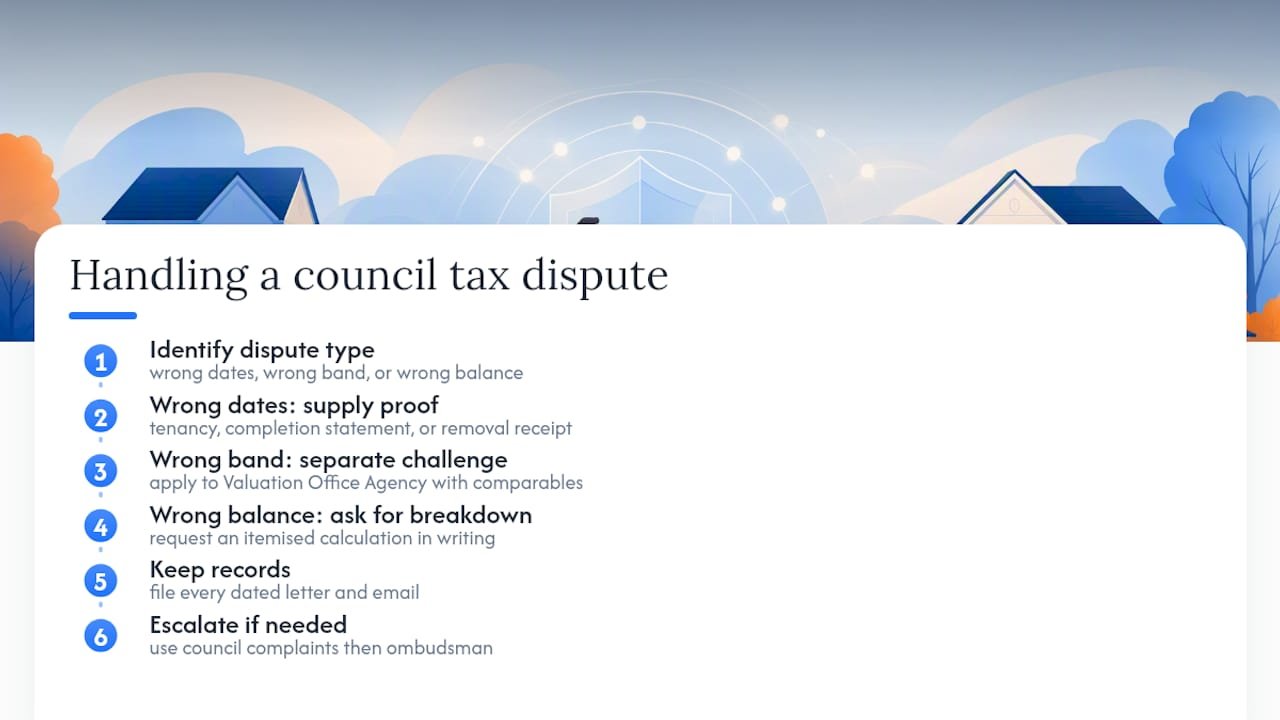
Most disputes after a move fall into one of three categories: wrong dates on your bill, wrong band, or wrong balance carried from your old address. Each has a slightly different fix.
If your bill shows the wrong move-in or move-out date, write to the council with your tenancy agreement, completion statement, or removal company receipt as proof. A dated invoice from a professional mover often carries more weight than a verbal recollection, because it shows exactly when your belongings were transported.
If you believe your property is in the wrong council tax band, that’s a separate process from a billing dispute. Band challenges go through the Valuation Office Agency, not the council directly, and you’ll need evidence such as comparable properties on your street in a lower band.
If the dispute is about an outstanding balance you believe you don’t owe, particularly one being carried over from a previous address, ask the council in writing for an itemised breakdown. Councils are required to explain how a figure was calculated, and a written breakdown often reveals a straightforward date error rather than genuine debt.
Throughout any dispute, keep every letter and email dated and filed together. Escalate through the council’s formal complaints procedure if a straightforward query goes unanswered, and only involve the Local Government and Social Care Ombudsman once you’ve exhausted the council’s own process. Most billing errors resolve within a few written exchanges once the right evidence is attached.
Moving into a shared house or multi-person household
Shared households add a layer that single tenancies don’t have: multiple named adults on one account, and the question of who’s actually liable.
When you move into a shared or multi-person household, every adult resident normally needs to be named on the council tax notification, not just whoever signs the tenancy first. Councils use a hierarchy of liability, which broadly means the person with the greatest legal interest in the property (an owner-occupier, then a tenant, then a licensee) is who they’ll bill first, but in most shared tenancies, all named tenants share joint and several liability. That means the council can pursue any one of you for the full amount if the group falls behind, regardless of who actually agreed to pay what internally.
If you’re the one submitting the moving-home form for a shared house, list every adult moving in, along with their move-in date, even if they’re arriving on slightly different days. This matters more than it sounds, because if one housemate moves in two weeks after the others, their share of liability technically starts later, and getting that date wrong on the form can complicate splitting the bill later.
Discounts also need fresh eyes in a shared setup. A single person discount disappears the moment a second liable adult moves in, and it’s your responsibility to tell the council promptly rather than wait for them to notice. Student households, where every named resident is a full-time student, can qualify for a full exemption, but this only holds if every single person on the tenancy meets that criteria. Even one non-student housemate changes the whole household’s status.
Publisher perspective: what moving day teaches you about council admin
Council tax admin gets pushed aside on moving day because everything else feels more urgent. A removals invoice with a timestamp is often the clearest proof you’ll have of your actual move date if a dispute ever surfaces. Booking professional help buys you the hour you’d otherwise lose to lifting boxes, time better spent on forms. Keep every paper record for at least two months after moving.
Book your move, then handle council tax with the time you’ve freed up
Council tax forms are far easier to complete when you’re not also wrestling with a hired van, unpacked boxes, and a sofa stuck on the stairs. Westlondonremoval’s house removals, man and van hire, and packing services are built around transparent hourly pricing and same-day availability, so you know exactly what you’re paying before the day arrives, no surprise costs competing for your attention when you should be submitting council forms.

Booking professionals for the physical move means you walk into moving day with your council tax notifications already filed, your dates confirmed in writing and a removals receipt in hand as proof if you ever need it. That’s the practical advantage over doing everything yourself under time pressure: the admin gets done on time because the heavy lifting isn’t eating your afternoon. If you’re moving in West London and want the physical side sorted properly, check availability for house removals in West London or get a quote for a Chiswick removal and lock in your date now.