
Most homes need between two and five movers, and the honest answer depends more on what you own than the number of bedrooms on the listing. A studio or one-bedroom flat is usually a two-person job. A two-bed needs two to three. A three-bed typically calls for three to four. Anything from a four-bedroom house upwards tends to need four to six, depending on how much you have and how it needs to be handled.
The rule of thumb is simple: start with the size-based recommendation, then add a mover for every complication that eats time. That means:
- Heavy or awkward items — pianos, safes, wardrobes that need dismantling
- Stairs or lift access on either end of the move
- A long carry from the door to the van, or restricted parking
- A tight deadline, such as a same-day completion with a hard finish time
The real currency in removals isn’t headcount, it’s person-hours (crew size multiplied by time), and Westlondonremoval has priced enough West London jobs to know exactly where that maths tends to go wrong for first-time bookers.
Key Takeaways
Getting crew size right means matching the recommended headcount for your home size to the specific access, item, and deadline factors your move actually has.
| Point | Details |
|---|---|
| Start with home size | Use 2 movers for a studio/1-bed, 2–3 for a 2-bed, 3–4 for a 3-bed, and 4–6 for larger homes. |
| Add movers for access problems | Stairs, no lift, narrow corridors, and long carry distances can add 30–50% to loading time. |
| Use person-hours to compare options | 2 movers for 6 hours equals 3 movers for 4 hours, so weigh cost against how fast you need the job done. |
| Flag special items early | Pianos, safes, and pool tables typically need 3–4 movers and sometimes specialist lifting kit. |
| Book with Westlondonremoval for accurate crew sizing | Westlondonremoval prices West London moves with transparent hourly rates and same-day availability based on your actual inventory and access, not just bedroom count. |
Table of Contents
- How many movers needed for your specific home size?
- What factors change the number of movers you need?
- How do you calculate the right crew size using person-hours?
- How many movers do you need for pianos, safes, and other bulky items?
- Does packing yourself change the number of movers you need?
- What should you tell movers when booking a quote?
- How does Westlondonremoval size a crew correctly?
- What does the crew-sizing advice usually get wrong?
- Get an accurate crew-size quote from Westlondonremoval
- Frequently asked questions about how many movers you need
- Sources
How many movers needed for your specific home size?
The table below reflects the typical crew recommendations used across the removals industry, adjusted for the sort of period conversions, narrow staircases, and permit-parking streets common across West London.
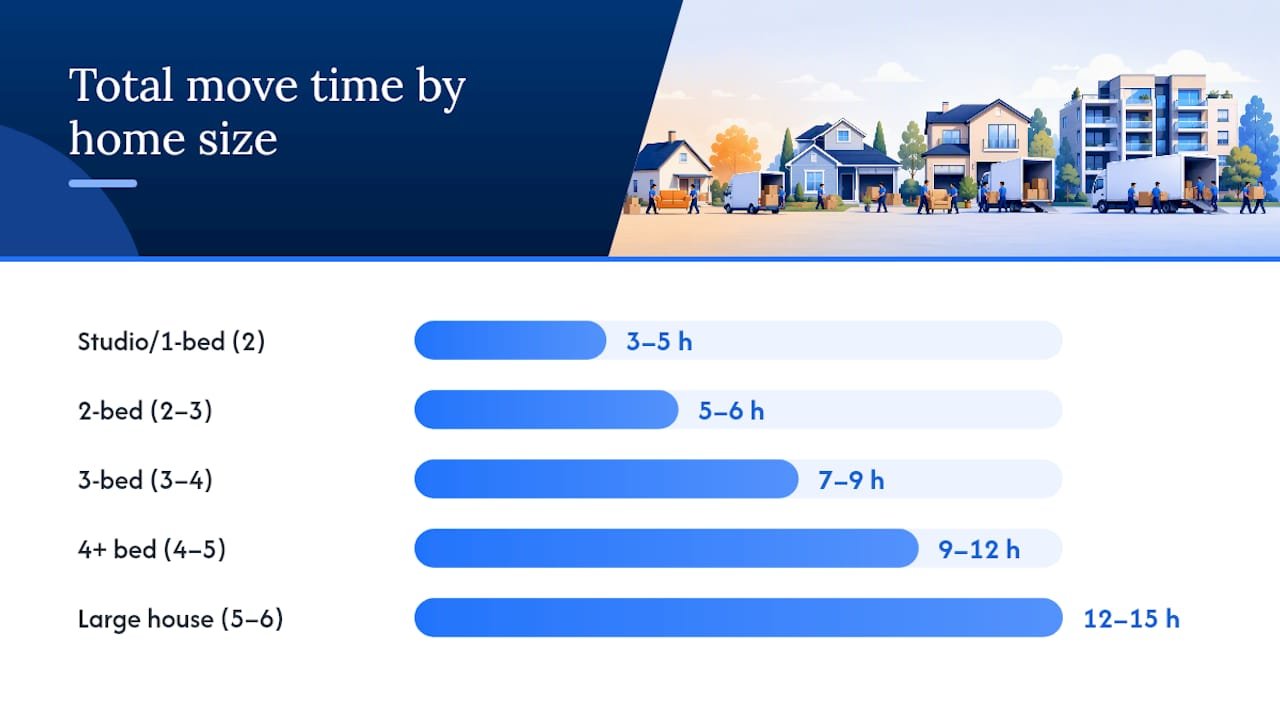
| Home size | Crew size | Loading hours | Unloading hours | Full-service total |
|---|---|---|---|---|
| Studio / 1-bed | 2 movers | 2 to 3 hours | 1–2 hrs | 3–5 hrs |
| 2-bed | 2–3 movers | 3 to 4 hours | 2–3 hrs | 5 to 6 hours |
| 3-bed | 3–4 movers | 4 to 5 hours | 3 to 4 hours | 7 to 9 hours |
| 4+ bed | 4–5 movers | 5 to 6 hours | 4 to 5 hours | 9 to 12 hours |
| Large house / estate | 5–6 movers | 6 to 8 hours | 4–6 hrs | 12 to 15 hours |
Loading almost always takes longer than unloading. It’s the phase where the crew wraps furniture, protects doorways, and plays “truck Tetris” to fit everything in one load, while unloading is mostly a matter of carrying boxes to a room you already know. Treat these ranges as a starting point, not a promise. A ground-floor flat with a driveway will sit at the bottom of its band; a third-floor conversion with no lift will push towards the top, whatever the crew-size and time estimator tools suggest as a baseline.
What factors change the number of movers you need?
Home size gets you to a starting point. These five factors are what actually move you off it.
Volume and packing state. A three-bed house that’s fully packed into labelled boxes moves faster than a two-bed flat where nothing has been touched. If you’ve done your own packing, you can often drop to the lower end of the crew range for that home size, because the crew is carrying rather than wrapping.
Heavy or special items. A piano, a gun safe, an oversized wardrobe, a pool table, these routinely need three to four movers minimum, sometimes with specialist lifting kit. One extra item like this can justify adding a whole extra person to the crew, not just extra time.

Access: stairs, lifts, corridors, and parking. This is the factor most people underestimate. A move from a second-floor flat with no lift can add 30 to 50% to the loading time compared with a ground-floor equivalent, and narrow corridors, restricted parking, and long carry distances all compound the delay. If the van has to park two streets away because of a residents’ bay, every box costs more time to carry, and more time is exactly what an extra pair of hands is meant to save you.
Move distance. A local move within West London and a long-distance relocation put different strains on the same crew. Long journeys mean movers arrive at the destination tired, which slows unloading right when precision (fitting furniture into the right rooms, reassembling beds) matters most. On longer moves, some crews rotate staff or add an extra person specifically to guard against that fatigue drop.
Time constraints. If your tenancy ends at midday and your new keys aren’t available until 2pm, or you’re trying to complete a full house move inside a single working day, that deadline pressure is a legitimate reason to add a mover. Paying for one more person for four hours is often cheaper, and far less stressful, than running into overtime charges because a smaller crew couldn’t finish on schedule.
- Pre-packed vs unpacked can change the crew recommendation by a full person
- One large special item can add a mover on its own
- No lift access can add 30 to 50% to loading time
- Tight deadlines justify paying for extra hands rather than risking overtime
Pro Tip: If you’re not sure whether your move counts as “access difficult,” picture the worst single item you own being carried down the actual route to the van. If that image involves squeezing past a bend, negotiating a spiral staircase, or crossing a road, mention it when you request your quote. It changes the crew recommendation more than almost anything else.
How do you calculate the right crew size using person-hours?
Person-hours is the simplest way to compare crew options honestly: multiply the number of movers by the number of hours the job takes, and you get a fixed total of labour that has to be spent regardless of how you slice it.
- Estimate the job’s total person-hours. A typical two-bed flat might need around 12 person-hours of labour from arrival to the last box off the van.
- Divide that total across different crew sizes. Two movers at 6 hours each equals 12 person-hours. Three movers at 4 hours each is also 12 person-hours. Four movers at 3 hours each is the same total again.
- Weigh the cost logic. Most removal companies charge per mover per hour, often with a two-hour minimum booking, so the total cost for equivalent person-hours can end up similar across crew sizes once minimums and travel time are factored in.
- Check whether extra hands unlock a shorter day. Small increases in crew size often shrink the job’s duration disproportionately, because doorways, stairwells, and van space create bottlenecks that a fourth pair of hands can work around rather than queue behind.
That fourth point is where the real decision sits. Two movers working 6 hours and four movers working 3 hours both add up to 12 person-hours, but the four-person crew finishes at lunchtime instead of dinner. If you’re paying by the hour and have a hard deadline (key handover, parking permit expiry, a connecting flight), the larger crew for less time usually wins on stress even when the invoice is roughly level.
There’s a ceiling, though. Beyond a certain point, adding movers stops helping and starts costing you through coordination overhead: five people can’t all fit through one doorway at once, and a crew of six on a one-bed flat spends more time waiting for space than carrying boxes. For homes at the smaller end of the quick-reference table, three or four is usually the practical maximum before returns diminish.
How many movers do you need for pianos, safes, and other bulky items?
Certain items break the standard crew-by-home-size rule entirely, because their weight or shape, not the size of your home, dictates how many hands are required to move them safely.
- Upright piano: minimum 3 movers; grand pianos usually need 4 and a piano board
- Gun safe or heavy safe: minimum 3 to 4 movers, sometimes a stair-climbing dolly
- Wardrobes and armoires (non-flat-pack): 2 movers minimum, 3 if stairs are involved
- Pool or snooker tables: 3 to 4 movers, often disassembled on site
- Home gym equipment (multi-station rigs, treadmills): 2 to 3 movers depending on weight and stairs
Items like these are consistently flagged in industry guidance as needing extra hands and, sometimes, specialist equipment such as hoisting straps, stair-climbers, or a piano board rather than just muscle. If a window removal is the only way to get a sofa or wardrobe out of a first-floor flat, that’s a job for a crew that has done it before and carries the right rigging, not an improvised solution on the day. If you’re shipping outsized furniture separately, a specialist like furniture shipping services can handle the logistics for pieces that won’t travel with the rest of your move.
The safest habit is to photograph and measure anything unusual before you request a quote, including doorway widths and staircase turns if the item is oversized. Guides across the industry agree this single step prevents most day-of surprises, because it lets the removal company confirm the crew and equipment in advance rather than reacting on the doorstep.
One more thing worth doing early: declare high-value items, antiques, and anything irreplaceable when you book, not when the van arrives. It affects how the job is insured and valued, and our guide to removal company insurance cover explains what’s typically covered as standard and what needs declaring separately.
Does packing yourself change the number of movers you need?
Packing state changes crew requirements almost as much as home size does, because a full-service pack adds labour hours that a self-packed move never generates.
As a rough benchmark, professional packers typically need 15 to 25 minutes per average room for wrapping and boxing, more for kitchens and anything fragile. On a three-bed house, that can mean 3 to 5 extra person-hours before the van is even loaded, which is why full packing often justifies bringing the crew size up by one person rather than just extending the day.

Partial packing, where you handle clothes, books, and non-fragile items yourself and leave the kitchen, artwork, and electronics to the professionals, tends to offer the best value. It cuts the packing time significantly without leaving breakables to inexperienced hands. If you’d rather understand the trade-offs before deciding, our comparison of man and van versus full removal company options breaks down which approach suits smaller moves.
Whichever route you choose, a short pre-move checklist reduces the hours (and therefore the crew) needed on the day itself:
- Disassemble beds, shelving units, and flat-pack furniture in advance
- Empty and defrost the fridge/freezer 24 hours before moving day
- Box everything except last-night essentials, and label boxes by room
- Clear a path from each door to the street for easy carrying
- Reserve parking or notify neighbours if you’re on a permit street
If you’d rather skip hired movers entirely for a small load, our practical guide to self-pack moves covers what that actually involves.
What should you tell movers when booking a quote?
An accurate quote depends entirely on what you tell the removal company before the day, not what they discover when they arrive.
- Send a room-by-room inventory, including any oversized or unusual items (piano, safe, gym equipment).
- Include access photos: front door, staircases, lift dimensions if relevant, and the likely parking spot for the van.
- Ask about the crew minimum and whether hourly pricing includes a two-hour (or longer) minimum booking.
- Ask about travel time charges, since some companies bill from depot to depot rather than just on-site hours.
- Confirm insurance levels for high-value or fragile items, and whether specialist kit (piano boards, hoisting straps) is available if you need it.
Treat a quote that skips these questions as a red flag. If a company gives you a fixed price without asking about stairs, parking, or specific heavy items, ask for a site visit or a measured inventory before you book, because that gap is exactly where day-of surprise charges come from.
A short message like this covers the essentials: “I’m moving from a two-bed, second-floor flat (no lift) to a ground-floor house, roughly 6 miles apart. I have a piano and need the sofa taken through a window. Street parking only, no permit needed. Could you confirm crew size, hourly rate, and minimum booking?”
Pro Tip: Ask for the hourly rate AND the minimum charge in the same sentence. A cheap hourly rate with a four-hour minimum can cost more than a slightly higher rate with a two-hour minimum, especially for a small flat move. Our guide on choosing a removal company covers the other questions worth asking before you commit.
How does Westlondonremoval size a crew correctly?
Getting the crew size right isn’t guesswork if you’ve done enough of these jobs to see the pattern repeat: same-size flats with wildly different loading times because of a staircase, a piano, or a permit-only street.
- Westlondonremoval specialises in hassle-free moving across West London, with transparent pricing and same-day availability built around exactly this kind of variable
- Core services span house removals, office relocations, and man and van jobs, each priced to reflect the crew and time the specific property actually needs
- The company has built a track record of over 1,000 satisfied clients, with consistently high ratings for reliability and efficiency
- Every job is handled by professional, insured staff, which matters most on the special items and awkward access moves where things are most likely to go wrong
The pattern that shows up again and again is the same one this article has walked through: home size gets you close, but access, item weight, and deadline pressure are what actually decide whether two movers is comfortable or two movers is a mistake. Getting that crew-sizing conversation right at the quote stage is the difference between a move that runs to plan and one that runs into overtime.
What does the crew-sizing advice usually get wrong?
Most crew-size guidance treats bedroom count as the whole answer, and that’s the part worth pushing back on. Two two-bed flats can need genuinely different crews: one with lift access and pre-packed boxes, another up two flights with a piano and a residents’ parking permit. Treating them the same is how quotes go wrong and moving days run late.
The bigger blind spot is cost. People assume more movers always means more money, when the person-hours maths often says otherwise, four movers for three hours can land close to two movers for six, and finish while you’ve still got daylight left. The advice that matters most isn’t “how many movers,” it’s “how many person-hours does this job actually contain, and what’s the smartest way to spend them.”
If there’s one thing to prioritise before requesting a quote, it’s access. Stairs, parking, and carry distance move the needle more than almost any other factor, and they’re the detail most people forget to mention until the van’s already outside.
Get an accurate crew-size quote from Westlondonremoval
Westlondonremoval is the practical alternative to guessing your own crew size or accepting a generic flat-rate quote that ignores your stairs, your parking, and your piano. Because pricing is transparent and hourly, you’re not paying for a crew sized for someone else’s flat, you’re paying for the person-hours your actual move needs, worked out from your inventory and access photos before the van ever leaves the depot.

That matters most on the moves this article has covered in detail: awkward access, bulky items, or a hard deadline where the wrong crew size turns into overtime charges. Westlondonremoval’s man and van and full house removal teams are insured, experienced with West London’s period conversions and permit streets, and available same-day when your timeline is tight. If you’re planning a move in Chiswick, Kensington and Chelsea, or Hammersmith and Fulham, get a quote for your Chiswick removal with your inventory and access details, and you’ll get a crew recommendation built around your actual home, not a generic bedroom count.
Frequently asked questions about how many movers you need
How many movers do I need for a one-bedroom flat?
Two movers is standard for most one-bedroom flats and studios, covering three to five hours for a full-service move. Add a third if you’re on an upper floor with no lift or have one especially heavy item.
Is it cheaper to hire more movers for fewer hours?
Often, yes, once you account for person-hours. Three movers working four hours can cost close to two movers working six, but you finish two hours sooner, which matters if you’re paying for a van hire slot or facing a key handover deadline.
How many movers do I need for a piano?
A minimum of three movers for an upright piano, and four for a grand piano, ideally with a piano board rather than manual carrying alone. Always declare a piano when requesting your quote so the crew and equipment are booked in advance.
Do I need extra movers if I’ve already packed everything myself?
Usually not. Pre-packing removes the wrapping and boxing labour, which often lets you drop to the lower end of the crew range for your home size, since the crew is carrying rather than preparing items.
What’s the minimum number of movers for a house move?
Two is the practical minimum for any professional move, since one person alone can’t safely lift most furniture. Three-bed houses and larger typically need three or more to keep the job within a reasonable number of hours.
Sources
The crew-size norms in this article draw on established industry references, alongside Westlondonremoval’s own service pages for readers ready to book.
- How Many Movers Do I Need? The Complete Guide for Every Move Size
- How to Calculate How Many Movers You Need | Angi
- Crew Size and Time Estimator | How Many Movers Do I Need?