
Professional office removal is defined as the planned decommissioning, clearance, and transport of all workplace assets during a business relocation. The role of removal in an office move extends far beyond shifting desks and chairs. It covers lease compliance, waste disposal, data security, and project coordination. Office managers and business owners who treat removal as a core part of their relocation plan consistently achieve smoother transitions, lower costs, and fewer legal headaches than those who bolt it on at the end.
What is the role of removal in an office move?
Removal in an office context means managing the full lifecycle of your existing workspace assets. That includes decommissioning fixed furniture and IT equipment, sorting items for reuse, recycling, or disposal, and transporting everything to its next destination. It is not simply a clearance job. A well-run removal process also satisfies your lease obligations, protects your business from liability, and keeps your relocation on schedule.
The industry term for this process is commercial office relocation services, and it sits at the intersection of facilities management, project management, and legal compliance. Office managers who understand this distinction make far better decisions about which providers to hire and how much budget to set aside.

Removal also directly affects employee experience. A poorly managed clearance creates confusion, delays IT setup at the new site, and can leave staff without workstations for days. A professional removal team, coordinated from the start, prevents all of that.
How do removal services affect office move timelines?
Professional removal cuts downtime significantly compared to ad-hoc or DIY approaches. Managed removal projects achieve on-time completion rates of 85–90%, compared to roughly 60% for unplanned moves. That gap translates directly into lost productivity and extended double-rent periods if your old lease overlaps with the new one.
Removal durations vary by office size and complexity. Small offices with standard furniture can be cleared in 2–4 hours using one or two vehicles. Large offices with modular wall systems, server rooms, or specialist equipment can take one to two full days. Knowing this in advance lets you build a realistic project plan rather than guessing.
Coordination is the key variable. Removal teams need access windows, lift bookings, and parking permits. Building management often imposes strict rules on move-out hours. When removal is planned early, these logistics are resolved before they become problems.
- Book removal at least four weeks before your move date for medium to large offices.
- Confirm lift and loading bay access with building management in writing.
- Align removal windows with IT disconnection and reconnection schedules.
- Build a buffer day between clearance and key handover to allow for snagging.
Pro Tip: Plan removal as the first task in your relocation project plan, not the last. Delays in clearance cascade into every other workstream, from IT setup to lease termination.
What costs and budget considerations are involved?
Office removal costs vary widely depending on volume, access, and the services required. Commercial cleanout pricing ranges from approximately £300 for a small office to over £1,000 for larger projects, with costs scaling further for specialist decommissioning work. These figures cover basic clearance only. Full office relocation services that include disassembly, sorting, secure storage, and disposal will cost more.
Budget overruns are common. Unplanned removal leads to cost overruns of around 30% on average. The fix is straightforward: appoint a project manager and get itemised quotes before work begins.
Experts recommend adding a 15–20% contingency on top of your total moving budget to cover unexpected removal costs. Short-term storage, cabling removal, and partition dismantling are the most common surprises.
| Cost factor | Common surprise |
|---|---|
| Furniture clearance | Volume underestimated at quote stage |
| IT decommissioning | Serial-number audits and secure hard-drive destruction not included |
| Lease restoration | Cabling, flooring, and partition removal required by landlord |
| Secure storage | Needed when new site is not ready on move day |
| After-hours access | Premium rates for out-of-hours building access |
Lease restoration is the single biggest hidden cost. Restoration bills can reach three to five times the move cost when lease clauses require returning a space to bare walls. A £75,000 move could trigger £225,000 or more in restoration fees if you have not read your lease carefully. Always review your lease with a solicitor before finalising your removal scope.
Pro Tip: Ask your removal provider to walk through the space before quoting. A site visit surfaces hidden costs like fixed partitions, raised flooring, and specialist equipment that a phone quote will miss entirely.
How does removal ensure legal compliance and risk management?
Professional removal is a legal obligation, not a preference. Commercial waste cannot be disposed of through domestic routes. Licensed carriers provide duty of care compliance, Certificates of Destruction for data-bearing assets, and documentation that protects your business from liability. Without these, you risk fines and enforcement action under the Environmental Protection Act 1990.
“Professional removal is a legal duty of care. Licensed carriers provide certified waste disposal and protect businesses from liability. Domestic waste disposal routes cannot satisfy commercial duty of care requirements.”
The compliance requirements go beyond waste disposal. Data security during removal is a serious risk area. Overlooking IT asset disposition and secure destruction exposes organisations to audit failures and insurance voidance. Hard drives, servers, and mobile devices must be wiped or physically destroyed by a certified provider, with documentation retained.
Key compliance obligations to address during removal:
- Obtain a Waste Transfer Note from your licensed carrier for every load.
- Request Certificates of Destruction for all data-carrying equipment.
- Maintain a chain of custody log for IT assets from disconnection to disposal.
- Check your lease for specific restoration obligations before removal begins.
- Confirm your removal provider holds a valid Waste Carrier Licence issued by the Environment Agency.
The chain of custody for data-bearing equipment is particularly critical. It transfers legal liability from your business to the removal provider at the point of collection. Without it, your organisation retains responsibility for any data breach that occurs after the equipment leaves your premises.
What questions should you ask removal companies?
Choosing the right removal provider is one of the most consequential decisions in your relocation project. The wrong choice costs money, time, and potentially your legal standing. Use a structured vetting process rather than selecting on price alone.
- Are you a licensed waste carrier? Ask for the licence number and verify it on the Environment Agency register. This is non-negotiable for commercial clearances.
- Do you provide Certificates of Destruction? Any provider handling IT equipment must offer certified destruction with documentation.
- What does your insurance cover? Confirm public liability and goods-in-transit cover. Ask for the policy limit and whether it covers specialist or high-value equipment.
- Can you work outside business hours? Many buildings restrict move-out to evenings or weekends. Confirm the provider can accommodate this and clarify the rate.
- How do you handle items for donation or resale? A good provider will sort furniture into reuse, recycling, and disposal streams rather than sending everything to landfill.
- Have you worked in this building before? Familiarity with access restrictions, loading bays, and building management contacts saves significant time.
- Will you provide an itemised quote after a site visit? Any provider quoting without seeing the space is guessing. Insist on a walkthrough.
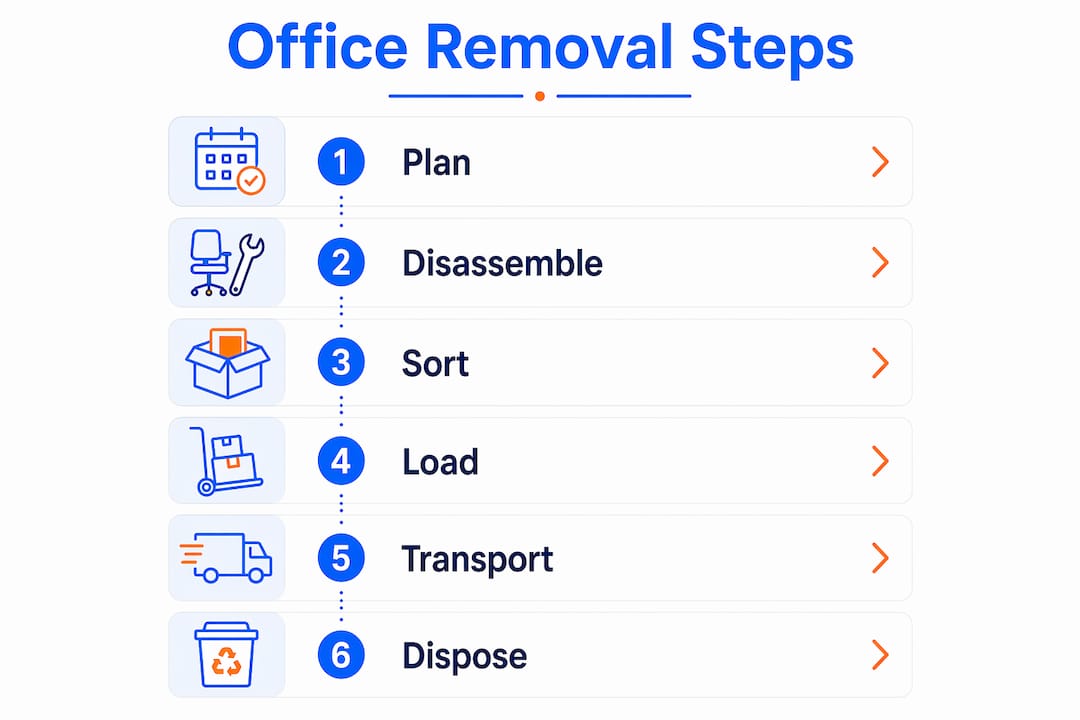
Understanding how office furniture removal works in practice helps you set realistic expectations. A full-service provider handles disassembly, sorting, loading, transport, and disposal. A man and van service handles transport only. Know which you need before you call.
How to use removal as a tool for a smooth office transition
The most effective office managers treat their removal team as a project partner, not a day-labourer. Co-leadership between office managers and removal teams produces measurably smoother moves because building logistics, access windows, and sequencing are agreed in advance rather than improvised on the day.
Practical steps to integrate removal into your broader relocation plan:
- Align removal with IT, HR, and facilities teams. IT needs to disconnect equipment before removal can begin. HR needs to communicate timelines to staff. Facilities needs to notify building management. All three must happen before removal day.
- Conduct a pre-move walkthrough with your removal provider. Walk every room together and agree what goes, what stays, and what needs specialist handling. Document this in writing.
- Use a room-by-room checklist. Assign responsibility for each area to a named person. This prevents items being left behind or moved to the wrong location.
- Plan for lease restoration separately. Restoration work often requires different contractors to removal. Book them in parallel, not sequentially.
- Do a final walkthrough with a checklist. Securing certificates of destruction and checking every room against your inventory at the end of move day prevents costly disputes with your landlord.
The importance of office removal as a project discipline is most visible when something goes wrong. A missed lease clause, an undocumented hard drive, or a last-minute storage requirement can each derail an otherwise well-planned move. Building removal into your project governance from day one prevents these failures.
Key takeaways
Professional removal is the single most underestimated function in an office relocation, and getting it right protects your budget, your legal standing, and your move timeline.
| Point | Details |
|---|---|
| Plan removal first | Book removal at least four weeks out and align it with IT, HR, and facilities schedules. |
| Budget for contingency | Add 15–20% to your total move budget to cover lease restoration, storage, and hidden costs. |
| Use licensed carriers | Only licensed waste carriers provide the duty of care documentation required by law. |
| Secure IT assets properly | Obtain Certificates of Destruction for all data-bearing equipment to transfer legal liability. |
| Treat removal as a partnership | Co-leadership with your removal team improves on-time completion and reduces costly surprises. |
Why removal is the part of an office move most businesses get wrong
I have seen a lot of office moves go sideways, and the cause is almost always the same. Removal gets treated as the last item on the list rather than the first. The office manager books a van for move day, assumes the clearance will sort itself out, and then discovers on the morning that the building requires a licensed carrier, the IT team has not disconnected the servers, and the lease requires the partitions to come down before handover.
The uncomfortable truth is that removal is the most legally and financially exposed part of any office relocation. Lease restoration clauses alone can multiply your move cost several times over if you have not read them. Data destruction obligations are real and enforceable. And the coordination required between removal, IT, facilities, and building management is genuinely complex.
What I have found actually works is treating your removal provider as a co-planner from the moment you sign the new lease. Share your project timeline with them. Walk the space together. Get their input on sequencing. The best removal teams know things about building access, waste disposal routes, and lease compliance that most office managers simply do not. Using that knowledge early is the difference between a move that finishes on time and one that runs three days over.
— London
How Westlondonremoval supports your office move
Westlondonremoval provides professional office removal across West London, covering everything from furniture clearance and IT decommissioning to secure disposal and lease restoration support. Our team is fully insured, and we work around your schedule including evenings and weekends to keep your business running.

We offer transparent, itemised quotes after a site visit, so you know exactly what you are paying for before work begins. Whether you need a man and van service for a small office clearance or a fully managed relocation for a large commercial space, we match the service to your actual requirements. Get in touch with Westlondonremoval today for a tailored removal plan and a clear, honest quote.
FAQ
What does a professional office removal service include?
A professional office removal service covers disassembly, sorting, loading, transport, and disposal of all workplace assets. Full-service providers also handle IT decommissioning, secure hard-drive destruction, and lease restoration work.
How long does an office removal take?
Small offices can be cleared in 2–4 hours. Large offices with modular systems or specialist equipment typically require one to two full days, depending on access and volume.
Why do I need a licensed waste carrier for office clearance?
Commercial waste disposal is a legal obligation under the Environmental Protection Act 1990. Licensed carriers provide Waste Transfer Notes and Certificates of Destruction, which protect your business from fines and liability.
What hidden costs should I watch for in an office move budget?
The most commonly missed costs are lease restoration work, secure IT asset destruction, after-hours building access fees, and short-term storage. Adding a 15–20% contingency to your total budget covers most of these surprises.
What questions should I ask a removal company before hiring them?
Ask for their Waste Carrier Licence number, confirm their insurance covers goods in transit, request an itemised quote after a site visit, and check whether they provide Certificates of Destruction for data-bearing equipment.