
Removal company insurance is defined as specialist coverage that protects your possessions while they are in the care of professional movers during transit and storage. Most homeowners and tenants assume their existing home contents policy covers a move. It does not. Home contents policies typically exclude goods in transit unless explicitly stated, leaving a significant gap on moving day. Understanding the role of removal company insurance means knowing which policies a removal firm carries, what each one covers, and where the limits fall short of your actual needs. The three core coverage types are Goods in Transit, Public Liability, and Employer’s Liability, and each serves a different purpose.
What does removal company insurance actually cover?
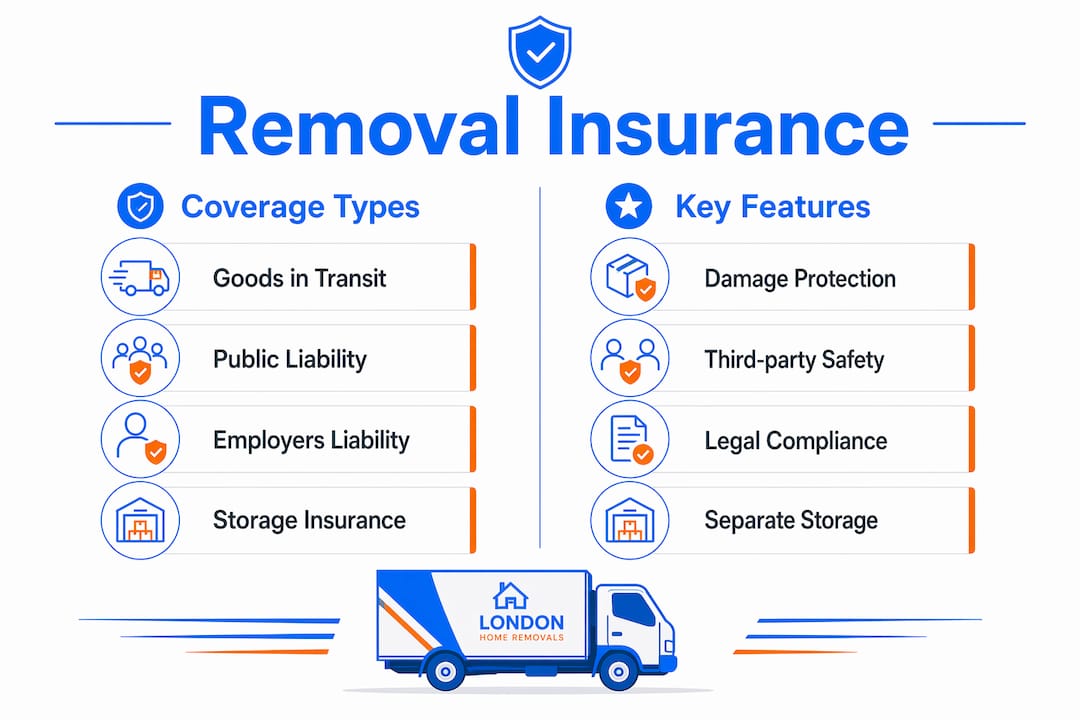
Removal company coverage is built from several distinct policies, not one single document. Each policy covers a different risk, and knowing the difference protects you from nasty surprises.
Goods in Transit (GIT) insurance covers your belongings from the moment they are loaded onto the removal vehicle until they are unloaded at your new address. It is the most relevant policy for you as a homeowner or tenant. GIT is not legally required, so the scope and limits vary considerably between firms.
Public Liability insurance protects against injury or damage to third parties during the move. If a removal operative drops a wardrobe and damages your neighbour’s wall, Public Liability pays the repair bill. Critically, Public Liability does not cover your own belongings directly. It exists to protect other people and their property, not your sofa.

Employer’s Liability insurance is a legal requirement for any removal company that employs staff. UK law mandates a minimum of £5 million in Employer’s Liability coverage, with fines of up to £2,500 per day for non-compliance. This policy protects employees injured on the job, not your goods.
Storage insurance is a separate matter entirely. Goods in Transit cover stops the moment your items are unloaded into a storage facility. If you need interim storage, you require a dedicated Goods in Storage or Warehouse Keepers’ Liability policy. Many customers do not realise this distinction until it is too late.
The table below summarises the four main policy types, what they cover, and their typical scope.
| Policy type | What it covers | Who it protects | Legally required? |
|---|---|---|---|
| Goods in Transit | Belongings during loading, transport, and unloading | You (the customer) | No |
| Public Liability | Third-party injury or property damage | Third parties | No, but standard practice |
| Employer’s Liability | Staff injuries during the job | Employees | Yes, minimum £5 million |
| Goods in Storage | Belongings held in a storage facility | You (the customer) | No |
Pro Tip: Ask your removal company to show you the actual insurance certificate, not just confirm verbally that they are insured. The certificate shows the exact coverage limits and any named exclusions.
What are the limitations of standard removal insurance?
Standard removal insurance frequently falls short of what homeowners and tenants actually need. The gap between what a policy covers and the real value of your belongings can be substantial.
Standard GIT policies often cap liability at £40–£50 per individual item, with total job limits between £10,000 and £25,000. The average UK family home contains contents valued at around £60,000. That means a standard policy could leave you tens of thousands of pounds short in a worst-case scenario.
Common exclusions make the gap even wider. Most removal companies only accept liability for items packed by their own staff, not boxes you have packed yourself. This is known as the owner-packed box exclusion, and it is an industry standard. The reasoning is straightforward: the removal firm cannot verify the condition of contents they did not pack, so they will not accept liability for them.
Other typical exclusions include:
- High-value items such as jewellery, art, and antiques, which standard policies routinely exclude or cap at very low amounts
- Sentimental items with no clear market value, which insurers will not compensate for emotional loss
- Pre-existing damage to any item, which the removal firm will deny liability for if it was already scratched or broken
- Consequential loss, meaning financial losses that result from the damage rather than the damage itself (for example, a broken computer causing lost work income)
- Mechanical or electrical failure in items that were working before the move but stop working after, unless there is clear evidence of physical impact
The difference between a contractual liability limit and actual insurance coverage also catches many customers off guard. A removal company’s terms and conditions may state a liability cap of £50 per item. That cap is a contractual limit, not a reflection of the insurance policy’s full scope. You are bound by whichever is lower.
Pro Tip: Before moving day, photograph every item of value and note any existing damage in writing. Send the condition report to your removal company by email so there is a timestamped record. This single step strengthens any future claim significantly.
How do you choose the right coverage for your move?
Securing the right moving insurance benefits requires action before the removal van arrives. Preparation is the single most effective way to protect your belongings and your finances.
Pre-move surveys, inventory lists, and clear written terms are as important as the insurance policy itself. A detailed inventory agreed with your removal company creates a baseline record. Without it, proving the condition or even the existence of a damaged item becomes very difficult.
A numbered checklist of actions to take before and during your move:
- Request the insurance certificate from your removal company and check the GIT coverage limit and any named exclusions before you sign anything.
- Contact your home insurer to ask whether your contents policy includes goods in transit coverage. Some policies do extend cover during a professional move, but you must confirm this explicitly.
- Create a written inventory of every item being moved, including photographs and notes on existing condition. Share this with your removal company in writing.
- Identify high-value items such as art, jewellery, and antiques. Standard removals insurance is usually inadequate for these, and you will need a separate rider or specialist inland marine insurance policy.
- Consider all-risk coverage as an upgrade. All-risk insurance obliges the insurer to prove an exclusion applies before denying a claim, whereas named-peril policies require you to prove your claim fits a listed cause. All-risk coverage is the stronger option for customers.
- Check third-party transit insurance if your removal company’s GIT limits are too low. Third-party all-risk policies typically cost between 1% and 5% of the declared value of your goods, offering far broader protection than released-value coverage.
- Confirm storage insurance separately if your belongings will spend any time in a storage facility between properties.
Understanding the difference between man and van services and full removal firms also matters here. Insurance coverage levels often differ significantly between service types, and a full removal company is more likely to carry comprehensive GIT and Public Liability policies as standard.
What should you do if damage or loss occurs during your move?
Acting quickly and methodically after damage or loss gives you the best chance of a successful claim. Delay and poor documentation are the two most common reasons claims fail.
The steps to follow are clear:
- Report damage immediately. Note any visible damage before the removal team leaves your property. Ask the team leader to sign a written record of the damage on the day.
- Photograph everything. Take clear photographs of damaged items alongside the packaging or box they arrived in. This helps establish whether the damage occurred during transit.
- Notify the removal company in writing within 24 hours. Most removal contracts specify a short window for reporting claims, and missing it can invalidate your right to compensation.
- Gather proof of value. Receipts, valuations, or bank statements showing purchase price all support your claim. Without proof of value, insurers will apply the lowest possible settlement figure.
- Contact your home insurer if the removal company’s policy limits are insufficient. If your contents policy extends to goods in transit, you may be able to claim the shortfall there.
- Keep all paperwork. Retain your removal contract, inventory, correspondence, and any written condition reports throughout the process.
Disputes most commonly arise over owner-packed boxes and pre-existing damage. If you packed your own boxes, the removal company will almost certainly decline liability for their contents. This is why professional packing by the removal firm, combined with a thorough moving checklist, reduces both risk and dispute.
Key takeaways
Removal company insurance is only effective when you understand its limits and take steps to fill the gaps before moving day.
| Point | Details |
|---|---|
| Legal requirements vary | Employer’s Liability is legally required at £5 million minimum; Goods in Transit is not mandatory. |
| Standard GIT limits are low | Per-item caps of £40–£50 and total job limits of £10,000–£25,000 often fall short of real contents values. |
| Owner-packed boxes are excluded | Most removal firms will not accept liability for boxes packed by the customer. |
| All-risk coverage is stronger | All-risk policies place the burden of proof on the insurer, not the customer, making claims easier to win. |
| Preparation strengthens claims | Inventories, photographs, and written condition reports are as important as the insurance policy itself. |
What we have learned from years of insured removals
We have seen the same pattern repeat itself across hundreds of moves. A customer assumes their home contents policy covers everything, packs their own boxes, and does not ask to see the removal company’s insurance certificate. Then something breaks. The claim is denied. The frustration is entirely avoidable.
The most common misunderstanding we encounter is that removal insurance is a formality rather than a genuine financial safeguard. Customers treat it like a box to tick rather than a document to read. The owner-packed box exclusion alone catches out a significant number of people every year. If you pack it yourself, the removal firm will not pay for it. That is not a technicality. It is a core condition of almost every GIT policy in the industry.
Our honest advice is this: treat the insurance conversation as part of the booking process, not an afterthought. Ask for the certificate. Check the per-item limit. If you own anything worth more than £500, find out whether it is covered. Art, jewellery, and antiques almost always need separate scheduling. A five-minute conversation before the move can save weeks of dispute afterwards.
We also believe that the best insurance strategy combines good paperwork with a reputable firm. A professional house removal company that carries out a pre-move survey, produces a written inventory, and communicates its insurance terms clearly is already reducing your risk before a single box is lifted. Insurance and preparation work together. Neither is sufficient on its own.
— West London removals
Westlondonremoval: fully insured moves across West London
Westlondonremoval carries full Goods in Transit and Public Liability insurance on every job, and meets all legal requirements including Employer’s Liability cover. We are transparent about our policy terms from the first conversation, so you know exactly what is protected before the van arrives.

Every move we carry out includes a written inventory and clear communication about coverage. If you have high-value items or specific insurance questions, we discuss them at the quoting stage, not after something goes wrong. Over 1,000 satisfied clients across West London trust us to handle their belongings with care. For insured removals in Chiswick and across West London, get in touch today for a transparent quote with no hidden conditions.
FAQ
What is Goods in Transit insurance?
Goods in Transit insurance covers your belongings from the point of loading onto the removal vehicle until they are unloaded at your destination. It is the primary policy protecting your possessions during a move, though coverage limits and exclusions vary between firms.
Does my home contents insurance cover a house move?
Most home contents policies do not automatically cover goods during a professional removal. You should contact your insurer directly to confirm whether transit coverage is included, as many policies require it to be added explicitly.
Are owner-packed boxes covered by removal insurance?
Most removal companies exclude owner-packed boxes from their Goods in Transit liability. If you pack your own boxes, the removal firm will typically decline any claim for damage to the contents, as they cannot verify the condition of items they did not pack.
What is the difference between all-risk and named-peril coverage?
All-risk coverage requires the insurer to prove an exclusion applies before denying your claim, which is the stronger position for customers. Named-peril policies require you to prove your loss fits one of the listed causes, making claims harder to win.
Do I need separate insurance for storage?
Yes. Goods in Transit cover ends once your items are unloaded into a storage facility. If your belongings will be stored between properties, you need a dedicated Goods in Storage or Warehouse Keepers’ Liability policy to maintain protection.