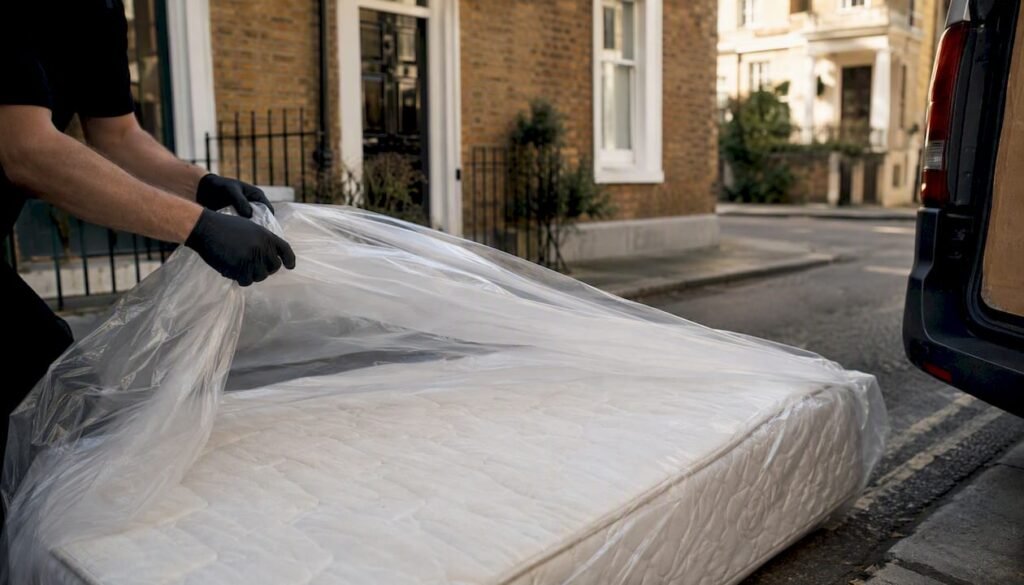
There are three lawful routes for mattress disposal in London: your borough’s bulky-waste collection or a household waste recycling centre (HWRC) drop-off, donation or reuse if the mattress is in good condition with its fire-safety label intact, or a private accredited mattress recycling and collection service. London Recycles confirms that councils offer bulky collections and reuse centres, while specialist private collectors recycle springs, frames and fillings rather than sending them to landfill.
Here is a quick overview of each route:
- Council bulky-waste collection: low to moderate cost (varies by borough); typical lead time of a few weeks; requires proof of residency.
- HWRC drop-off: usually free with proof of residency; you transport the mattress yourself; same-day if you have a vehicle and a slot.
- Donation or reuse (Freecycle, Freegle, British Heart Foundation): free; only suitable for clean, undamaged mattresses with a valid fire-safety label; lead time depends on demand.
- Private accredited collection: fastest option, often same-day or next-day; paid service; ideal for upper-floor flats or tight deadlines.
Your immediate next step: check your borough’s bulky-waste page for fees and availability, or contact a local insured removal service if access is difficult.
Key takeaways
Responsible mattress disposal in London means choosing a lawful, documented route: council bulky collection, HWRC drop-off, donation, or an accredited private service.
| Point | Details |
|---|---|
| Three lawful routes | Council bulky collection, HWRC drop-off, or an accredited private recycling service cover every situation. |
| Fire-safety label is essential for donation | Charities and reuse centres will refuse any mattress without a valid fire-safety label; check it before offering. |
| Council lead times | Borough bulky-waste collections typically take 1–3 weeks; book early if you have a move deadline. |
| Fly-tipping carries penalties | Leaving a mattress on the pavement is illegal; always request a waste transfer note from any private collector. |
| Westlondonremoval for access problems | Westlondonremoval provides insured carry-down, transparent pricing and documented disposal for West London residents. |
Table of Contents
- How does your borough’s bulky-waste collection work?
- Can you donate or give away your mattress?
- What can you drop off at a household waste recycling centre?
- What do specialist mattress recycling services actually do?
- How do you choose the right route and what should you ask?
- How to prepare your mattress for collection or drop-off
- What are the legal and environmental rules you need to know?
- How Westlondonremoval can handle the practical problems
- Why responsible disposal matters in London
- Book a local mattress collection with Westlondonremoval
- Sources
How does your borough’s bulky-waste collection work?
Every London borough offers some form of bulky-waste collection, though fees, lead times and access rules differ. The City of London’s bulky item collection page is a useful example: it lists specific collection points, the required proof of residency and example charges for collections from property. Ground-floor estate collections are sometimes free; collections from individual properties carry a stated fee for up to three items.
Typical booking steps:
- Visit your borough’s website and search “bulky waste collection” or “large item collection.”
- Check the accepted items list to confirm mattresses are included (they almost always are).
- Book online or by phone, providing your address and the number of items.
- Confirm the collection date and note any access requirements.
- Move the mattress to the agreed collection point before the crew arrives.
What to expect on the day:
- Most boroughs ask you to leave the mattress at a ground-floor point or a designated estate collection area.
- Photo ID and a recent council tax bill are the standard proof-of-residency documents.
- Lead times typically run several weeks, though some boroughs offer earlier slots.
Buildings without lifts present a real challenge. Councils generally expect residents to bring items to the collection point themselves. If you live on an upper floor with no lift, you are responsible for the carry-down. Gov confirms that local arrangements vary, so always check your specific borough page for the exact rules before booking.
Pro Tip: Book the council collection before you buy a new mattress. Many retailers offer a paid take-back service on delivery day, which can save you the carry-down effort entirely.
Can you donate or give away your mattress?
Donation is the lowest-impact route, but it comes with clear conditions. The mattress must be clean, free of stains or damage, and it must carry a valid fire-safety label. NLWA’s mattress guidance is direct on this point: charities and reuse centres will refuse upholstered items without a valid fire-safety label, which makes the item waste rather than a donation.
Charity collection options:
- British Heart Foundation: accepts mattresses in good condition with the fire-safety label intact. Book a free home collection via their website; they will confirm whether your item qualifies.
- Furnishing Futures: coordinates reuse pathways through partner charities and social enterprises and may be able to rehome eligible mattresses.
Free give-away platforms:
- Freecycle lets you post a free listing for a usable mattress; local members collect directly from you.
- Freegle works on the same principle and has active groups across London.
- Olio is a community sharing app with a strong London user base for furniture and household items.
Pros and cons at a glance:
- Pros: free, zero landfill, supports charities or neighbours in need.
- Cons: charities will refuse if the label is missing or the mattress is stained; collection timing depends on volunteer availability.
Pro Tip: Before offering the mattress anywhere, photograph it from all angles and take a close-up of the fire-safety label. Send these images with your listing or charity enquiry to speed up acceptance and avoid a wasted collection attempt.
What can you drop off at a household waste recycling centre?
HWRCs accept mattresses at no charge, making them the cheapest route if you have access to a vehicle. Most London boroughs require you to show photo ID and a recent council tax bill or utility bill as proof of residency before you can use the site. Tower Hamlets’ reuse and recycling centre page is a clear example of how boroughs publish their access rules and centre locations.
Steps to drop off a mattress:
- Find your nearest HWRC using your borough’s website or the NLWA centre list if you are in north London.
- Check whether pre-booking is required. Several boroughs now operate a slot-booking system to manage queues.
- Bring photo ID and a recent council tax bill or utility bill showing your address.
- Arrive in a private vehicle. Many sites do not permit vehicles that appear to be used for commercial purposes; if in doubt, call ahead.
- Follow site staff instructions for where to unload.
When drop-off makes sense:
- You have a car or van and can transport the mattress yourself.
- You want a free, same-day solution.
- The mattress is not suitable for donation.
When it is impractical:
- You live in an upper-floor flat with no lift and no one to help carry the mattress down.
- You do not have access to a vehicle large enough.
- You need the mattress gone urgently and cannot get a booking slot.
In those situations, a private collection service is usually the more sensible choice.
What do specialist mattress recycling services actually do?
Private mattress recyclers dismantle mattresses and separate the components: steel springs, timber frames, foam and fabric. These materials are then sent to specialist processors rather than landfill. This is worth knowing because a standard skip or general waste carrier may simply tip the mattress, while an accredited recycler documents where each material goes.
What to ask before you book:
- Can they provide their waste carrier licence number?
- Will they issue a waste transfer note confirming lawful disposal?
- Which recycling facility receives the mattress, and can they confirm landfill avoidance?
- Is the price fixed, or does it change for stairs, extra mattresses or same-day bookings?
What drives the price:
- Mattress size (single, double, king, super-king).
- Number of items collected in one visit.
- Stairs or carry-down labour if you live above the ground floor.
- Same-day or next-day premium versus a standard booking.
When a private collection is the right call:
- Upper-floor flat with no lift and no council carry-down assistance.
- You need the mattress collected within 24–48 hours.
- You are clearing a rental property or commercial premises with multiple items.
- You want documented proof of recycling for your own records.
Pro Tip: Ask for the name and postcode of the recycling facility, not just a vague “we recycle everything” assurance. A legitimate recycler will give you this without hesitation.
How do you choose the right route and what should you ask?
The decision comes down to four factors: cost, speed, access, and whether the mattress is reusable.
Decision flow:
- Cheapest option with a vehicle: HWRC drop-off, usually free.
- Mattress in good condition with fire-safety label: offer to the British Heart Foundation, Freecycle or Freegle first.
- No vehicle, no urgent deadline: book your borough’s bulky-waste collection.
- Upper-floor flat, tight deadline, or multiple items: book a private insured collection service.
Questions to ask any provider before booking:
- Are they registered as a waste carrier with the Environment Agency?
- Will they provide a waste transfer note after collection?
- Are the crew and vehicle insured?
- Where exactly does the mattress go after collection?
Red flags to watch for:
- Refusal to provide a waste transfer note.
- Vague recycling claims with no named facility.
- A price that seems unusually low with no explanation of disposal costs.
- No verifiable business address or registration.
Timing guide:
- HWRC drop-off: same day if a slot is available.
- Donation via Freecycle or Freegle: typically 1–5 days depending on local demand.
- Council bulky-waste collection: usually a few weeks.
- Private collection: often same-day or next-day, depending on the provider.
How to prepare your mattress for collection or drop-off
A little preparation prevents delays and avoids extra charges on the day.
- Strip all bedding and remove any mattress protectors before the collection team arrives.
- Clear the route from the bedroom to the front door or collection point, removing trip hazards.
- Measure the mattress and note the size. This helps the collection team bring the right vehicle and confirms any size-related pricing.
- Photograph the mattress from above and from the side, and take a close-up of the fire-safety label if you plan to donate.
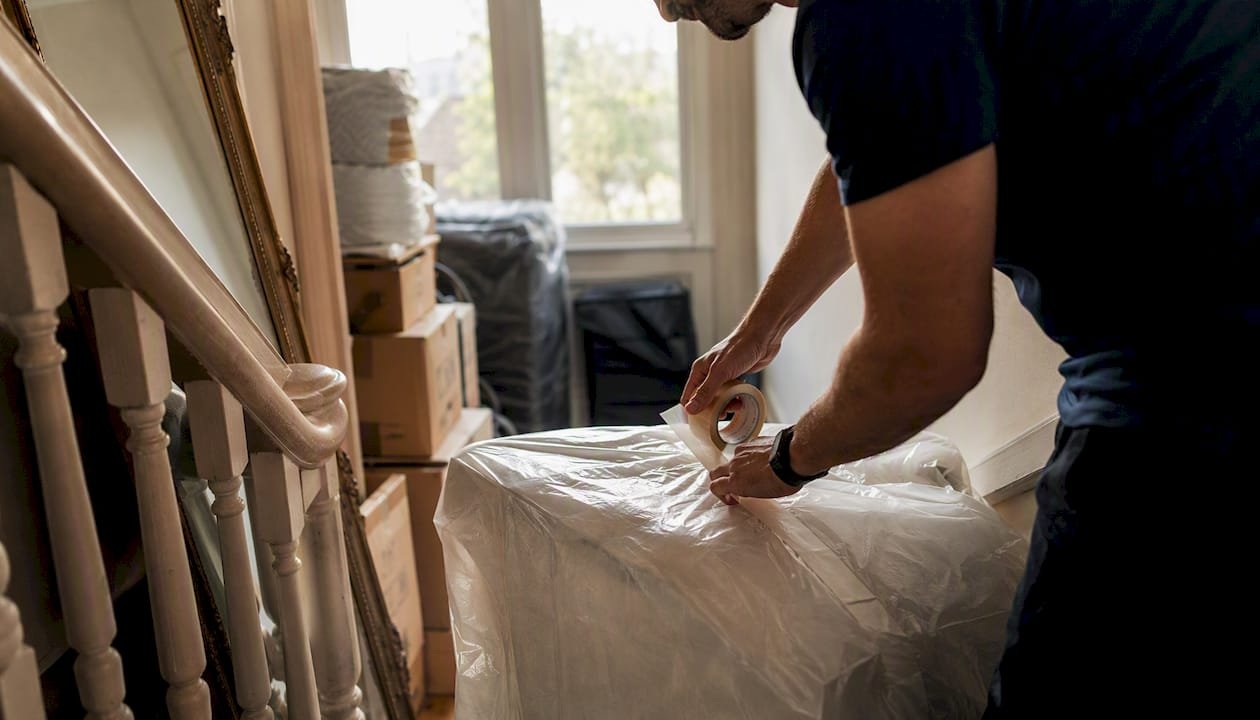
- Wrap or bag the mattress if the collector requests it. Some private services supply a mattress bag; others ask you to source one.
- Move it to the agreed collection point. For council collections, this is usually the ground floor or a designated estate area.
For flats above the ground floor, arrange carry-down help in advance. If there is no lift and no one available to assist, book a private service that includes carry-down labour as part of the price.
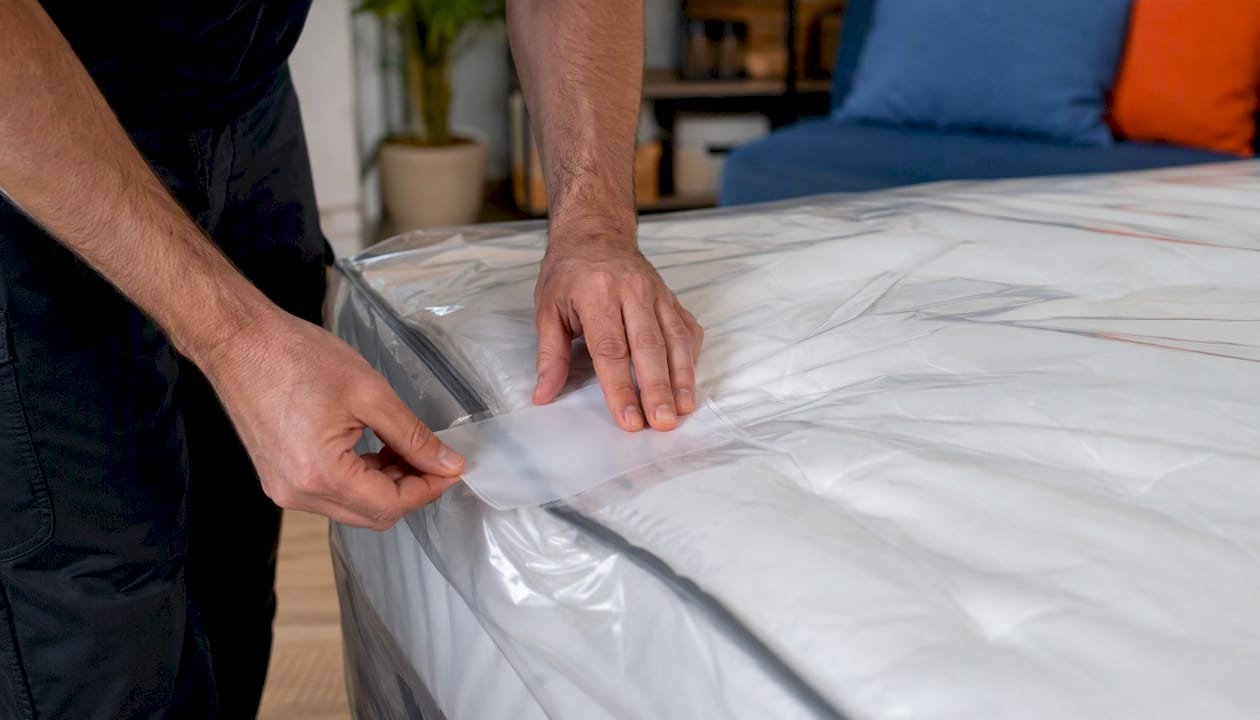
Pro Tip: Use a purpose-made mattress bag and tape over the fire-safety label area before wrapping. This keeps the label legible if the mattress is later accepted for reuse rather than recycling.
What are the legal and environmental rules you need to know?
Fly-tipping is illegal across London. Leaving a mattress on a pavement, in an alley, or on communal land without authorisation can result in a fixed-penalty notice or prosecution by the council. Always use one of the lawful routes described above.
Key legal points:
- Keep the waste transfer note or receipt from any private collector as proof of lawful disposal. If a fly-tipping allegation arises, this document is your evidence.
- Only use waste carriers registered with the Environment Agency. You can check a carrier’s registration on the Environment Agency’s public register.
- Commercial premises (landlords clearing multiple units, offices) have stricter duty-of-care obligations and should always request a waste transfer note.
Environmental benefits of proper disposal:
- Mattress recycling recovers steel, timber and foam that would otherwise go to landfill.
- Reuse via charities or community platforms extends the product’s life and avoids the energy cost of manufacturing a replacement.
- The City of London’s approach to electrical and specialist recycling shows how borough partnerships with specialist processors can divert significant volumes of material from landfill, a model that applies equally to bulky furniture items.
For national guidance on household waste and recycling collections, GOV.UK’s recycling page directs residents to their local council as the authoritative source for borough-specific rules.
How Westlondonremoval can handle the practical problems
When the council collection is weeks away or the mattress is on the third floor with no lift, a private insured service is often the only realistic option. Westlondonremoval offers exactly that for residents across West London.
What the service covers:
- Collection from any room, including upper-floor flats with tight staircases.
- Fully insured crew with experience handling bulky items safely.
- Ability to arrange documented recycling or reuse, with a waste transfer note available on request.
- Transparent pricing with no hidden charges for stairs or carry-down labour.
What to ask when you book:
- Confirm the waste carrier licence and ask for the waste transfer note to be issued after collection.
- Ask for the recycling destination so you have a clear record of responsible disposal.
- Provide your postcode, photos of the mattress and access notes (floor, lift availability, parking) to get an accurate quote quickly.
For larger clearances, such as furniture removal from an empty property or a full house removal in West London, Westlondonremoval can combine mattress collection with the wider job, saving you a separate booking.
Pro Tip: When requesting a quote, send two photos: one showing the mattress and one showing the access route (staircase, corridor width). This removes the need for a site visit and speeds up confirmation.
Why responsible disposal matters in London
Proper mattress disposal is not just a personal admin task. Every mattress left on a London pavement adds to the fly-tipping burden that councils spend public money clearing, and it signals to others that the street is an acceptable dumping ground. Choosing a lawful route, whether that is the council collection, an HWRC drop-off, a charity, or an insured private service, keeps local streets cleaner and feeds materials back into recycling streams that genuinely need the volume to remain viable.
Donation, when the mattress qualifies, is the best outcome. It supports charities like the British Heart Foundation, gives the item a second life, and costs nothing. When donation is not possible, documented recycling through an accredited collector is the next best step. The choice that helps no one is leaving it on the pavement and hoping for the best.
Book a local mattress collection with Westlondonremoval
Westlondonremoval offers a faster, more flexible alternative to waiting weeks for a council slot, with the added reassurance of an insured crew, transparent pricing and documented disposal. Whether you need a single mattress collected from a top-floor flat or a full clearance combined with a house move, the team handles access challenges that council services simply cannot.
Every collection includes carry-down assistance where needed and a waste transfer note on request, so you have written proof of lawful, responsible disposal. Pricing is clear upfront, with no surprises for stairs or same-day bookings.
Ready to book? Get a quote for your West London collection by sharing your postcode, a photo of the mattress and your access details. The team will confirm availability and pricing quickly, often for same-day or next-day collection.
Sources
The following pages are the most reliable starting points for booking and further guidance:
For borough-specific bulky-waste booking pages, search your borough name plus “bulky waste collection” on GOV.UK or your council’s own website. HWRC locations and opening times are listed on the same pages.