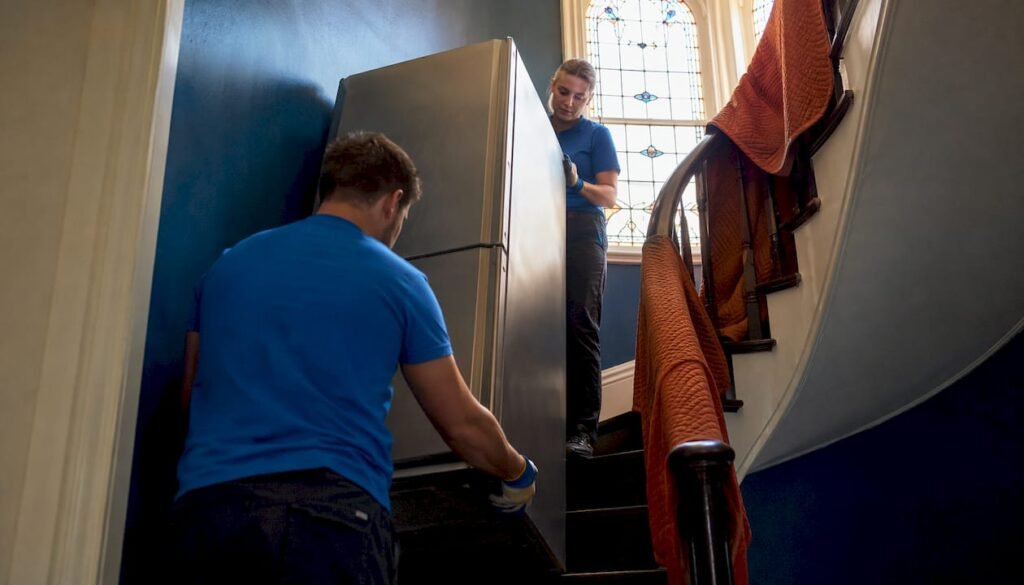
Moving heavy appliances yourself is reasonable for a single, ground-floor move when you have two helpers, the right kit, and a clear route. Hire insured professionals when stairs are involved, when you are dealing with a modern inverter-compressor fridge, a gas appliance, or a tight UK terraced house where the risk of injury or property damage rises sharply.
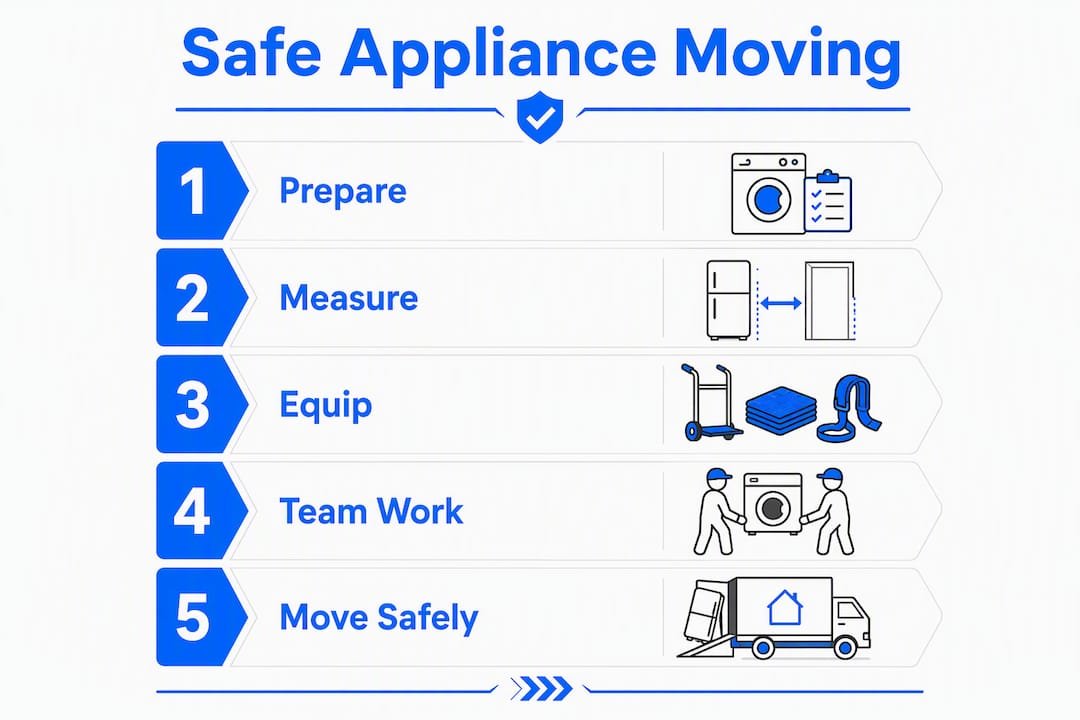
Three things to do right now:
- Measure every doorway, corridor, and stairwell before you touch the appliance.
- Defrost your fridge or freezer at least 24 hours before moving day.
- Hire an appliance dolly from a local tool-hire shop, or book a specialist such as Westlondonremoval if stairs or tight angles are involved.
Westlondonremoval offers fully insured, same-day appliance moves across West London, with trained staff and specialist equipment. For anything beyond a straightforward ground-floor shift, that is the safer and often cheaper route once you factor in the cost of potential damage.
Table of Contents
- What can go wrong when you move appliances without proper care?
- What you must do before you move any appliance
- What equipment do you need for a safe appliance move?
- How to move a heavy appliance safely, step by step
- Appliance-by-appliance guidance
- When should you hire professionals, and how do you choose one?
- How Westlondonremoval handles heavy-appliance moves
- Key takeaways
- The view from the van
- Book Westlondonremoval for your appliance move
- Useful sources
What can go wrong when you move appliances without proper care?
The risks split into three categories: injury to you, damage to the appliance, and damage to your home. All three are more likely than most people expect.
Personal injury is the most immediate concern. Fridges and washing machines are heavy appliances that require careful handling. Back strain, crushed fingers, and falls on stairs are the most common outcomes of an unprepared DIY move. UK homes, particularly Victorian terraces and purpose-built flats, often have narrow stairwells and tight 90-degree turns that make navigating tight angles far more hazardous than the lift itself.
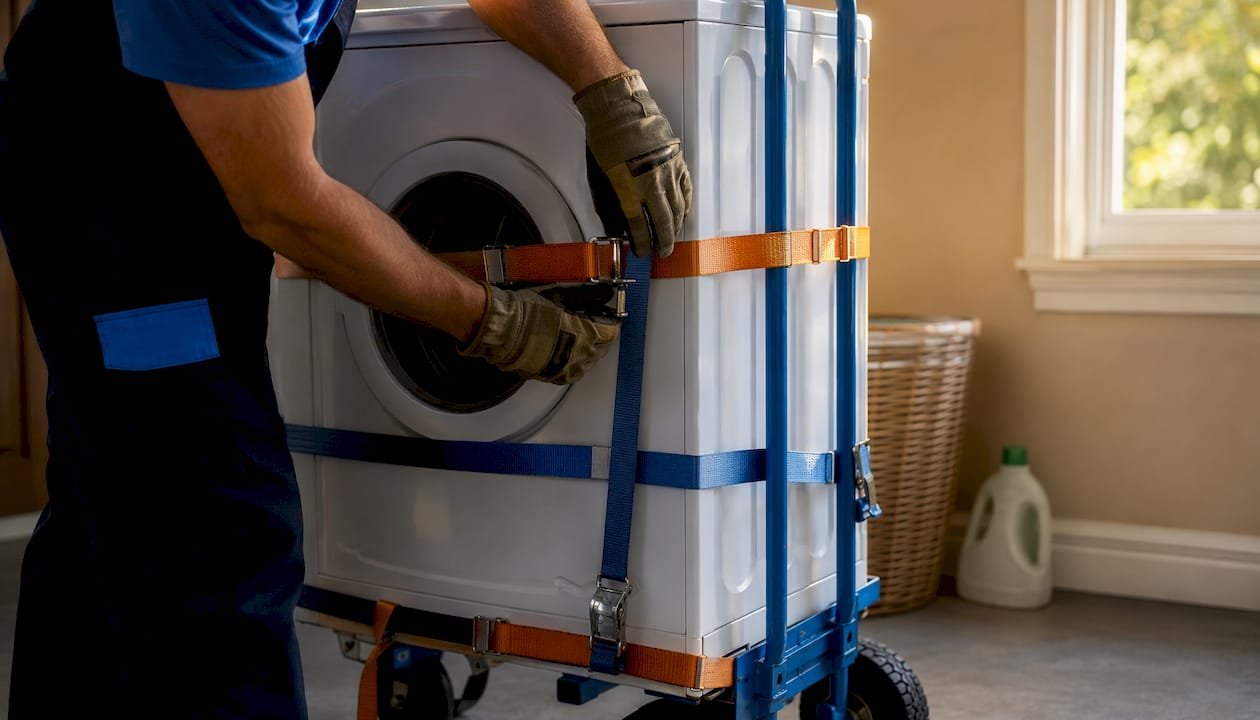
Appliance damage is subtler but expensive. Tilting a fridge beyond 45° allows compressor oil to migrate into the cooling system. According to Orange Box Self Storage, compressor failure rates rise by 35%–50% within 12 months when a fridge is moved incorrectly and powered on too soon. Modern eco-friendly inverter compressors are more sensitive than older models, so what was once a manageable DIY job now carries a higher financial risk. Washing machines suffer drum and suspension damage when moved without transit bolts fitted.
Property damage is the third cost people overlook. Scuffed hardwood floors, gouged skirting boards, and dented door frames are common outcomes. Repairing a scratched solid-wood floor can run to several hundred pounds; replacing a damaged door frame in a period property costs even more. Good floor protection and padding cost a fraction of that.
What you must do before you move any appliance
Preparation prevents most of the problems described above. Work through this checklist before moving day.
- Measure everything. Record the appliance’s height, width, and depth, then measure every doorway, corridor, and stairwell on the route. Note whether doors can be removed from their hinges to gain extra clearance. A standard UK internal door opening is roughly 76 cm wide; many American-style fridge-freezers are wider than that.
- Clear and protect the route. Remove rugs, door mats, and any furniture in the path. Lay cardboard or plywood sheets on hardwood or tiled floors. Pad door frames and bannisters with moving blankets or foam corner guards.
- Defrost the fridge or freezer. Unplug at least 24 hours beforehand and dry the interior completely; 24–48 hours is the recommended window depending on ice build-up. Meltwater in transit can damage other items and encourage mould.
- Drain the washing machine and dishwasher. Run a short spin cycle to clear residual water, then disconnect and drain the inlet and outlet hoses. Lay towels beneath the connections; there is always some residual water.
- Fit transit bolts on the washing machine. Transit bolts lock the drum to the frame and prevent suspension damage. If you no longer have the original bolts, contact the manufacturer or an authorised technician to source replacements before moving day.
- Pack removable parts separately. Glass shelves, fridge drawers, oven trays, and dishwasher racks should be wrapped individually in bubble wrap or towels and packed in a labelled box. Tape cords and hoses to the appliance body so they do not snag.
For a full house-moving checklist tailored to West London residents, the West London moving checklist covers appliance prep alongside everything else.
Time estimates: Allow 30–45 minutes to prepare a fridge-freezer (defrost aside), 20–30 minutes for a washing machine with transit bolts, and 15–20 minutes for a dishwasher or freestanding oven.
Pro Tip: Check the manufacturer’s user manual for model-specific transport orientation guidance. Some fridge models must travel on a specific side; some washing machines have a particular bolt pattern. Five minutes with the manual can prevent an expensive mistake.
What equipment do you need for a safe appliance move?
The right kit makes the difference between a controlled move and an accident. For a one-off home move, hiring is almost always more cost-effective than buying.
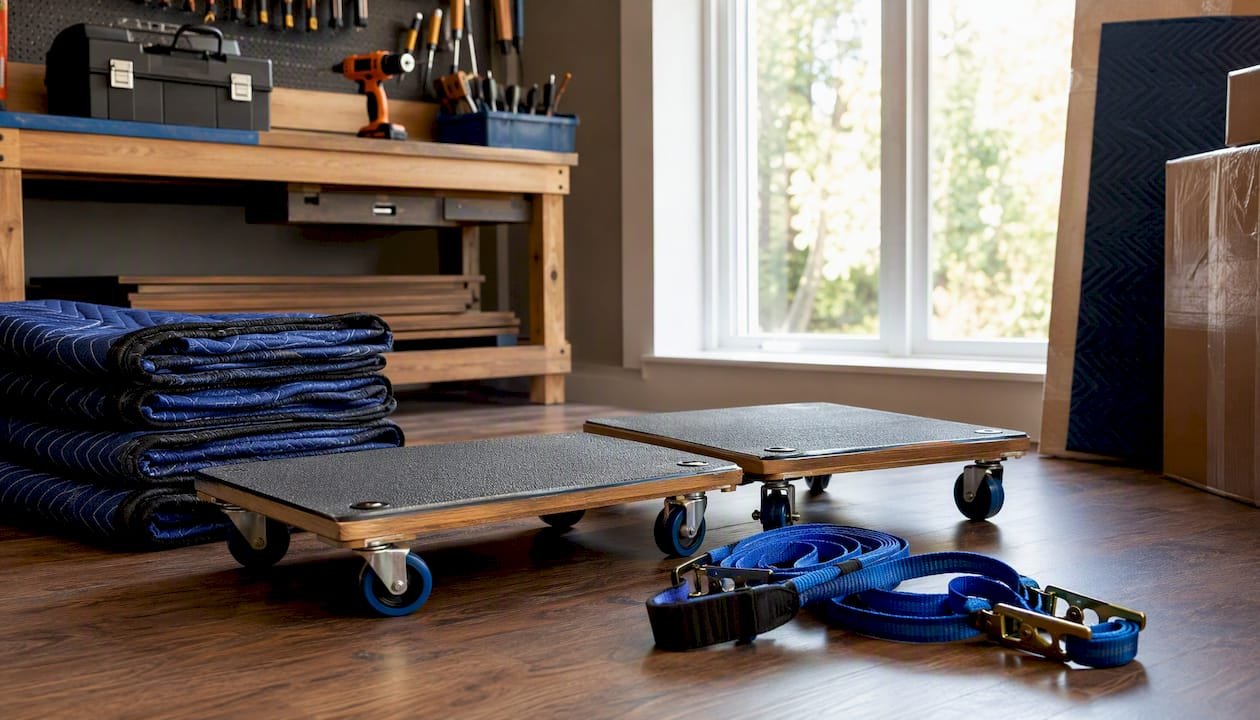
- Appliance dolly (hand truck). A two-wheeled upright dolly with a strap is the single most important piece of kit. Choose one rated for at least 150 kg. A stair-climbing dolly with tri-star wheels is worth the extra hire cost if stairs are unavoidable.
- Ratchet straps. Two 25 mm ratchet straps are the minimum. These secure the appliance to the dolly and, later, to the van wall. Industry guidance lists ratchet straps as non-negotiable; bungee cords and rope are not adequate substitutes.
- Moving blankets. Wrap the appliance before it moves anywhere. Blankets protect both the appliance finish and your walls and door frames.
- Furniture sliders. Useful for shifting an appliance a short distance across a smooth floor before loading it onto the dolly.
- Plywood or cardboard sheets. Protect floors from dolly wheels and appliance feet.
- Work gloves. Non-negotiable for grip and finger protection.
- A ramp. If loading into a van without a tail lift, a sturdy aluminium loading ramp prevents the dangerous step-up that causes most van-loading injuries.
In the UK, tool-hire shops such as HSS Hire and national DIY chains offer appliance dolly hire by the day. Westlondonremoval brings all of this equipment as standard, which removes the logistics of sourcing and returning hire kit on an already busy moving day.
Pro Tip: When hiring a dolly, check the rated capacity and add a 20% safety margin above your appliance’s actual weight. A 100 kg fridge on a dolly rated to exactly 100 kg leaves no margin for the dynamic load of stairs or kerbs.
For specialist safety equipment used in larger-scale logistics, JIENCO UK supplies industry-standard safety cages and lifting accessories for professional operations.
How to move a heavy appliance safely, step by step
Before you start: confirm the route is clear, the appliance is fully prepared, and you have at least one other person with you. Never attempt a heavy appliance move alone.
- Final checks. Confirm all hoses are disconnected, transit bolts are fitted (washing machines), glass shelves are removed, and doors are taped shut or secured with a strap.
- Disconnect power. Unplug from the mains. Do not disconnect a gas appliance yourself. A Gas Safe registered engineer must disconnect and reconnect any gas cooker or gas dryer.
- Wrap the appliance. Cover it fully in moving blankets and secure with ratchet straps. This protects the finish and gives you something to grip.
- Tilt and load onto the dolly. With one person steadying the appliance, tilt it back slightly and slide the dolly plate underneath. Secure the strap around the appliance and dolly before moving.
- Navigate doorways. Angle the dolly to clear the frame. One person guides from the front, one controls the dolly from behind. Move slowly; sharp turns are where most damage happens.
- Stair technique. On stairs, the stronger person takes the lower end (the heavier load). Go down backwards, one step at a time, with the person at the top controlling the tilt. Never rush. A stair-climbing dolly removes most of the risk here.
- Load into the van. Use a ramp where possible. Back the dolly up the ramp with the appliance tilted towards you. Once inside, stand the appliance upright immediately.
- Secure in the van. Strap the appliance to the van’s side wall using ratchet straps, with moving blankets between the appliance and any hard surfaces. The goal is zero movement in transit. Relying on surrounding boxes to hold an appliance in place is not adequate.
- Allow settling time. After delivery, let a fridge stand upright for at least 4 hours before plugging in (longer if it was tilted significantly during the move). Do not run a washing machine until water connections are confirmed secure.
If at any point the route looks too tight, the stairs too steep, or the appliance too heavy for your team, stop and call a professional. The cost of a specialist visit is far less than a back injury or a broken compressor.
Pro Tip: Assign roles before you start: one person calls directions, one controls the dolly. Talking through each step before you lift prevents the miscommunication that causes most accidents.
Appliance-by-appliance guidance
Different appliances have different failure points. Here is what matters for each.
Fridge-freezer
- Defrost 24–48 hours before moving and dry the interior thoroughly.
- Remove all glass shelves and drawers; pack them separately.
- Transport fridge upright wherever possible. If it must go on its side, lay it with the hinge side uppermost.
- Do not tilt beyond 45°; beyond that angle, compressor oil can migrate into the cooling system.
- Wait 4–24 hours after the move before plugging in, depending on how much it was tilted. If it was laid flat, wait a full 24 hours.
Washing machine
- Fit transit bolts before moving. Moving without them is a leading cause of drum and suspension damage; if the original bolts are lost, source replacements from the manufacturer.
- Drain inlet and outlet hoses completely and tape them to the machine body.
- Keep the machine upright throughout the move.
- Do not run a cycle until water connections at the destination have been checked and confirmed leak-free.
Dryer
- Remove the lint filter and any internal trays.
- For a gas dryer, a Gas Safe registered engineer must disconnect the gas supply before the machine moves. This is a legal requirement, not a preference.
- Electric dryers: unplug and tape the power cord to the body. Disconnect the vent hose and cap the outlet.
Dishwasher
- Run a short cycle to clear residual water, then disconnect and drain the inlet and outlet hoses.
- Remove the cutlery basket and lower rack; pack them separately.
- A flat platform dolly works better than an upright appliance dolly for dishwashers, which are lower and wider.
Freestanding oven
- Remove all racks, trays, and knobs and pack them separately.
- For a gas oven, a Gas Safe registered engineer must disconnect the supply. Never attempt gas disconnection yourself; the liability and safety risk are significant.
- Electric ovens: isolate at the consumer unit before disconnecting.
When should you hire professionals, and how do you choose one?
Some moves are beyond safe DIY territory. Hire insured professionals when any of the following apply:
- The route involves stairs or a multi-level property.
- You are in a typical UK terraced or Victorian house with tight hallways and 90-degree turns.
- The appliance is a modern inverter-compressor fridge or a high-value unit.
- You do not have access to the correct equipment.
- A gas appliance needs disconnecting.
- You cannot recruit two able-bodied helpers.
When you do hire, ask these questions before booking:
- Do you carry public liability insurance and goods-in-transit cover? Can you show proof?
- Do you have experience specifically with appliance moves, including fridge-freezers and washing machines?
- What equipment will you bring? (Expect: appliance dolly, ratchet straps, moving blankets, ramp.)
- Will you provide a written estimate before the job?
- What is your policy if damage occurs?
Red flags to watch for: vague or verbal-only insurance answers; refusal to confirm transit-bolt policy for washing machines; any suggestion that a team member will disconnect a gas appliance.
| Factor | DIY | Man and van | Specialist removals |
|---|---|---|---|
| Cost | Hire kit + helpers’ time | Moderate hourly rate | Higher, but all-inclusive |
| Equipment | You source it | Basic dolly, may vary | Full specialist kit as standard |
| Insurance | None (your risk) | Check policy carefully | Public liability + goods in transit |
| Stairs/tight turns | High risk | Depends on experience | Handled routinely |
| Gas disconnection | Not permitted | Not permitted | Coordinates Gas Safe engineer |
| Best suited for | Ground floor, simple moves | Single appliance, easy access | Stairs, high-value or gas appliances |
For a clear view of what professional removal costs in West London, the removal costs guide breaks down typical hourly rates and what is included.
How Westlondonremoval handles heavy-appliance moves
Westlondonremoval manages appliance moves as part of its specialist moves service across West London. The process is straightforward and designed to remove the stress from what is genuinely a high-risk task.
- Pre-move survey. The team confirms appliance dimensions, access details, stair configuration, and parking before the crew arrives. Nothing is left to chance on the day.
- Specialist equipment. Every job includes appliance dollies, ratchet straps, moving blankets, and ramps as standard. No extra hire cost for you.
- Trained staff. The crew knows transit-bolt requirements for washing machines, compressor-tilt limits for fridges, and the legal position on gas appliances. They will not attempt a gas disconnection; they will coordinate a Gas Safe engineer if needed.
- Fully insured. Westlondonremoval carries public liability and goods-in-transit insurance on every job. If something goes wrong, you are covered.
- Transparent pricing. Written estimates before every job, with no hidden charges. Same-day availability is offered where scheduling allows.
- Post-delivery checks. The crew confirms the appliance is positioned correctly, upright, and stable before leaving.
Over 1,000 satisfied clients across West London have trusted Westlondonremoval with their moves, including removals in Kensington and Chelsea and across Ealing, Acton, and Chiswick.
Pro Tip: Before the crew arrives, clear a 1-metre path from the appliance to the front door, confirm parking for the van, and have the appliance’s user manual to hand. Those three things alone cut 20 minutes off a typical job.
Key takeaways
Safe appliance relocation comes down to preparation, the right equipment, and an honest assessment of whether the route and appliance type are within DIY capability.
| Point | Details |
|---|---|
| Measure before anything else | Check appliance dimensions against every doorway, corridor, and stairwell on the route before moving day. |
| Defrost and drain in advance | Fridge-freezers need 24–48 hours to defrost; washing machines and dishwashers must be fully drained before moving. |
| Transit bolts are non-negotiable | Moving a washing machine without transit bolts is a leading cause of drum damage; source replacements if originals are lost. |
| Compressor risk is real | Tilting a fridge past 45° can raise compressor failure rates by 35%–50%; always wait 4–24 hours before plugging in after a move. |
| Westlondonremoval for complex moves | For stairs, tight UK terraced houses, or high-value appliances, Westlondonremoval provides insured, specialist handling across West London. |
The view from the van
The mistake we see most often is not the heavy lift itself. It is the moment someone decides the staircase “looks fine” without measuring it, or assumes a washing machine can be moved without transit bolts because the drum feels solid when you shake it. It never ends well. The drum is designed to move during a wash cycle; it is not designed to absorb the shock of a van going over a speed bump at 20 mph with nothing holding it in place.
The one tip that separates experienced movers from first-timers: protect the bannister before you start, not after you have already scraped it. Wrap it in moving blankets and tape them in place. On a tight UK staircase, the bannister is almost always the first casualty, and in a period property, replacing a turned-wood bannister is a job that costs far more than the removal itself.
Book Westlondonremoval for your appliance move
When the appliance is heavy, the stairs are steep, or the hallway is the width of a standard UK door frame, the reliable choice is a team that has done it hundreds of times before.

Westlondonremoval offers same-day availability across West London, fully insured crews, and transparent written estimates before every job. Booking is straightforward: call or request a quote online, confirm your appliance dimensions, access details, and stair configuration, and the team handles the rest.
Before you call, have these details ready: appliance make and dimensions, number of flights of stairs, any tight turns or narrow corridors, and parking availability for the van. That information allows the team to give you an accurate quote and send the right crew with the right kit.
For appliance moves in Chiswick and the surrounding area, book your removal here or visit the West London house removals page for a full overview of services and pricing.
Useful sources
The following sources support the guidance in this article and are worth consulting for model-specific or regulatory detail.
| Source | What it covers |
|---|---|
| Bosch UK: moving a fridge-freezer | Manufacturer guidance on tilt limits, securing methods, and post-move settling time for fridge-freezers. |
| Orange Box Self Storage: fridge-freezer moving guide | Compressor oil migration risks and the 35%–50% failure rate increase associated with incorrect moves. |
| iMoving: how to move a washing machine | Transit bolt requirements, drum-securing methods, and step-by-step washer preparation. |
| Lugg: how to move heavy appliances safely | Professional standards for van loading, ratchet-strap technique, and zero-movement transit. |
“When carrying a fridge or freezer on a trolley, try not to tip it back more than 45 degrees. Keeping the fridge upright keeps the internal refrigerant in the right place.” — Bosch UK guidance on moving a fridge-freezer
Recommended
- How to disassemble furniture before moving: 2026 guide – West London Removal
- How to move without professional removers: a practical guide – West London Removal
- Furniture disposal options when moving house: 2026 guide – West London Removal
- Move belongings in stages: your practical guide – West London Removal