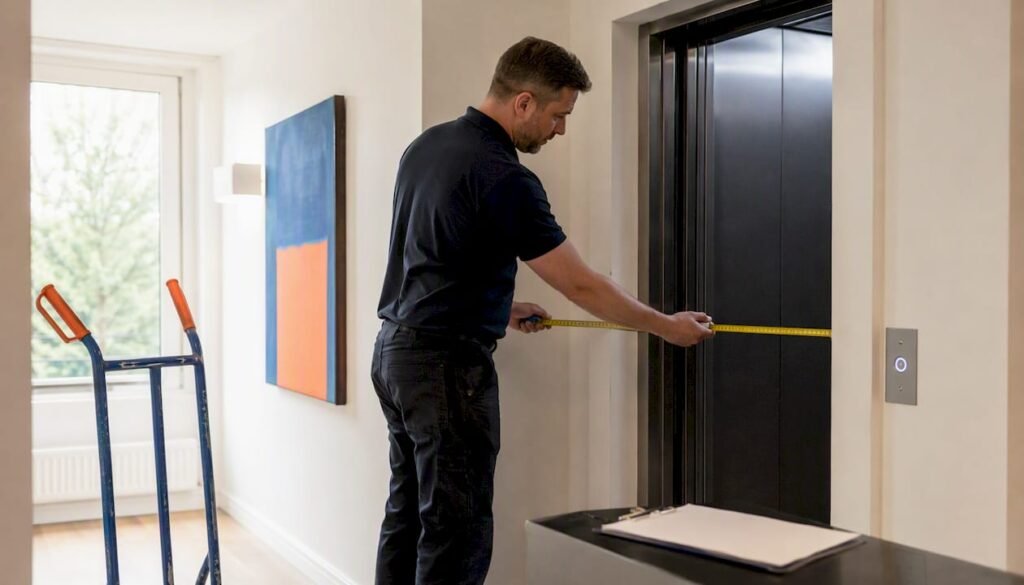
A lift that fits your largest item, can be booked, and sits close to the loading bay will usually speed your move and reduce the risk of damage. If any one of those conditions fails, you may still face stair carries, extra crew, or a hired furniture hoist. The three things to do right now:
- Measure and photograph the lift car, every doorway, and the full route from the van to your front door.
- Check building booking rules and any permit requirements with your building manager or council.
- Send that data to your mover before requesting a quote so the price reflects reality, not assumptions.
Westlondonremoval handles all of this as part of a pre-move survey, including arranging external hoists and building liaison when the internal lift is not suitable.
Key takeaways
Good lift access for moving comes down to three things: the right measurements collected in advance, confirmed building permissions, and a mover who prices the job with that information in hand.
| Point | Details |
|---|---|
| Measure before you quote | Collect lift car dimensions, door clear width, threshold height, and route distance before contacting any mover. |
| Check building rules early | Managed blocks often require 5–10 working days’ notice; parking bay suspensions need 3–4 weeks in London. |
| Send photos and a sketch | A labelled photo set removes ambiguity and prevents on-the-day surprises for both you and your mover. |
| Plan a contingency | If any item exceeds the lift dimensions, arrange hoist hire or disassembly in advance, not on move day. |
| Use Westlondonremoval for complex access | Westlondonremoval conducts pre-move surveys, arranges permits, and coordinates hoist hire across West London. |
Table of Contents
- What does ‘lift access’ actually mean for your move?
- Why a lift does not always solve the access problem
- How to tell whether the building lift is suitable for moving goods
- Exactly what measurements and photos to send your mover
- When is lift access enough, and when does it only help part of the move?
- UK building rules, permissions, and when you need a permit
- Practical alternatives when the lift will not work
- How lift availability changes your moving quote
- How a professional removals service handles limited lift access
- Checklist to give your mover and questions to ask before you book
- Westlondonremoval takes the lift problem off your plate
- A local remover’s perspective on the one thing that goes wrong most often
- Sources
What does ‘lift access’ actually mean for your move?
Most people assume “there is a lift” settles the question. It rarely does. Lift access for moving is a collection of specific, measurable conditions, and every one of them affects how your move is priced and planned.
The concrete factors that determine whether a lift is genuinely usable:
- Internal car dimensions (width, depth, height): your largest item must fit with clearance to manoeuvre.
- Door clear width and height: the opening is almost always narrower than the car interior.
- Threshold depth and sill height: a raised sill can stop a furniture trolley dead.
- Rated weight limit: most passenger lifts in London mansion blocks are rated at 400–630 kg. A double wardrobe, two movers, and a trolley can approach that limit quickly.
- Distance from the loading bay to the lift: a 60-metre corridor carry adds significant time per trip.
- Availability of a separate goods or service lift: some buildings have one; many do not.
- Booking rules and permitted move windows: many managed buildings restrict moves to weekday mornings or require 48–72 hours’ advance notice.
When you send a quote request to a mover, they need all of the above. Without it, any price you receive is an estimate built on guesswork, and the gap between that estimate and the final invoice is where disputes happen. A house moving checklist for West London residents can help you gather this information systematically before you contact anyone.
Why a lift does not always solve the access problem
A lift being present is not the same as lift access being suitable. Access problems are among the most frequent causes of extended moving time in urban moves, and the lift is often at the centre of them.
Common failure modes:
- The lift is too small for the item. A standard passenger lift in a 1970s London block may have an internal depth of only 1.4 m. A king-size mattress is 2.0 m long. It will not go in flat, and tilting it may not be possible if the ceiling is low.
- The door head is lower than the car ceiling. This catches tall wardrobes and headboards that would otherwise fit the car.
- The lift has a weight cut-out. Some older lifts trip the overload sensor at a lower threshold than the rated maximum, particularly when the floor is uneven or the sensor is poorly calibrated.
- The carry from bay to lift is long or obstructed. A loading bay at the rear of a building, a tight 90-degree turn in the corridor, or a set of steps between the car park and the lobby all add time and risk.
- Booking restrictions create bottlenecks. Many managed buildings will refuse or delay a move if the mover cannot present proof of insurance, a booking confirmation, or attempts to use the lift outside agreed hours.
- Only a passenger lift is available. Passenger lifts are not designed for furniture trolleys, and some buildings prohibit their use for removals entirely.
A practical example: a three-bedroom flat on the sixth floor of a Hammersmith mansion block with a 1.5 m x 1.2 m passenger lift and a 40-metre corridor from the service entrance. Every large item either goes up the stairs or requires an external hoist. The lift helps with boxes and small furniture, but the move still takes longer than a comparable ground-floor house.
How to tell whether the building lift is suitable for moving goods
The quickest way to assess a lift is to look at it and ask two questions: was it designed to carry people, or was it designed to carry loads?
Visual signs of a goods or service lift:
- Heavy-duty rubber or steel flooring rather than carpet or decorative tiles.
- Larger car dimensions, typically wider and deeper than a standard passenger lift.
- A separate external loading door or a wider entrance with no decorative surround.
- Control panel labels that include “goods”, “service”, or a separate key-switch for building staff.
- Protective padding or hooks already fitted to the walls.
Signs that a passenger lift is not suitable for removals:
- Mirrored or polished interior walls with no padding provision.
- A rated capacity below 630 kg displayed on the compliance plate inside the car.
- A door clear width below 900 mm.
- A threshold ramp or raised sill that would obstruct a loaded trolley.
Accessibility guidance for lifts notes that compliant lifts should provide level entry where possible, which is relevant here: a raised threshold that meets DDA requirements for ambulant users may still obstruct a furniture trolley carrying 150 kg.
Checklist of minimum checks before move day:
- Photograph the compliance plate showing rated capacity and car dimensions.
- Measure the door clear width and height yourself; do not rely on building plans.
- Check the threshold height and whether a ramp is present.
- Confirm landing clearance: is there enough space on the landing to manoeuvre a large item out of the lift and into the corridor?
- Ask building management whether removals are permitted in the passenger lift, or whether a service lift must be used.
Pro Tip: Ask the concierge or building manager whether any other removal company has used the lift recently and whether there were any problems. This often surfaces restrictions that are not written in the building’s move policy.
Exactly what measurements and photos to send your mover
This is the section to save and use. Send these measurements and photos with every quote request, and your mover can price the job accurately without a site visit.
Measurement checklist
| What to measure | How to measure it | Why it matters |
|---|---|---|
| Lift car internal width | Floor level, widest point | Determines whether items fit across |
| Lift car internal depth | Floor to back wall | Determines length of items that can enter |
| Lift car internal height | Floor to ceiling | Catches tall wardrobes and headboards |
| Door clear width | Between door frames at narrowest point | Often 50–100 mm less than car width |
| Door clear height | Top of frame to floor | Frequently lower than car ceiling |
| Threshold height | Sill lip above floor level | Affects trolley use |
| Corridor width (narrowest point) | At any turn or obstruction | Determines whether long items can be carried |
| Distance from van stopping point to lift | Paced or measured in metres | Directly affects time per trip |
| Stair width (if applicable) | Between handrails | Needed for contingency planning |
Photo list
- Inside the lift car from two angles (facing the door, and from the door looking in).
- The compliance plate showing rated capacity.
- The door frame from outside, showing the full height and width.
- The threshold or sill at floor level.
- The corridor at its narrowest point and at every turn.
- The route from the van stopping point to the building entrance.
- Any steps, ramps, or obstructions between the entrance and the lift.
- A labelled sketch showing the floor plan of the route with your measurements annotated.
Pro Tip: Photograph a tape measure in frame for every measurement shot. It removes any ambiguity and saves a follow-up call from the mover.
For moving heavy appliances in particular, the threshold height and door clear width are the two measurements that most often cause problems on the day.
When is lift access enough, and when does it only help part of the move?
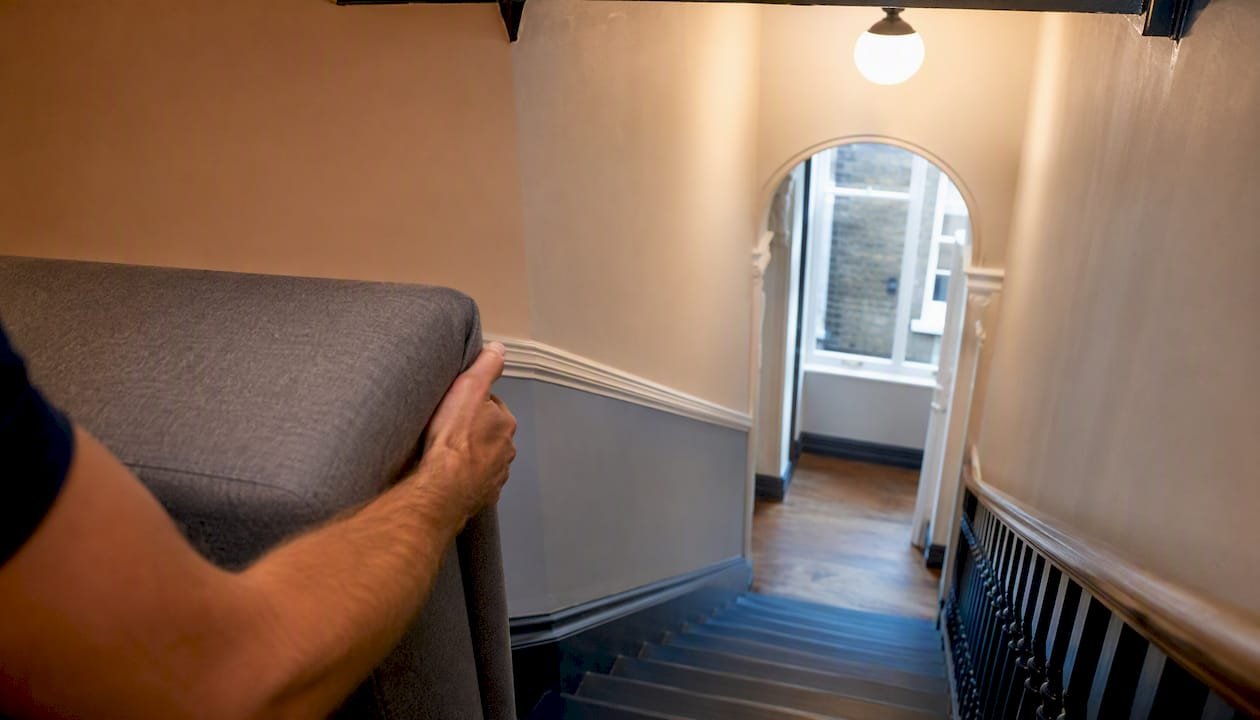
A lift covers the whole job when every item fits the car with room to manoeuvre, the carry distance is short, and the booking is confirmed. That combination is common in purpose-built blocks built after 2000, where building-control accessibility categories such as M4(2) often require a lift to be provided and sized for accessibility.
Fully sufficient scenarios:
- All furniture fits within the lift car dimensions with at least 100 mm clearance on each side.
- The carry from van to lift is under 30 metres with no steps or tight turns.
- A service lift has been booked for the move day with a confirmed time window.
- The weight of the heaviest single load (item plus crew plus trolley) stays within 80% of the rated capacity.
Partial-help scenarios are more common than most people expect. The most frequent causes of extended moving time are waiting for a shared lift, making many small trips because the lift is too small, and long carries between the van and the lift. A double-ended sofa, a large American-style fridge, or a piano will often need a different solution even when the lift handles everything else.
When a lift only helps part of the move, the typical on-the-day responses are:
- Disassembly and reassembly of the oversized item (adds time and a reassembly fee).
- Reorientation of the item to fit diagonally (only works if the car height allows it).
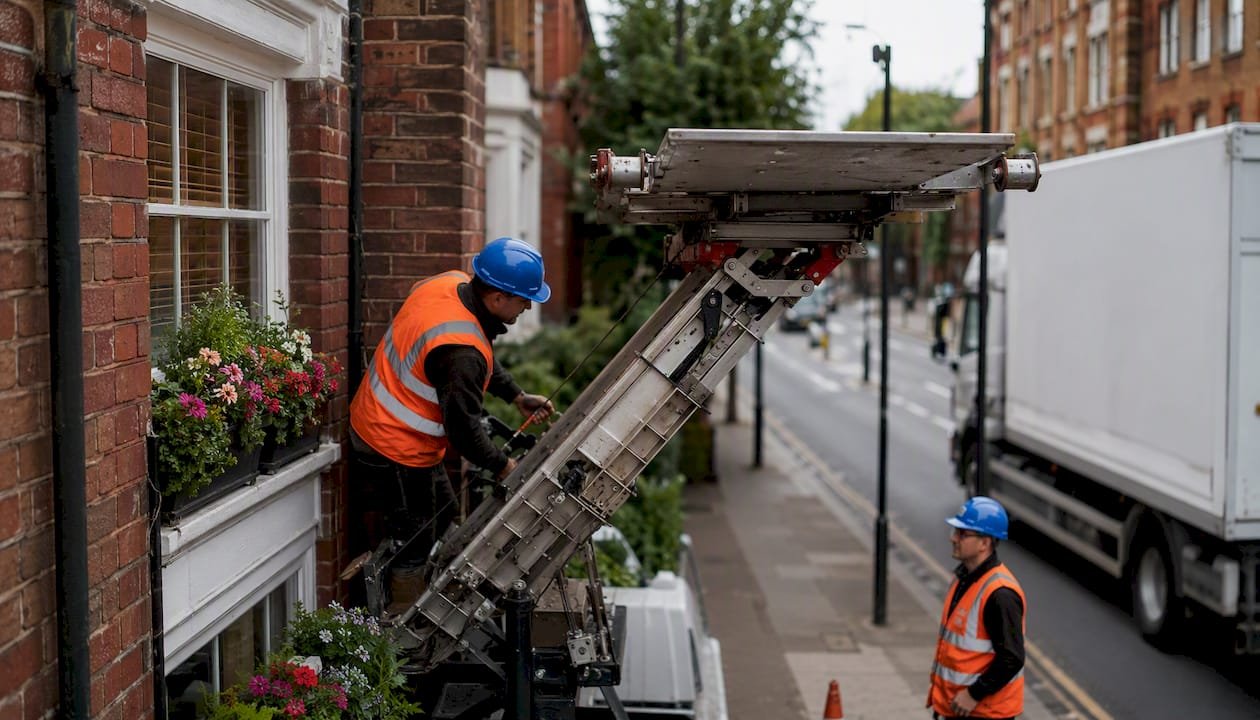
- Partial hoist: the oversized item goes up the external hoist while everything else uses the internal lift.
Each of these adds cost. Disassembly and reassembly is usually charged per item; a partial hoist hire adds a half-day equipment fee on top of the removal quote.
UK building rules, permissions, and when you need a permit
Getting the permissions right is where many moves in London go wrong. The rules are not complicated, but the lead times catch people out.
Permissions that commonly apply:
- Building manager move notice: most managed blocks require written notice of a move, often 5–10 working days in advance.
- Service lift booking: where a goods lift exists, it must usually be reserved with a deposit against damage.
- Lift protection: many buildings require the mover to fit protective pads or boards to the lift interior before use, and some supply these themselves.
- Parking bay suspension: many London boroughs require a parking bay suspension for a removal van, and moves in London typically need several weeks’ notice for such arrangements. Failing to apply in time commonly causes delays and extra costs.
- Public highway permit for an external hoist: if a furniture hoist or ladder lift is placed on a public road or pavement, a permit from the local council is required. Commercial lift-hire operators note that municipal permits are required where a lift is placed on a public road, and permit costs are typically charged separately from the hire package.
Typical lead times:
- Building manager notice: 5–10 working days minimum; some buildings require 4 weeks.
- Parking bay suspension: apply at least 3–4 weeks before move day.
- Public highway permit for a hoist: varies by borough, but 2–3 weeks is a safe minimum.
Insurance and documentation checklist:
- Confirm the removal company holds public liability insurance (minimum £1 million, ideally £2 million or more).
- Ask for a copy of their goods-in-transit insurance certificate.
- Check whether the building requires the mover to name the building management company as an additional insured party.
- Confirm who is liable for lift damage: the removal company’s policy should cover accidental damage to the building.
Pro Tip: A good removal company will handle the parking bay suspension and hoist permit applications on your behalf. Ask at the quote stage whether this is included or charged separately, and confirm the lead time they need from you to start the process.
Practical alternatives when the lift will not work
When the internal lift is unsuitable, there are four realistic options. Each suits a different combination of floor height, item type, and budget.
- External furniture hoist (ladder lift): a vehicle-mounted hoist that extends to the window or balcony. Residential hoists can reach up to approximately 26.5 metres and lift up to around 400 kg, covering most London mansion blocks and purpose-built flats. They are fast and low-risk for large items but require a public highway permit if placed on the road and a suitable window or balcony opening. Setup typically takes 30–45 minutes.
- Trailer lift (vehicle-mounted platform lift): a hydraulic platform on the removal vehicle that raises items to van height. Useful for loading and unloading but does not replace vertical access inside the building.
- Stair carry with extra crew: the reliable fallback. Slower and physically demanding, but requires no equipment or permits. A two-person stair carry on a narrow Victorian staircase adds roughly 30–50% to the time estimate for large items. Published platform lift installed costs range from approximately £11,000 to £30,000 for permanent installations, which puts the cost of a temporary hoist hire in perspective for a one-day move.
- Partial disassembly: removing legs, doors, or panels from large furniture so it fits the existing lift or staircase. Adds reassembly time and requires the right tools and experience. For specialist moves involving pianos or antiques, disassembly is rarely appropriate, and a hoist is almost always the safer choice.
If an item simply cannot be moved economically, furniture disposal options may be worth considering before committing to expensive hoist hire or extra labour.
How lift availability changes your moving quote
Lift access affects the quote in several distinct ways, and understanding each one helps you compare quotes fairly.
Cost drivers linked to lift access:
- Additional manpower for stair carries: each extra crew member adds to the hourly rate.
- External hoist hire: typically charged as a half-day or full-day equipment fee, plus the operator’s time.
- Permit and bay suspension fees: parking bay suspensions and public highway permits carry council fees that vary by borough.
- Wasted time waiting for a shared lift: time spent waiting is billable time on an hourly-rate contract.
- Lift damage deposit: some buildings require a refundable deposit against damage to the lift interior, paid by the mover or the client.
- Disassembly and reassembly fees: usually charged per item or per hour of specialist time.
How quotes are typically adjusted:
A mover pricing a sixth-floor flat with no service lift and a small passenger lift will usually add a floor premium (an extra charge per floor above the ground), increase the crew size, and add a contingency line for hoist hire if any item is flagged as oversized. If you have not provided measurements, that contingency will be priced conservatively, meaning higher.
Red-flag checklist for quotes:
- No mention of floor level or lift suitability in the quote breakdown.
- A flat rate with no contingency for access issues.
- No line item for permits or bay suspension when the move is in a controlled parking zone.
- Vague language about “additional charges on the day” without specifying what triggers them.
A quote that addresses lift dimensions, crew size, and permit arrangements explicitly is almost always more reliable than one that does not.
How a professional removals service handles limited lift access
A professional team does not arrive on move day and discover the sofa does not fit. The work happens beforehand.
Typical steps a professional removal company takes:
- Pre-move survey: either a video call walkthrough or an in-person visit to measure the lift, route, and largest items. This is the single most effective way to prevent on-the-day surprises.
- Measurement review: comparing your item dimensions against the lift car and route measurements to flag any conflicts before the move.
- Permit and booking arrangements: applying for parking bay suspensions, booking the service lift, and arranging any external hoist hire with the required lead times.
- Protective wrapping and boarding: fitting lift pads, floor protection, and corner guards before any item enters the building.
- Staged move planning: sequencing the move so the lift is used efficiently, large items go first, and the crew is not waiting for each other.
The practical benefit of using an insured, experienced team is that decisions get made correctly under pressure. When a wardrobe does not fit the lift on the day, an experienced crew knows immediately whether to tilt, disassemble, or call for the hoist. That decision, made quickly and correctly, is what keeps a move on schedule.
Westlondonremoval carries out pre-move surveys, handles permit applications, and works with trusted hoist operators across West London. For complex access situations, the professional house removals service covers the full process from survey to completion.
Checklist to give your mover and questions to ask before you book
Copy and paste this into your message to any mover
- Internal lift car dimensions: width ___ mm, depth ___ mm, height ___ mm
- Door clear width ___ mm, door clear height ___ mm
- Threshold height ___ mm
- Corridor width at narrowest point ___ mm
- Distance from van stopping point to lift entrance ___ m
- Floor level of the property: ___
- Goods/service lift available: yes / no / unknown
- Lift booking required: yes / no; notice period required: ___ days
- Parking restrictions: controlled zone yes / no; bay suspension arranged: yes / no
- Building requires proof of insurance: yes / no
- Permitted move hours: ___ to ___
- Largest single item: ___ (dimensions if known)
- Photos attached: yes / no
Questions to ask any mover before you book
- Do you carry public liability and goods-in-transit insurance, and can you provide certificates?
- Have you worked in this building or a similar managed block before?
- Will you arrange the parking bay suspension and any hoist permits, or is that my responsibility?
- How do you charge if the move runs over the agreed time because of lift delays or waiting?
- Do you charge extra for disassembly and reassembly if an item does not fit the lift?
- What is your contingency plan if the lift breaks down or is unavailable on move day?
- Is the hoist hire included in your quote, or is it a separate cost?
Red flags to watch for:
- Reluctance to provide insurance certificates before the job.
- No mention of a pre-move survey for a flat above the third floor.
- A quote that does not change when you provide detailed access information.
- Inability to confirm whether they handle permit applications.
Westlondonremoval takes the lift problem off your plate
When lift access is limited, the difference between a smooth move and a stressful one is preparation. Westlondonremoval offers pre-move surveys, arranges external hoist hire, handles parking bay suspensions and building liaison, and sends fully insured crews who know how to make decisions quickly when access is tight.
Whether you are moving into a mansion block in Kensington, a purpose-built flat in Chiswick, or an office in West London, the team assesses the access situation before move day so nothing is left to chance. Over 1,000 clients have trusted Westlondonremoval with exactly these kinds of moves, and transparent hourly pricing means the quote you receive reflects the actual job.
Get a quote for your move at West London Removal house removals, or if you are in Chiswick, book directly via the Chiswick removals page.
A local remover’s perspective on the one thing that goes wrong most often
The most common problem we see is not a lift that is too small. It is a lift that was never booked. A client arrives on move day with a confirmed removal crew, a van parked outside, and a building manager who has no record of the move. The service lift is locked, the passenger lift cannot take the wardrobe, and the building’s move window closes at noon. That situation is entirely preventable, and it costs hours.
The habit that stops it: contact the building manager the moment you have a move date, confirm the booking in writing, and send the confirmation to your mover. Do the same for the parking bay suspension. Use the checklist in this guide, photograph everything, and share it before you request a quote. If you are not sure what to measure or what to ask, contact us for a pre-move survey. We will do it for you.
Sources
The sources below cover the main areas where you may need to verify rules or check technical requirements.
- Moving House in London | A Practical Guide for 2026
- Accessibility & Facilities – London Building Control
- DDA (Equality Act) compliant lifts: what does this mean? – Gartec
- Platform Lifts & Access Lifts for Accessible Buildings – Stannah Lifts
- Movinglift