
A waste transfer note (WTN) is the written record proving that non-hazardous controlled waste passed legally from one party to another, along with a full description of what was moved. If your business produces, carries, or receives waste of any kind, you must complete one for every transfer and keep a copy for the legally required retention period, whether on paper or stored digitally. Both the person handing over the waste and the person taking it away share this duty.
- Never let waste leave your premises without a signed note attached.
- Electronic signatures are legally acceptable, so there’s no excuse to skip this step under time pressure.
Two years. That’s the minimum retention period for a standard WTN under the Duty of Care regulations, and it applies whether you’re a landlord clearing a flat or a facilities manager overseeing a full office strip-out.
Key Takeaways
A valid waste transfer note requires an accurate waste description, correct LoW/EWC code, both parties’ signatures, and two years of retained records to satisfy UK duty of care law.
| Point | Details |
|---|---|
| Definition and duty | A WTN records the legal transfer of non-hazardous waste; both parties must keep a copy for the legally required retention period. |
| Description is critical | Vague terms like “general waste” invalidate a note; specify materials and the correct LoW/EWC code. |
| Season tickets need schedules | An annual WTN only works if the parties, waste, and site stay identical, backed by a logged schedule. |
| Hazardous waste differs | Fluorescent tubes, batteries, and solvents need a consignment note with three-year retention, not a standard WTN. |
| Westlondonremoval builds it in | Insured teams issue signed WTNs or season ticket schedules and store copies digitally on every job. |
Table of Contents
- When you need a waste transfer note explained through real triggers
- What must a valid waste transfer note contain?
- How do season tickets work for repeat waste collections?
- Record keeping, retention periods and who can inspect your files
- Consignment notes versus a waste transfer note explained side by side
- Avoiding the most common WTN mistakes before you sign
- Where to find a template and how a worked example looks
- How removals firms actually handle waste transfers on the ground
- Why the paperwork matters more than most businesses assume
- Let Westlondonremoval handle the paperwork as well as the lifting
- Where to check the official guidance
- Sources
When you need a waste transfer note explained through real triggers
Most businesses assume a WTN is only for skips and industrial bins. In practice, the trigger is simpler: does a business hand waste to another party? If yes, you need one.
- Any collection by a licensed waste carrier — from a single sack of shredded paper to a full commercial bin round.
- Skip hire and exchange — every time a skip company swaps a full skip for an empty one, that’s a transfer requiring documentation.
- Brokered waste deals — where a broker arranges disposal on your behalf, the WTN chain still needs to be intact from producer to final destination.
- Office clearances, shop refits, and house moves involving business tenants — landlords clearing a commercial let must document waste leaving the site.
Households are exempt from producing WTNs for their own domestic rubbish. The moment a business becomes involved, though, the exemption disappears. A landlord using a removals firm to clear a rental property, a shop owner disposing of old fixtures, or a sole trader clearing a workshop: all fall under business duty of care, even if the waste looks identical to household rubbish.
What must a valid waste transfer note contain?
A WTN is only as good as the information written on it. Missing a single mandatory field can invalidate the entire document, and that’s the gap inspectors look for first.
- Waste description, including the correct List of Wastes (LoW) or European Waste Catalogue (EWC) code. This needs to be specific enough that the next holder knows exactly how to handle and dispose of it safely.
- Quantity and units — weight in kilograms or tonnes, or a volume estimate where weighing isn’t practical.
- Container type — skip, wheelie bin, sealed drum, loose load, and so on.
- Date and place of transfer.
- Names and addresses of both the transferor and transferee, plus their waste carrier registration or exemption number where applicable.
- The transferor’s Standard Industrial Classification (SIC) code, which helps classify the type of business and its likely waste streams.
- Signatures from both parties — electronic signatures satisfy this requirement under current NetRegs guidance.
Estimates are acceptable for quantity where you don’t have a weighbridge ticket, but round sensibly and note that it’s an estimate. The field that trips up more businesses than any other is the description. Writing “general waste” or “mixed rubbish” tells an inspector nothing and leaves the next handler guessing.
Pro Tip: Describe waste the way you’d explain it to someone who has never seen your business. “Mixed office waste including cardboard, paper, and non-hazardous packaging” beats “general waste” every time.
How do season tickets work for repeat waste collections?
If the same carrier collects the same type of waste from the same site on a regular basis, you don’t need a fresh WTN every single time. A season ticket covers up to 12 months of transfers, provided the parties, the waste description, and the site all stay unchanged.
- The moment any of those three things change (a new carrier, a different waste type, a second site), the season ticket no longer applies and you need a new one.
- You must still keep a schedule recording every individual collection: date, time, quantity, and site.
- A spreadsheet, your invoicing system, or weighbridge printouts all work as a schedule, so long as it’s consistent and retrievable.
Season tickets get misapplied more often than any other part of the WTN system. Businesses assume the annual ticket covers everything, then can’t produce a schedule when asked.
Record keeping, retention periods and who can inspect your files
Standard WTNs and season tickets must be kept for the legally required retention period from the date of the last transfer they cover. Hazardous waste consignment notes carry a longer requirement: three years, reflecting the higher risk profile of that waste stream.
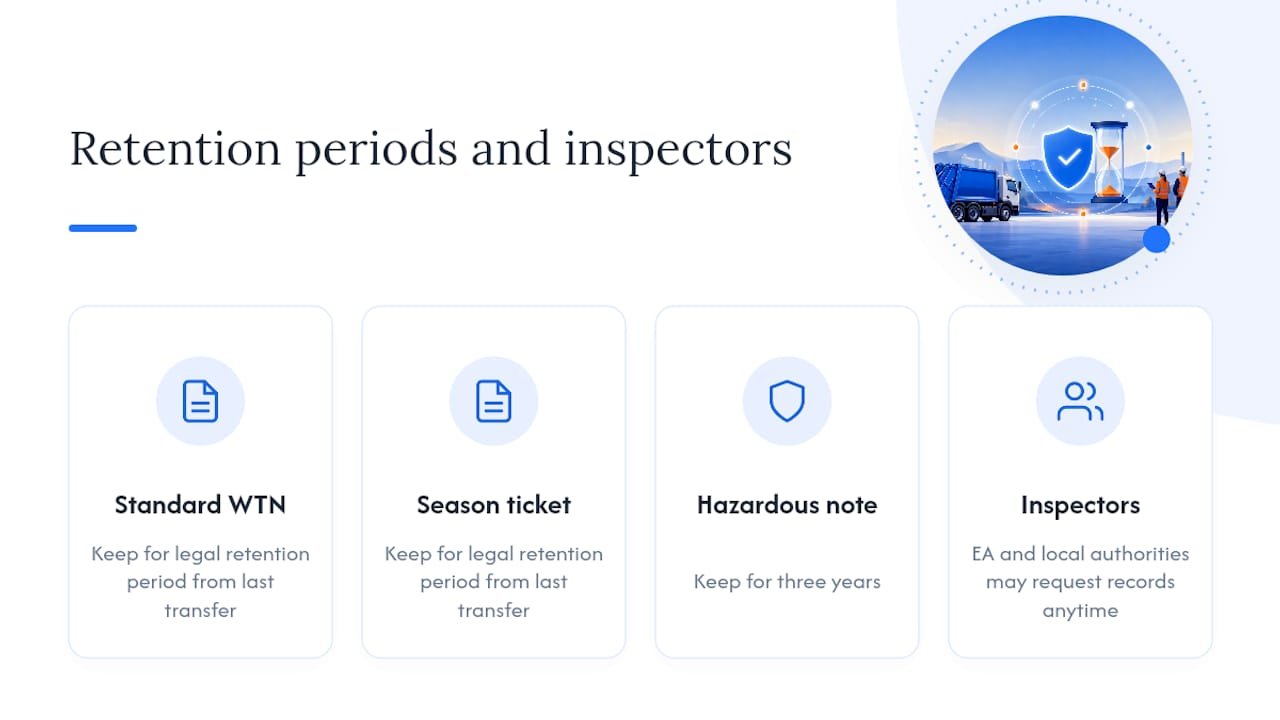
Both the Environment Agency and local authorities have the power to request these records at any time, not just after an incident. Audits are commonly triggered by fly-tipping investigations near a business address, complaints from neighbours, or routine spot checks on waste carriers.
Failing to produce adequate WTNs isn’t a paperwork slip, it’s a breach of duty of care under Section 34 of the Environmental Protection Act 1990, and it’s a criminal offence carrying potential fines. Missing or vague documentation shifts liability back onto the producer, even where the waste ended up being handled correctly.
Consignment notes versus a waste transfer note explained side by side
Hazardous waste doesn’t use a WTN at all. It requires a consignment note, a separate and more detailed document with its own three-year retention period.
- Fluorescent tubes and other lamps containing mercury.
- Batteries, particularly lead-acid and lithium types.
- Solvents, paints, and chemical residues.
- Contaminated soil from building or demolition work.
If you’re not sure whether something counts as hazardous, check its classification before assuming a standard WTN will do. Getting this wrong is one of the most common compliance failures among smaller businesses handling refurbishment or clearance work, and treating hazardous waste as ordinary rubbish invalidates the entire paper trail.
Avoiding the most common WTN mistakes before you sign
Most WTN problems come down to five recurring failures, and every one of them is preventable with a two-minute check before signing.
- Vague descriptions that don’t specify materials or the correct LoW code.
- Missing the EWC/LoW code entirely, even when the description is otherwise fine.
- Unsigned notes — a completed form with no signature isn’t valid.
- Unverified carriers — always check the carrier’s registration on the public Environment Agency register before the waste leaves your site.
- Missing SIC code for the transferring business.
Before signing anything, run through this quick sequence: confirm the carrier is registered, check the description matches what’s actually being collected, verify the quantity is realistic, and make sure both signature fields are filled.
Pro Tip: Name a single person in your business as the WTN owner. When responsibility is shared across a team, records get lost. When one person owns it, digital copies get filed the same day, every time.
Where to find a template and how a worked example looks
GOV.UK provides an official WTN template, but there’s no legal requirement to use that exact form.
- An invoice or delivery note counts as a valid WTN if it includes every mandatory field and both signatures.
- A worked example: “Mixed non-hazardous office waste (EWC 20 03 01), approx. 0.5 tonnes, wheelie bin, collected 14 March 2026 from Unit 4, Business Park, London, by [registered carrier], transferor SIC 82990, signed both parties.”
- Keep whichever format you choose consistent across your business so staff don’t miss fields.
How removals firms actually handle waste transfers on the ground
Every reputable removals company builds waste documentation into its standard workflow rather than treating it as an afterthought. The producer (you, the client) describes what’s being disposed of, the carrier records the collection details, the driver signs on collection, and a digital copy gets stored immediately rather than left in a van.
- Insured removal firms won’t move waste off-site without a completed note, because that document is what protects both parties if anything is later questioned.
- Digital storage means a copy is retrievable within minutes, not buried in a filing cabinet somewhere.
- A professional carrier checking your paperwork before collection is doing you a favour, not creating red tape.
A missing or vague waste transfer note is the single document an inspector will ask for first if fly-tipped waste is traced back to a job. Insisting on proper documentation at collection isn’t bureaucracy, it’s the thing that keeps the liability off the client’s desk months later.
Westlondonremoval has built this into every clearance and man-and-van job across more than 1,000 completed moves, treating the WTN as a standard step rather than an optional extra.
Why the paperwork matters more than most businesses assume
The conventional advice on waste transfer notes treats them as a box-ticking formality, something to sign quickly so the van can leave. That’s backwards. The WTN is the only evidence standing between your business and liability if waste is later found dumped illegally, and inspectors don’t care how busy you were on collection day.

Where most guidance falls short is treating every field as equally important. It isn’t. The waste description carries the most enforcement weight by a distance, and businesses that write “general waste” are taking on risk they don’t need to. Get the description right, verify the carrier’s registration before anything leaves your premises, and the rest of the form falls into place.
If you prioritise one thing from this whole process, make it verification at the point of collection, not filing after the fact. By the time you’re searching for a two-year-old WTN during an audit, the mistake has already happened. Build the check into the moment waste leaves your site, and the record-keeping looks after itself.
— West London removals
Let Westlondonremoval handle the paperwork as well as the lifting
Westlondonremoval documents every waste transfer the same way a compliance officer would want it done, without you having to chase the carrier for a signature afterwards. Whether you’re clearing an office, a rental property, or a house full of furniture nobody wants, our insured teams issue signed WTNs or maintain season ticket schedules for repeat clients, and every copy gets stored digitally the same day.

That means no scrambling for paperwork if the Environment Agency ever asks, and no liability landing back on your desk months later. Our man-and-van and full removal services cover furniture disposal during house moves, office clearances, and everything between tenancies, with transparent hourly pricing and same-day availability across West London.
If you need waste removed properly and documented correctly, book your Chiswick removal and let us handle the transfer note while you focus on the move itself.
Where to check the official guidance
For templates, classification rules, and enforcement details, go straight to the source rather than relying on secondhand summaries.
- Gov
- NetRegs: practical guidance on completing a WTN
- Natural Resources Wales: WTN guidance for devolved administration
- Haulier
Sources
- Gov
- NetRegs — Waste transfer notes and how to complete them
- Natural Resources Wales — Completing waste transfer notes
- GOV.UK — Duty of care: waste transfer note template (PDF)