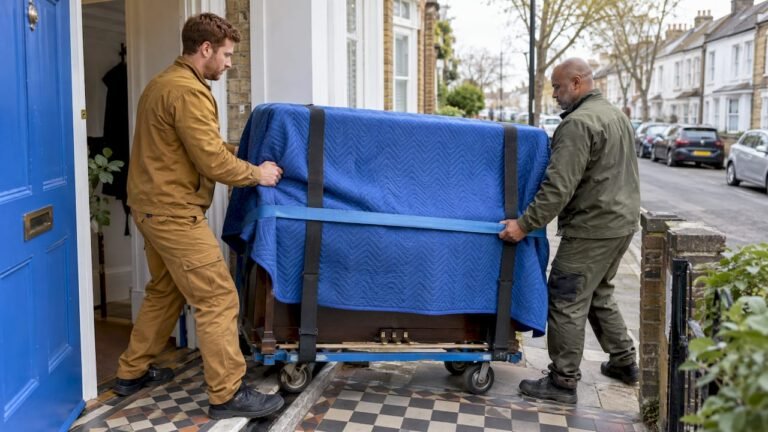
British citizens can move to Ireland without a visa, a work permit or anyone’s permission. The hard part is not the right to live there. It is the sequence: sorting your Irish paperwork, deciding what to take, getting your belongings across the Irish Sea, and clearing them through Irish customs. We run removals from West London, and this guide sets out the whole move in the order you will do it, including the UK to Ireland removals questions people ask us most.
TL;DR
- You do not need a visa or work permit as a British citizen, and you keep your British citizenship even if you later become Irish. Your non-British partner or family members may be in a different position.
- Nothing is registered when you arrive, so get your PPS number (Ireland’s equivalent of a National Insurance number), proof of address and an Irish bank account sorted early.
- Household goods moving from the UK need a customs form (C&E 1076) with a full inventory, emailed to Revenue two weeks before arrival.
- Start removals planning three to six months ahead: itemised quotes, packing, insurance for valuables and a delivery window that matches your keys.
- We handle the UK end: house removals from £65 per hour, packing from £25 per hour, and specialist and long-distance moves.
Table of Contents
- Do you need a visa or permission to move to Ireland?
- What to arrange before and after you move
- Bringing your belongings: the customs paperwork
- Planning your UK to Ireland removals
- Moving a business or a student room
- Our view on moving to Ireland
- Start your move from West London
- FAQ
- Sources
Do you need a visa or permission to move to Ireland?
If you hold a British passport, no. GOV.UK’s guidance on living in Ireland states that British nationals do not need a visa to live, work or study there, and no work permit is required. Ireland also recognises dual UK-Irish citizenship, so you do not have to give up your British nationality.
This works because of the Common Travel Area, an arrangement between the UK and Ireland. The FCDO’s entry requirements page for Ireland confirms that British citizens can visit and remain indefinitely, and that Ireland is not part of the Schengen area, so Schengen rules do not apply to you.
If you are moving with a partner or family member who is not British
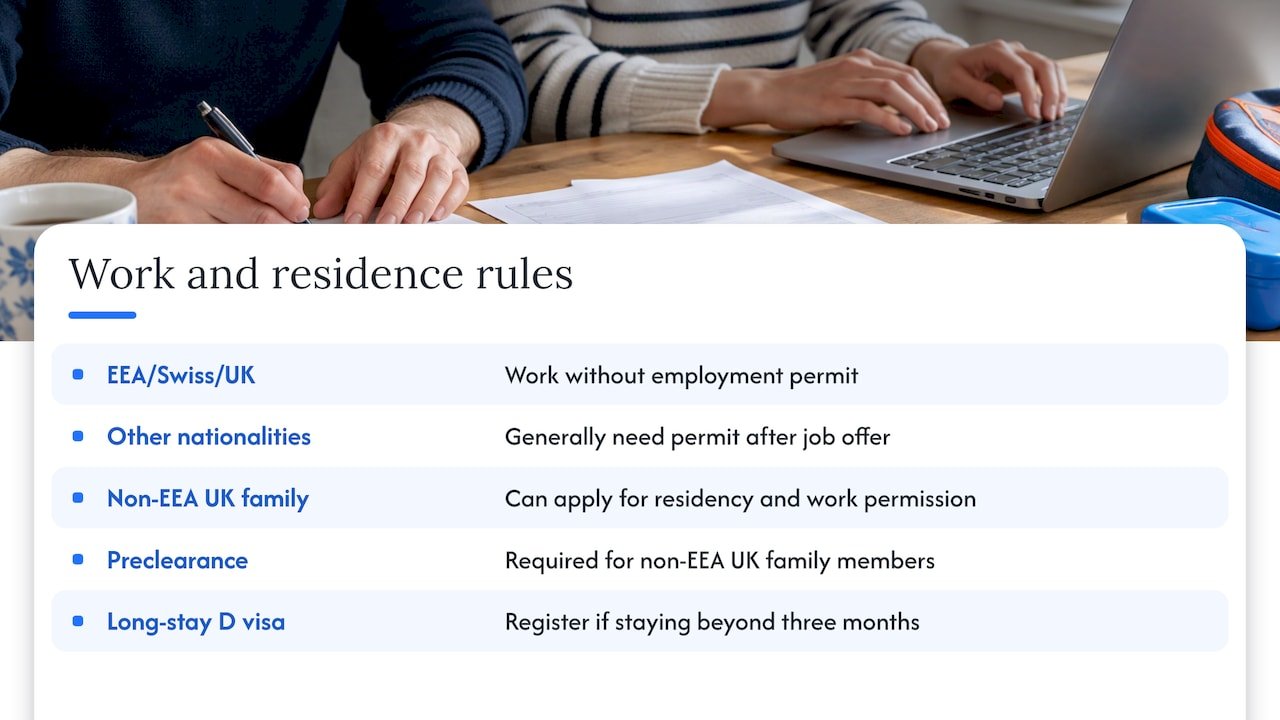
This is where plans go wrong. Citizens Information, Ireland’s public information service, explains that people from the EEA, Switzerland and the UK can work without an employment permit, while other nationalities generally need one, applied for after a job offer. Non-EEA family members of UK citizens who move after 1 January 2021 can apply for residency and permission to work. A UK visa, indefinite leave to remain or settled status does not carry over to Ireland, as Irish immigration solicitors KOD Lyons point out.
The visa requirements page adds that non-EEA family members of UK citizens must apply for preclearance, and that anyone on a long-stay D visa staying beyond three months must register for an Irish Residence Permit. If this applies to you, settle it with the Irish immigration authorities before you book a removal date, because your travel date depends on it.
What to arrange before and after you move
Because you register nothing on arrival, it is easy to land with no paperwork trail. The sttld guide notes that there are no routine passport controls between the UK and Ireland, but airlines and ferry operators ask for ID and an immigration officer can ask for proof of citizenship. Carry your passport. It also warns that banks, employers and the HSE (Ireland’s health service) may later ask for a PPS number or proof of address.
PTSB’s moving checklist splits the move into three phases, which we have adapted here.
| When | What to do |
|---|---|
| About a month before | Check visa needs for anyone not British, learn the Irish tax system, review healthcare options, check your driving licence, gather key documents, research schools and pet rules |
| About a week before | Copy your documents, prepare work or university paperwork, check PPS number requirements, notify UK organisations, confirm accommodation and proof of address |
| On arrival | Apply for a PPS number, register with Revenue if you are working, open an Irish bank account |
For the UK side, our change of address checklist lists who to tell, and our house moving checklist covers the practical run-up.
Housing: rent first if you can
Experts for Expats recommends renting first for flexibility, since Irish mortgage lenders apply strict affordability checks and larger deposits than the UK. It also advises spending at least a week in your preferred area before committing, because costs vary widely: Dublin and Cork are considerably more expensive than Limerick, Galway or Waterford. Keep a financial buffer, as finding a home often takes longer than planned.
Healthcare, tax and driving
A few points are worth knowing before you go. All are drawn from Citizens Information’s page on moving to Ireland from the UK:
- Healthcare: public healthcare is free or reduced-cost if you are ordinarily resident, meaning you live in Ireland or intend to for at least a year. GP visits generally carry a fee unless you hold a medical card or GP visit card. Your UK GHIC card only covers temporary visits, so many new arrivals consider private health insurance.
- PPS number: if you have never had one, you must be in Ireland to apply for it. It helps you access benefits and public services.
- Driving licence: a UK licence can be used as a visitor for up to 12 months, but must be exchanged once you are resident. English, Welsh and Scottish licences need a DVLA check code.
- Tax: the UK-Ireland double taxation agreement means you do not pay tax on the same income in both countries. On the UK side, Experts for Expats advises telling HMRC you are leaving, typically using form P85, and checking whether you qualify for split-year treatment if you arrive mid-year.
If you are working, Relocate in Europe advises registering your job with Revenue before your first payday, because pay without a PPS number can be taxed at the emergency rate.
Bringing your belongings: the customs paperwork
Great Britain is outside the EU, so moving your household goods to Ireland is a customs matter, not just a transport one. This surprises many people who assume the Common Travel Area covers their furniture. It covers people, not goods.
Irish Revenue’s guidance on permanent relief from import charges sets out the rules. In summary:
- Complete form C&E 1076 (Rev 2) with a full inventory of what you are bringing.
- Email it to the relevant port’s Revenue address two weeks before the goods arrive, with evidence of your residence abroad, your transfer of residence, and your ownership and use of the goods.
- To qualify for relief, the goods must have been owned and used for at least six months, and you must have lived outside the EU for at least 12 continuous months.
- The goods must arrive between six months before and 12 months after you move.
- You must not hire out, lend, sell or otherwise dispose of the goods for 12 months.
- Alcohol, tobacco, commercial means of transport and articles for use in a trade or profession are excluded.
A customs agent’s guide from October 2026 adds that a late or incomplete submission can mean goods are held at the port or released only after you pay duty on deposit. That is a costly surprise on moving day.
What this means for your inventory
Write the inventory as you pack, room by room, with each item’s description and when you bought it. A vague line such as “kitchen items” invites questions. Boxes that are labelled and numbered against your list make the paperwork match the load. This is one reason we pack to a list: our packing service starts from £25 per hour, and a packed and listed move is far easier to document than one boxed in a rush.
Planning your UK to Ireland removals
For most people this is the biggest decision after the housing. Start three to six months ahead, as Experts for Expats suggests, and work through these steps.
1. Decide what is worth moving
Crossing the Irish Sea costs more than a local move, and every item goes on the customs inventory. Sell, donate or dispose of anything you would not pay to replace. Our guide to furniture disposal options covers the choices, and we also offer debris disposal for what is left. Many people also move belongings in two stages, an early load of non-essentials and a final load of daily items. Our guide to moving belongings in stages explains how to split them.
2. Choose the right type of move
The size of your move decides the vehicle. A one-bedroom flat or a student room may suit a van. A family home needs a full crew and a larger lorry. Our comparison of man and van versus a full removal company sets out the difference. For a full house move we charge from £65 per hour, and for a specialist item such as a piano or antiques, special moves also start from £65 per hour. We also do long-distance and European moves.
3. Get an itemised quote
Ask every provider the same questions: how the price is built (hourly or fixed), what the crew does at each end, what is included in packing materials, and what happens if the ferry is delayed. Experts for Expats recommends itemised quotes, and our guide to choosing a removal company lists what to check. Our pricing is transparent, with no hidden fees, so the figure you are quoted is the figure you plan around.
4. Pack for a long journey
Your boxes will be loaded, driven to a port, shipped and unloaded again. Use strong boxes, fill the gaps, and wrap breakables well. Our guide to packing fragile items shows how. If time is short, we can pack for you.
5. Insure what matters
Experts for Expats advises confirming insurance for high-value items before the move. Our guide to moving insurance costs explains what to budget. Our team is professional and fully insured. Ask for the cover details in writing before you sign, and list your most valuable items.
6. Match delivery to your keys
There is no point arriving with a lorry and no front door key. Confirm your tenancy or completion date, and your proof of address, before you fix the delivery. If you are between homes, our guide to furniture removal between tenancies will help you plan the gap.
Do not forget your own journey
You will probably make several trips before the move: viewing, collecting documents, closing accounts. If you live in London, comparing transport costs for Oyster and contactless payment can trim the cost of those trips. Budget for currency too. Experts for Expats advises treating the move from pounds to euros as a planning item, since converting a large sum just before you leave exposes you to exchange-rate swings. Staged transfers or forward contracts can steady the budget.
Moving a business or a student room
The same rules apply to a business, with one catch: Revenue excludes articles for use in a trade or profession from the personal relief, so company equipment is treated differently from your own household goods. Check this early with a customs adviser, and plan the Irish side separately. For the UK side of an office move, our office relocation service starts from £75 per hour.
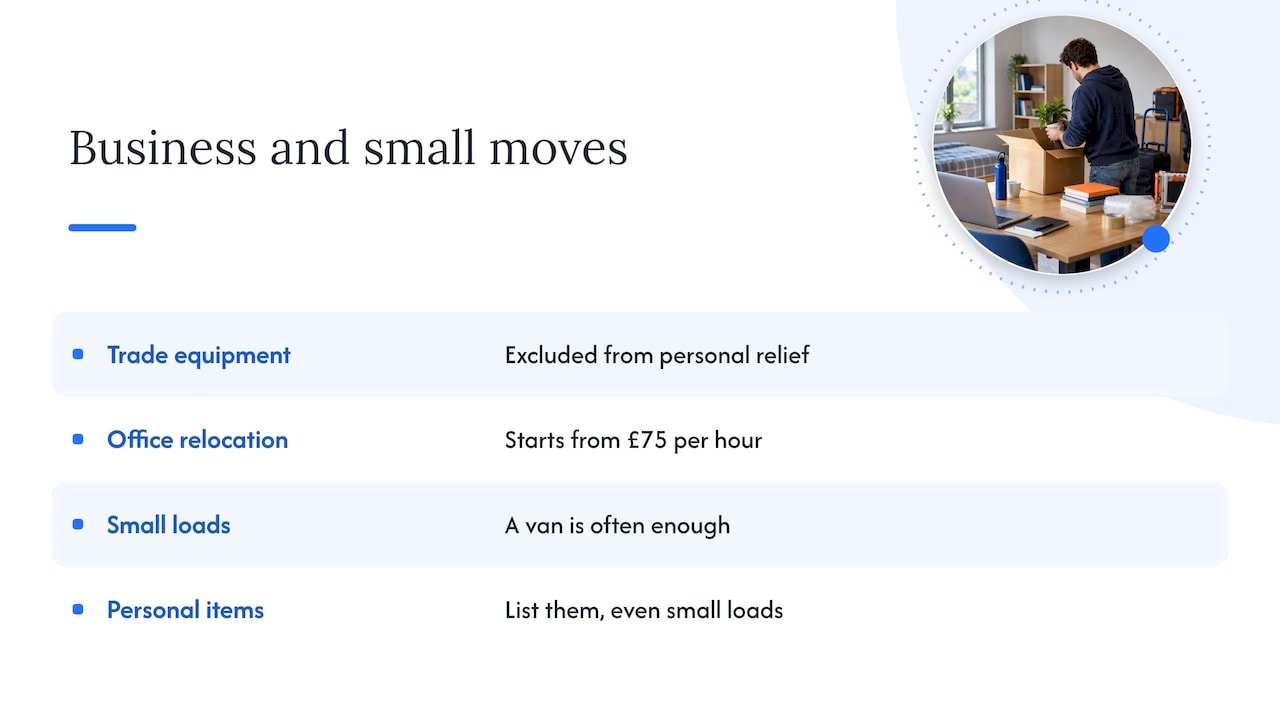
Students and anyone with a small load will often find a van enough. We offer man and van services too. Remember that even a small load of personal items should be listed, so you can answer questions at the port.
Our view on moving to Ireland
Most people we speak to worry about the wrong thing. They think the difficult part of moving to Ireland is permission to live there. For British citizens it is not. The difficult part is the order of events: who is told, when the goods are listed, when the lorry is booked, and whether the keys will be ready when it arrives.
We build every move around that order. We quote transparently by the hour, with no hidden fees. Our crews are experienced and fully insured. We can pack to a written list, which gives you the inventory your customs form needs. And with same-day availability for local jobs, a last-minute gap in your plan, such as a final load or a clearance, does not have to become a crisis.
Our advice is simple. Decide what comes with you, get the packing done properly, and give yourself weeks, not days. A calm, planned move costs less in stress, and usually in money too.
West London removals
Start your move from West London
If you live in West London, we can take care of the UK end of your move. That means packing, loading and the heavy lifting for house removals from £65 per hour, with packing from £25 per hour and a fully insured team. Tell us your date and the size of your home, and we will give you a clear quote.

See our house removals service, or get in touch through our site to plan your move.
FAQ
Do I need a visa to move to Ireland as a British citizen?
No. British nationals can live, work and study in Ireland without a visa or work permit, and you keep your British citizenship. Non-British family members may need to apply for their own permission, so check their position before you set a date.
Do I have to pay customs duty on my furniture?
Not if you qualify for transfer of residence relief. You need to submit form C&E 1076 with an inventory and evidence by email two weeks before arrival. The goods must have been owned and used for at least six months, and you must keep them for 12 months after import.
When should I start planning my removal?
Three to six months ahead is sensible. That gives you time to sort housing, compare itemised quotes, arrange insurance for valuable items and prepare the customs paperwork, which has a two-week deadline before arrival.
Can I keep driving on my UK licence?
Only for a while. Citizens Information says a UK licence can be used as a visitor for up to 12 months, but it must be exchanged once you are resident in Ireland.
Is healthcare in Ireland the same as the NHS?
No. Public healthcare is available to people who are ordinarily resident, but GP visits generally carry a fee unless you hold a medical card or GP visit card. Your GHIC card only covers temporary visits.
Sources
- Living in Ireland – GOV.UK
- Entry requirements – Ireland travel advice – GOV.UK
- Coming to work in Ireland – Citizens Information
- Visa requirements for entering Ireland – Citizens Information
- Returning to Ireland from the United Kingdom – Citizens Information
- Permanent relief from payment of import charges – Irish Revenue
- Moving to Ireland checklist – PTSB
- Moving to Ireland from the UK or EU – sttld
- Moving to Ireland from the UK: your essential relocation checklist – Experts for Expats
- Moving to Ireland from the UK: CTA, Family and Citizenship – KOD Lyons
- Transfer of Residence Ireland: C&E 1076 – C&L Declarations
- Moving to Ireland guide – Relocate in Europe
- Oyster vs contactless in London