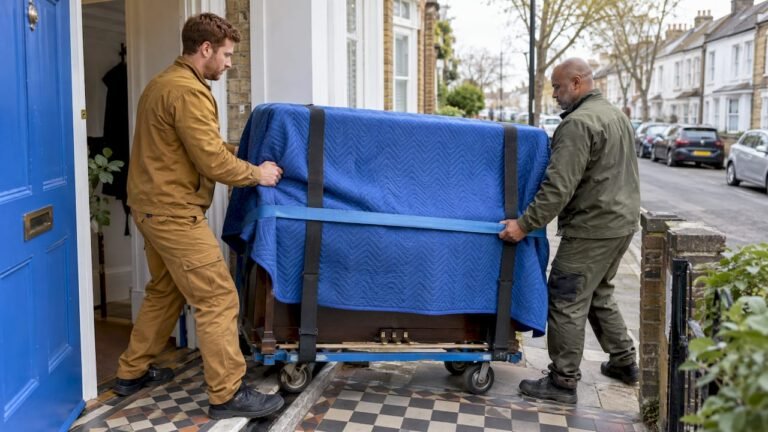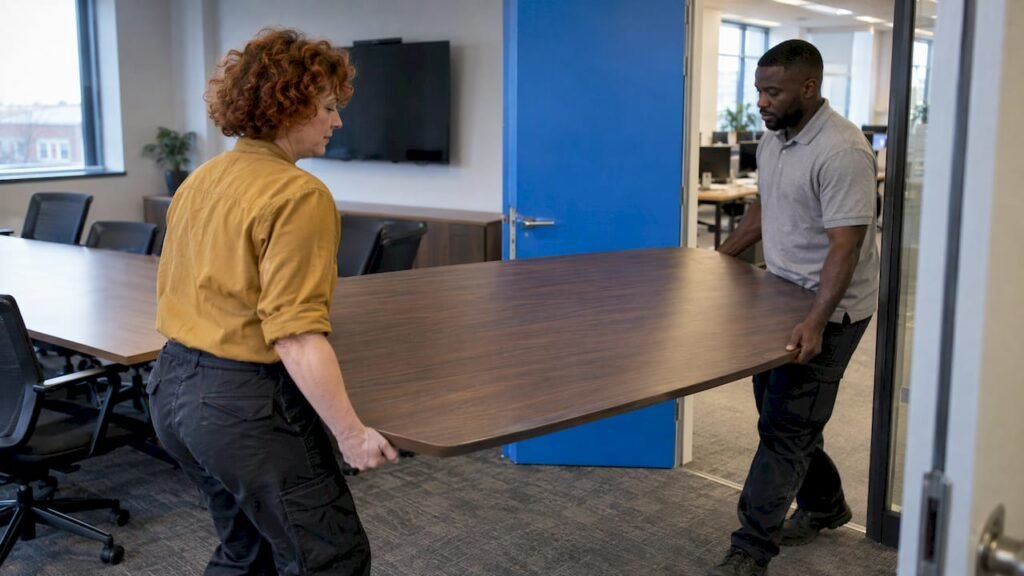
Office furniture movers do more than carry desks down the stairs. A good team plans the order of the move, protects the building at both ends, keeps every item insured in transit and has your workstations ready for staff on the first morning. That is the job we do for West London businesses: our office relocation service starts from £75 per hour, with transparent pricing, a fully insured team and same-day availability when a move cannot wait.
This guide is for office managers, business owners, landlords and shop owners who need furniture moved properly. It covers what the service includes, what changes the price, which insurance matters and how to plan the day.
TL;DR
- Office furniture movers handle lifting, wrapping, loading, transport, unloading and placing furniture to your floor plan. Packing and specialist items can be added.
- Compare quotes on scope, not on the headline figure: packing, parking, stairs and access can be included by one company and charged separately by another.
- Ask for public liability, employer’s liability and goods-in-transit insurance, and check that the cover includes damage to both buildings.
- Give every company the same inventory and access details, so the prices you receive can be compared fairly.
- Our office relocation work starts from £75 per hour and packing from £25 per hour, with same-day availability for urgent moves.
Table of Contents
- What an office furniture removal service includes
- Who needs office furniture movers
- How to choose between a full team and a man and van
- What affects the price of an office furniture move
- Insurance: what an office mover should hold
- Checklist for choosing an office furniture moving company
- Planning the move so furniture lands in the right place
- Old furniture: clearing it responsibly
- Booking us for your office furniture move
- Our view on office furniture moves
- FAQ
- Sources
What an office furniture removal service includes
The core of the service is moving furniture safely from one location to another. In practice that covers desks, chairs, meeting tables, filing cabinets, storage units, reception furniture and shelving. The work usually breaks into five stages:
- Survey and plan. The mover looks at what is going, how it will leave the building and where it will go at the other end.
- Protection. Furniture is wrapped and floors, lifts and door frames are protected so that neither the old nor the new premises are marked.
- Loading and transport. Items are loaded in a sensible order, so that what you need first comes off the van last.
- Unloading and placing. Furniture goes to the right floor and the right desk position, rather than into a pile in reception.
- Clear-up. Packing materials and unwanted items are removed so that the space is usable.
A good mover also asks about what is not obvious: stairs, narrow corridors, lift booking times, loading bay rules and parking restrictions. In London these details often decide how long a move takes.
If you want to see how the furniture move fits into the wider job, our guide to what office relocation involves walks through it from the first survey to the last box.
Furniture only, or the whole office?
Some businesses only need desks and chairs moved to a new floor or a new unit. Others are moving IT, files, personal items and furniture together. The British Association of Removers’ commercial moving good-practice guide describes a plan that sets out timings for sorting files, fitting out the new areas, staff packing their personal items, the uplift from the old premises and delivery and set-up at each new location. Even a furniture-only move benefits from the same discipline: one written schedule that everyone on both sites can see.
Who needs office furniture movers
The reader who searches this phrase is rarely one type of customer. These are the common cases we see in the brief for West London:
- Businesses moving premises. A full office relocation, where furniture is one part of a bigger project. Our commercial removals guide covers how this works for West London firms.
- Small businesses and start-ups. A few desks, chairs and a printer, moving from a serviced office to a unit. Our small business relocation checklist helps with the order of tasks.
- Landlords and estate agents. Furniture needs to be moved in or out between tenancies, or cleared from an empty unit. Our page on furniture removal from an empty property explains the process.
- Shops and showrooms. Delivery of furniture, appliances or stock to customers or between sites, where a man and van is often the right size of job.
- Students and tenants. Anyone moving a desk and a few pieces between rooms or flats, for whom a small van is enough.
How to choose between a full team and a man and van
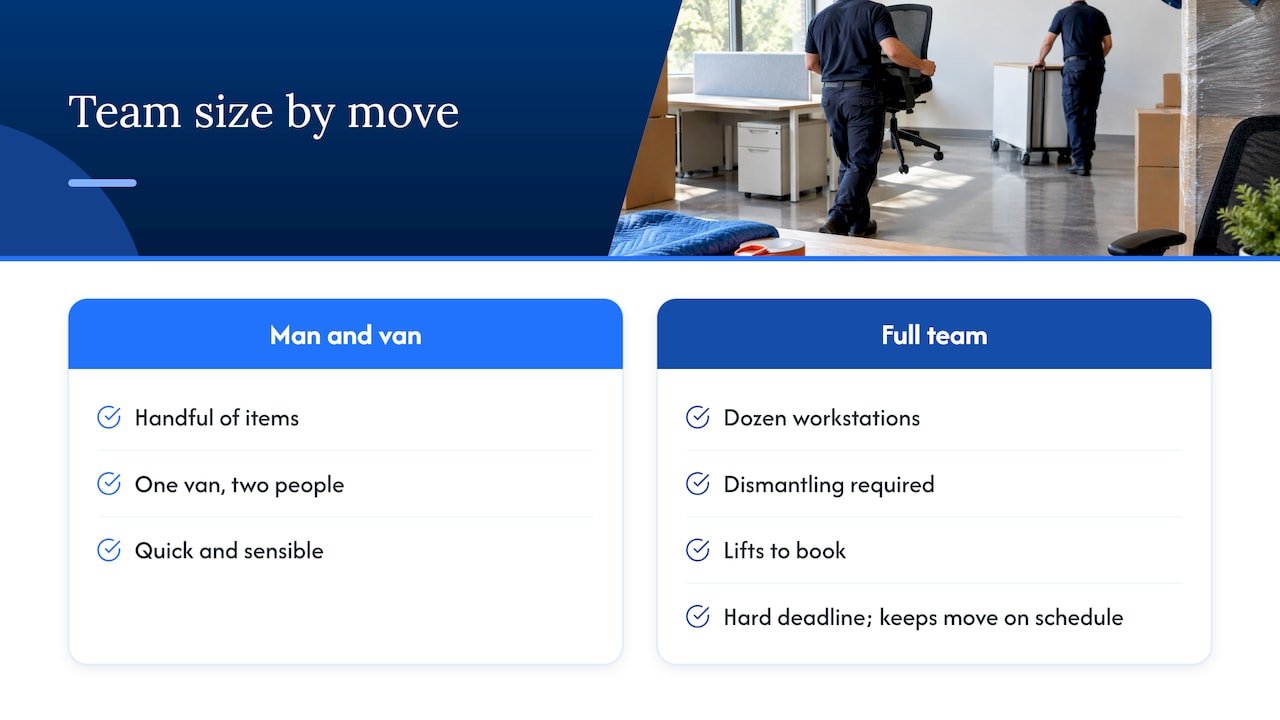
The right size of service depends on the volume and the access, not just the budget. For a handful of items, a single van and two people can be quick and sensible. When you have a dozen workstations, items that need dismantling, lifts to book or a hard deadline, a full removal team keeps the move on schedule.
Our man and van vs removal company guide sets out the difference in detail, and our man and van service covers the smaller jobs. If you are unsure which fits, describe the inventory and the buildings, and we will tell you which one it needs.
What affects the price of an office furniture move
Office removals are usually priced in one of two ways: by the hour for a team and vehicle, or as a fixed quote after a survey. Our work is charged by the hour, which keeps the pricing easy to follow. Our current published rates, read from our site in November 2026, are:
| Service | Published rate |
|---|---|
| Office relocation | from £75 per hour |
| House removals | from £65 per hour |
| Special moves (pianos, antiques) | from £65 per hour |
| Packing services | from £25 per hour |
The factors that move the total are the same for any mover:
- Volume. The number of desks, chairs and cabinets, and how many trips or vehicles that needs.
- Access. Stairs, a lift or no lift, distance from the van to the door, and parking or loading restrictions.
- Dismantling and reassembly. Large desks and workstations take longer than loose chairs.
- Packing. Whether staff pack their own items or the mover does it.
- Timing. Evening or weekend moves keep the office closed for less time, and they need planning.
- Distance. A move within West London is a different job from a long-distance move.
For a wider look at budgets, see our guides to office relocation costs in London and removal hourly rates.
Comparing quotes properly
The Association of International Movers warns in its consumer guide that quotations can look alike yet cover different work: one company may include packing materials, dismantling or parking, while another prices them separately. It adds that the lowest figure is not automatically the lowest final cost, and it suggests checking whether the document is a quotation or an estimate.
The same guide argues that the useful comparison is service against service and assumption against assumption, and that an incomplete survey produces an incomplete price. In practice, that gives you a simple routine:
- Write one inventory: item types, quantities and anything oversized.
- Note access at both buildings: floors, lifts, parking, loading times.
- Give the same list to every company you ask.
- Line the quotes up on what each includes and excludes.
- Check the insurance, the payment terms and how long the price is valid.
A clear hourly rate helps here, because you can see what you are paying for and how the time is likely to be used.
Insurance: what an office mover should hold
Insurance is the part of the quote that people skip and later wish they had read. The British Association of Removers says that for commercial moves it is essential for the mover to hold public liability, employer’s liability and goods-in-transit and storage insurance, so every stage of the move is covered. It also suggests checking whether a particular move needs extra cover.
In plain terms:
- Goods-in-transit covers your furniture while it is being loaded, driven and unloaded.
- Public liability covers injury to third parties, for example a visitor or a passer-by.
- Employer’s liability covers the mover’s own staff working on your premises.
The BAR commercial moving guide goes further. It says cover should include company property being moved, damage the contractor causes to premises at every location, employees’ personal effects (unless a corporate policy excludes them) and injury to third parties. It also says to look out for policies that exclude unattended property or unexplained disappearance, and to be careful with what some contractors call “liability cover”, where the contractor takes responsibility under their own insurance, which is not insurance for you. The guide recommends placing insurance responsibility with the mover, which gives you one place to go if something is damaged, and that anything high-value or irreplaceable left uninsured should be accepted in writing by a senior officer.
For a deeper explanation, read our guide to removal company insurance and our piece on moving insurance costs. Our team is fully insured, and you can ask us for the details of cover before you book.
Checklist for choosing an office furniture moving company
BAR’s guidance on choosing an office mover points to a few things worth confirming: whether the company holds the British Standard BS 8522 for removals, whether it has relevant experience and references, whether it can meet your dates, whether it holds the insurances above, and whether it offers a dedicated move manager and packing and unpacking services (see the BAR guidance).
Add the practical questions:
- Can they start on short notice if your dates slip? We offer same-day availability.
- Is the price clear on parking, stairs, dismantling and materials?
- Will the same team do the move that did the survey?
- Who deals with the building manager, lift booking and access passes?
- What happens to packing waste and old furniture afterwards?
Our guide on why businesses need specialist movers for office relocations explains why this extra care pays back on the day.
Planning the move so furniture lands in the right place
Most problems on moving day are planning problems. These steps keep the day calm:
- Decide what is going. Moving furniture you no longer use costs hourly time. Sort first.
- Measure the new space. Check that desks, cabinets and meeting tables fit the doors, corridors and lifts as well as the floor plan.
- Label by destination. Give each item a zone or desk number that matches a floor plan, so movers place it without asking.
- Brief staff. People should clear their desks and pack personal items before the team arrives, as the BAR guide’s timeline suggests.
- Book the buildings. Lifts, loading bays and parking permits often need booking in advance.
- Check your lease. Look at the notice period, reinstatement duties and any condition schedule at the old premises before you set the move date.
If you are redesigning the layout rather than copying the old one, thinking about office amenity space design before the move helps you decide which furniture to take and which to replace.
Packing the small items
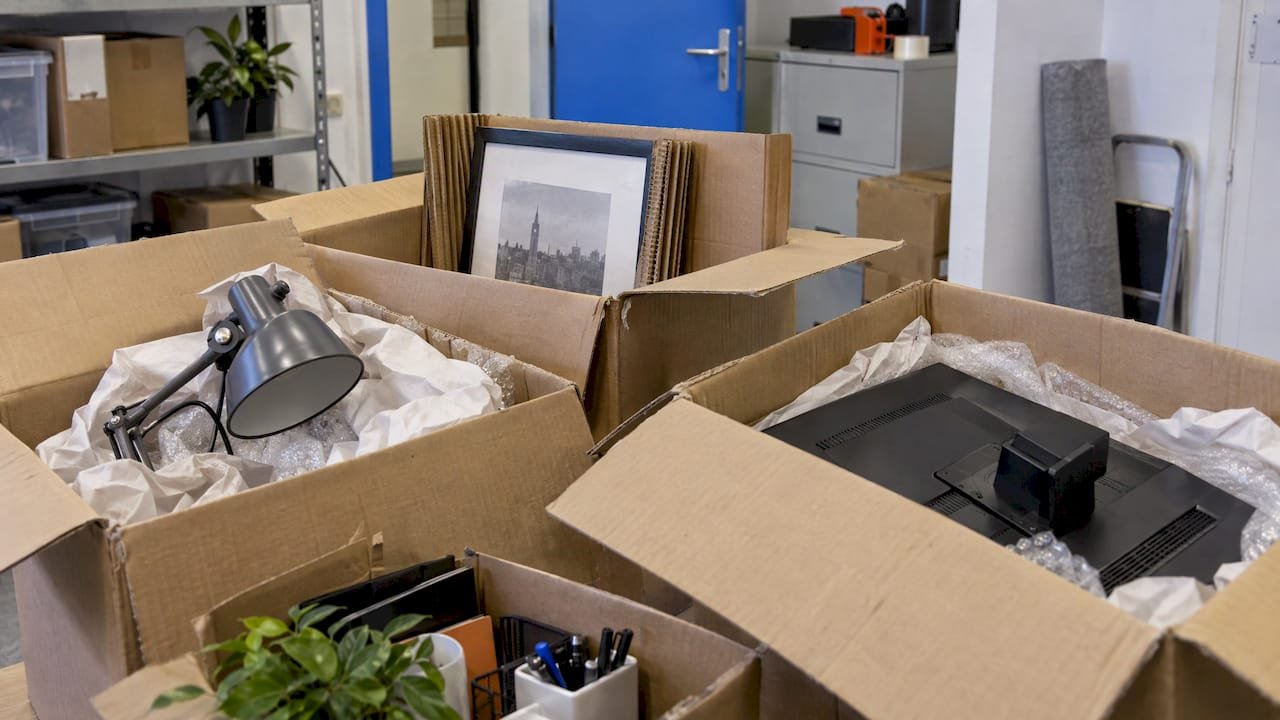
Desks and chairs are the obvious load, but the move often goes wrong with monitors, stationery, framed prints and lamps. Packing is charged separately from the move, and our packing services start from £25 per hour. You can read what to expect in our guide on what a packing service includes, and our fragile items packing guide covers the delicate pieces.
Old furniture: clearing it responsibly
A move is when old desks, broken chairs and dead filing cabinets finally leave. Under the UK’s waste duty of care code of practice, a business that hands waste to someone else must make sure that person is authorised to take it, agree and sign a written description of the waste and keep records. Failing to comply is a criminal offence. The code also says you can check a carrier’s registration on the Environment Agency’s public register in England.
That applies to office clear-outs. Our debris disposal service takes unwanted items away as part of the job, and our guide to a licensed waste carrier check shows what to look at, while furniture disposal options covers what happens to the items afterwards.
Booking us for your office furniture move
We are a West London removal company with more than 1,000 satisfied clients, and we handle house removals, office relocations, man and van jobs, packing and specialist moves. For office furniture, our office relocation service is the one to start with. It runs on transparent hourly pricing from £75 per hour, with an insured, professional team and same-day availability.

Tell us what is moving, how many floors are involved and when you need it done. If your move includes a piano or antique pieces, our special moves start from £65 per hour. If you are based in Hammersmith and Fulham or Kensington and Chelsea, we cover those boroughs too. Get your quote when you have your inventory ready.
Our view on office furniture moves
Furniture is the part of an office move that everyone sees. If a desk arrives scratched or a cabinet is on the wrong floor, the whole move feels like it went badly, however well the rest was handled.
That is why we think of an office furniture move as a job with a plan, not a van with two people. We want to know the buildings, the access and the order things will be needed on the first morning. Then the hours we charge go on moving, not on searching for a lift key.
We price by the hour, openly, because it lets you see what the job involves. We are fully insured and our team is professional, so you are not worrying about damage or paperwork while you run your business. And when a date changes, we offer same-day availability so one delay does not become a week of lost work.
If you take one thing from this guide, make it this: ask every mover for the same scope in writing, and choose the team that can explain each line of it.
West London removals
FAQ
How much do office furniture movers cost in London?
It depends on volume, access and the time the job takes. Our office relocation service starts from £75 per hour, and packing starts from £25 per hour. For any quote, check what is included, such as packing, parking and dismantling, so you can compare like with like.
Do office furniture movers dismantle and reassemble desks?
Many do, and it is worth confirming in writing, because it changes the time and the price. Tell us which desks, workstations and storage units are large or fixed, and we will plan the hours around them. Mention it when you describe the inventory.
What insurance should an office furniture mover have?
The British Association of Removers names public liability, employer’s liability and goods-in-transit and storage insurance as essential for commercial moves. Ask that it covers damage to both buildings as well as your furniture. We are fully insured and can answer questions about cover before you book.
Can you move office furniture at short notice?
Yes. We offer same-day availability across West London, subject to the job. Call with your inventory and access details, and we will confirm what we can do.
Can the movers take away old office furniture?
Yes, our debris disposal service can clear unwanted items. For a business, waste must go with an authorised carrier and be documented, as the government’s duty of care code explains, so keep the paperwork we give you.
Sources
- The Key to a Successful Office Move, BAR Commercial Moving Group good-practice guide
- AIM Consumer Guide: How to Understand and Compare Removal Quotes
- British Association of Removers: Office Movers, use a CMG member
- GOV.UK: Waste duty of care code of practice