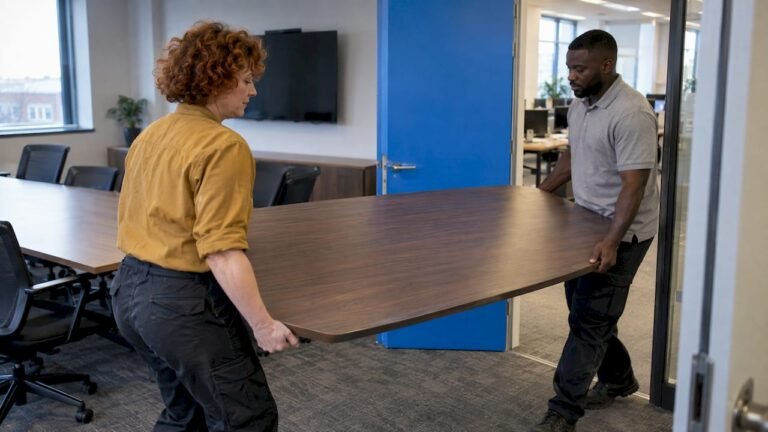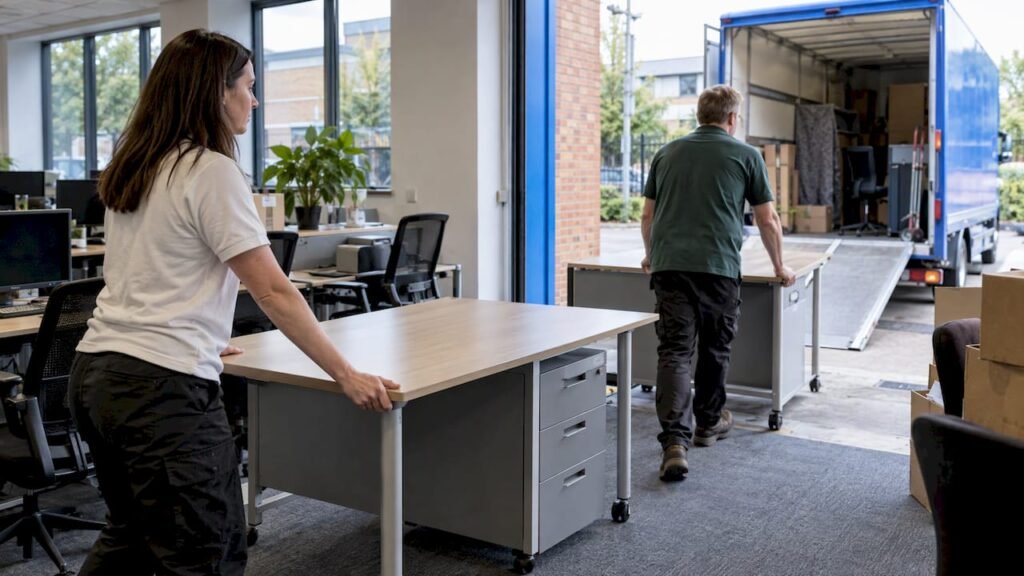
Commercial removals are moves of a business’s premises, furniture, equipment and stock, from a two-desk office to a shop, clinic or workshop. The aim is to get you trading again in the new place with as little lost time as possible. We handle office relocations in West London from £75 per hour, with transparent pricing and same-day availability. This guide explains how a commercial move works, what it includes, what drives the cost and how to plan it, so you can book with confidence.
TL;DR
- A commercial move is planned around your working hours and your IT, not just your furniture. Start with a walk-through and a written plan.
- Our office relocation service starts from £75 per hour. Packing is from £25 per hour. Both are published rates with no hidden fees.
- Industry guidance says to expect quotes within about 20% of each other. A wider gap usually means the quotes cover different things.
- Giving as much notice as you can saves money, because summer and weekends are the busiest periods.
- Small offices, shops and landlords with a unit to clear can book the same service. Same-day availability helps when a lease ends suddenly.
Table of Contents
- What commercial removals cover
- What a business relocation service includes
- How a commercial move works, step by step
- Planning around IT and downtime
- What affects the cost of commercial removals
- How to compare quotes for a business move
- Moves for smaller businesses
- When to start planning
- Why use specialist movers for business moves
- Perspective
- Book your commercial move in West London
- FAQ
- Sources
What commercial removals cover
A commercial removal is any move done for a business rather than a household. The customers are varied: shops, cafes and restaurants, offices, schools and nurseries, clinics and surgeries, warehouses and workshops all move premises. The difference from a house move is the pressure on time. A family can live among boxes for a weekend. A business loses money every hour it cannot answer the phone, serve a customer or log in.
A commercial move usually involves:
- Desks, chairs, storage units, meeting tables and other workplace furniture.
- Computers, monitors, printers and phones, with the cabling that goes with them.
- Filing, archives and stationery.
- Shop fittings, stock, display units and appliances.
- Specialist or awkward items such as safes, pianos, antiques or large machinery.
- Clearing what you no longer need from the old premises.
If you are a one-person business or a very small team, the same logic applies. A small office removal is simply a shorter version of the process below, often finished in a day.
What a business relocation service includes
What each firm includes differs, so read the quote line by line. In general, a full service covers six things.
- Survey and planning. Someone looks at what is moving, how it gets out of the old building and how it gets into the new one.
- Packing. Staff pack their own desks, or the removal team packs everything. We offer professional packing from £25 per hour, which frees your team to keep working.
- Dismantling and reassembly. Desks, shelving and workstations come apart and go back together.
- Loading, transport and unloading. This is the core of the job. The vehicles and crew should suit the volume and the access at both ends.
- Placing furniture. Items go to the right floor and the right desk, working from a plan, not into a heap.
- Clearance. Unwanted furniture, packaging and rubbish leave the old site. Our debris disposal service is there for that.
For a closer look at what each step involves, see our complete guide to what office relocation involves.
How a commercial move works, step by step
The British Association of Removers (BAR) says the mover should be involved from the start, providing a feasibility and cost study, and that a good plan sets specific timings for each part of the move. Its Commercial Moving Group guidance also notes that the IT department may dictate the precise schedule. That matches how the move runs in practice.
1. Decide what is moving
Decide what goes, what needs storing and what is thrown away. BAR recommends putting this in a written statement that both you and the mover can refer to. This is the cheapest part of the whole move: every item you dispose of before moving day is an item you do not pay to carry.
2. Walk the premises with the mover
Show the crew both buildings. Point out lifts, stairs, narrow doors, loading areas and parking restrictions. Access is the most common reason a quote changes on the day. Common West London issues are permit parking, short loading windows and offices on upper floors.
3. Agree a written timetable
Put the schedule on paper: when the old site is cleared, when the new one is ready, when IT goes live. BAR advises supplying a written timetable to every contractor involved. That includes cleaners, IT support, the landlord and the removal team.
4. Prepare your team
Tell staff when to clear their desks, how to label their boxes and what will be moved by the crew. Label by destination (floor, room or desk number), not by contents. Tell clients your move date and any change of address or phone number in good time.
5. Move
On the day, one person from your side should be on hand to answer questions and solve snags. A move done in an evening or over a weekend keeps trading time intact, and our team can work to that kind of schedule.
6. Settle in and check
Before the first normal working day, check that desks, power, phones and networks work. Walk the old premises one last time to make sure nothing is left behind.
Planning around IT and downtime
The biggest risk to a business move is rarely a broken chair. It is a team that arrives on Monday and cannot work. Plan your IT first. List every device, decide which systems must stay live, arrange broadband and phone lines at the new site early, and test the setup before staff arrive. Telecoms installations can take weeks, so order them as soon as you have a date.
To cut disruption further:
- Stagger the move by department if you cannot shut for a day.
- Move at the weekend or in the evening where the building allows it.
- Back up data before devices are packed.
- Keep a small box of essentials (chargers, keys, spare cables) with a named person.
- Make sure security is in place at both sites while the move is under way.
Our small business relocation checklist turns this into a timeline you can tick off.
What affects the cost of commercial removals
No two business moves cost the same, but the same factors always drive the price:
| Factor | Why it matters |
|---|---|
| Volume | More furniture and equipment means more crew time and vehicle space |
| Access | Stairs, no lift, long carries and parking restrictions add time |
| Packing | A removal team that packs costs more than staff packing themselves, but saves your team’s hours |
| Dismantling | Workstations and shelving take time to take apart and rebuild |
| Timing | Peak periods and out-of-hours moves can change availability and price |
| Specialist items | Safes, pianos, antiques and heavy equipment may need extra crew or kit |
| Clearance | Rubbish and unwanted furniture have to be taken away |
| Distance | Local moves are quick; longer moves add travel time |
On our published rates, house removals start from £65 per hour and office relocation from £75 per hour. Because the price is hourly, the work you do beforehand, such as clearing out and labelling, directly lowers the final bill. For wider budget figures, our office relocation costs guide for London goes through typical totals, and hourly rates explained shows how to estimate the hours.
Timing and notice
BAR says summer and weekends are the industry’s peak periods, so a carefully planned timetable and as much notice as possible saves money. If your lease ends at short notice, our same-day availability is there for exactly that.
How to compare quotes for a business move
BAR advises businesses to expect a range of about plus or minus 20% in quotes. A wider spread probably means the quotes do not cover the same work. It also warns against choosing on price alone. To compare like with like, give each firm the same list of items, the same dates and the same access details, then check each quote for:
- The number of crew and vehicles, and the hours allowed.
- Whether packing, dismantling and reassembly are in or out.
- Exclusions and the cost of extras, in writing.
- Insurance cover and its terms.
- Whether disposal of unwanted items is included.
BAR also suggests inviting no more than three or four companies to tender, and showing each one around the premises separately with the same member of staff. That way every quote is based on the same information. For large corporate moves, BAR’s guidance on choosing a mover points to certification under the BS 8522 commercial moving standard, along with references, risk assessments and proof of insurance.
Our approach is simple: published hourly rates, no hidden fees, and a fully insured, professional team. That makes our quotes easy to set beside any other.
Moves for smaller businesses
Not every business needs a project manager. A small office, a shop, a studio or a landlord clearing a unit often needs a crew, a van and a clear plan.
- Small offices: a few desks, chairs and computers can move in a day. Book the crew for hours, not days.
- Shops and showrooms: shelving, stock and fittings need careful packing. Our packing service can take this on.
- Landlords and estate agents: if a tenant leaves furniture or rubbish behind, we can clear the unit. See our guide to arranging furniture removal from an empty property.
- Local retailers: if you only need furniture or appliance deliveries, our man and van service is the lighter option.
If you are unsure whether a van or a full crew suits the job, our comparison of man and van and a full removal company gives you a quick answer.
When to start planning
There is no fixed rule, but longer is safer. Big moves need months for lease negotiations, IT and fit-out. For a small office, a few weeks is realistic: enough time to give notice, order broadband, tell clients and book a date. Work back from the day the old lease ends, not from the day you would like to move.
Why use specialist movers for business moves
Office furniture is heavy, IT equipment is fragile and the schedule is tight. A team that does this regularly knows how to protect floors and lifts, move workstations in the right order and keep the whole job on time. Our article on why businesses need specialist movers covers it in more detail, and the role of removals in an office move shows where the crew fits in your timeline.
Perspective
Most business owners tell us the same thing: they do not fear the move itself, they fear the Monday after. That is why we think of a commercial removal as a plan first and a van second.
We believe the best moves start with a clear scope and a clear price. Our rates are published, our team is professional and fully insured, and our crews are available the same day when a deadline will not wait. With more than 1,000 satisfied clients, we know that a calm, well-organised move is what people remember.
If you give us your list, your dates and your access details, we will give you a straightforward hourly price and a plan that fits your working week.
West London removals
Book your commercial move in West London
We move offices, shops and small businesses across West London. Our office relocation service starts from £75 per hour, with professional packing from £25 per hour and a fully insured team. Send us the number of people, the addresses and your preferred dates, and we will come back with a clear price.

If you want a quote for a specific job, you can start at West London Removal.
FAQ
What is the difference between commercial removals and house removals?
Commercial removals move businesses: offices, shops, clinics and workshops. They are planned around trading hours, IT and equipment, so the schedule matters as much as the lifting. House removals focus on household furniture and boxes.
How much does a small office move cost?
It depends on the volume, access and how much packing you want done. Our office relocation service starts from £75 per hour, so the final cost follows the hours the job takes. Clearing out and labelling beforehand reduces those hours.
Can you move my business outside working hours?
Yes, evening and weekend moves are a common way to keep disruption low, and BAR notes that weekends are a busy period, so book early. Contact us with your dates and we will confirm availability.
What should I have ready before the movers arrive?
Have a written list of what is moving, labels by destination, backed-up data and clear access at both sites. Name one person on your side to answer questions on the day. Our small business relocation checklist covers the rest.
Do you clear unwanted furniture and rubbish?
Yes. Our debris disposal service takes away unwanted furniture and waste from the old premises. Our guide to the waste transfer note explains the paperwork that protects your business.