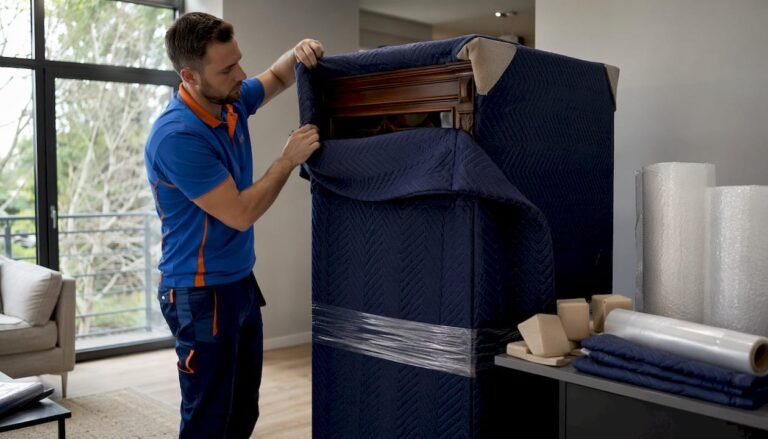
Moving your belongings in stages is defined as a phased relocation method where you transport items across multiple planned trips or time periods rather than in a single move. This approach reduces physical strain, lowers the risk of damage, and keeps your household functional throughout the transition. Standard phased moving timelines run 6–8 weeks, with 80% of packing complete two weeks before moving day. Rushing that timeline increases damage risk by over 50%. Westlondonremoval has supported over 1,000 clients through exactly this kind of carefully planned, multi-stage process, and the results speak for themselves.
What does a move belongings in stages guide actually cover?
A phased move is not simply “moving slowly.” It is a structured method built around packing by frequency of use rather than by room. That single principle separates a well-executed staged move from a chaotic one.
The industry term for this approach is phased relocation. It applies equally to families downsizing, renters between tenancies, and households managing an overlap between two properties. The core benefit is operational continuity. Phased moves spread risk by transferring belongings in waves, maintaining full household functionality throughout, with the old and new homes running in parallel during the transition.
This method also gives you time to catch problems early. A broken box, a missing key, or a furniture measurement error is far easier to fix when you have days rather than hours to respond.
What do you need to prepare before a staged move?
Preparation is the foundation of every successful phased move. Skipping this stage costs you time, money, and energy later.
Declutter before you pack a single box
Decluttering first effectively halves your packing effort. Donating or discarding unwanted items reduces your shipment size and, with a removal company, your cost. Work through each room and sort items into three categories: keep, donate, and discard. Use your furniture disposal options wisely to avoid paying to move things you no longer want.
Gather your supplies and build your inventory
You need more packing materials than you think. Stock up on double-walled boxes in small, medium, and large sizes, packing tape, bubble wrap, packing paper, and permanent markers. Create a numbered inventory list from the start. Every box gets a number, and that number maps to a written or digital list of its contents. This system pays off enormously at the unpacking stage.
Key preparation checklist:
- Declutter every room before packing begins
- Source double-walled boxes in at least three sizes
- Buy colour-coded labels or stickers for each room
- Create a numbered inventory spreadsheet
- Notify your employer, bank, and GP of your new address
- Book utilities transfers at least two weeks ahead
Pro Tip: Address updates and utility transfers require 1–2 weeks’ notice, especially during peak moving periods. Book internet and electricity transfers the moment your moving date is confirmed.
| Preparation task | Recommended timing |
|---|---|
| Declutter and donate | 7–8 weeks before move day |
| Order packing supplies | 6 weeks before move day |
| Notify utilities and services | 4–6 weeks before move day |
| Update address with employer and bank | 4 weeks before move day |
| Confirm removal bookings | 3–4 weeks before move day |
How do you organise your packing timeline across phases?
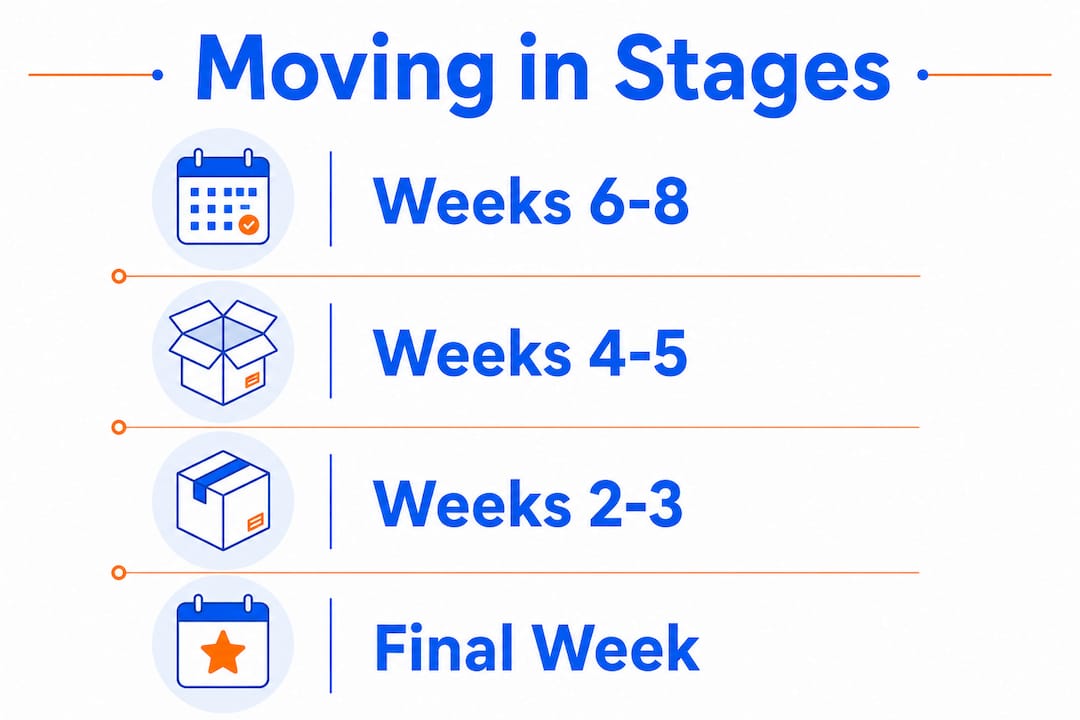
The 6–8 week phased timeline is the professional standard for residential moves. Each week has a clear purpose, and the sequence is deliberate.
Weeks 6–8: storage rooms and off-season items
Start with the spaces you use least. Loft storage, garage shelves, spare room wardrobes, and seasonal items such as Christmas decorations or camping gear are ideal first candidates. Professional movers recommend a “storage-to-essentials” sequence that keeps your home fully functional while packing progresses. Packing this far ahead also gives you access to better removal rates and more flexible scheduling.

Weeks 4–5: books, décor, and non-essential furniture
Pack books, ornaments, artwork, and any furniture you can live without for a few weeks. Disassemble flat-pack furniture and wrap components carefully. Label every piece with its destination room and a box number.
Weeks 2–3: clothing, linen, and secondary appliances
Pack off-season clothing first, then work through linen cupboards, spare bedding, and secondary appliances such as a bread maker or food processor. Keep one set of bedding and towels per person accessible until the final days.
Final week: kitchen, bathroom, and daily essentials
Pack the kitchen last, leaving a survival kit box with a pan, knife, mug, and plate accessible until moving day. Bathroom essentials, toiletries, and daily medications go into your essentials box, not into general packing.
Phased packing sequence at a glance:
- Loft, garage, and storage spaces (weeks 6–8)
- Books, artwork, and decorative items (weeks 5–6)
- Spare room furniture and off-season clothing (weeks 4–5)
- Linen, secondary appliances, and non-daily kitchenware (weeks 2–3)
- Bathroom essentials and daily clothing (final 3–5 days)
- Kitchen survival kit and essentials box (last 24 hours)
| Packing phase | Items included | Timing |
|---|---|---|
| Phase 1: storage | Loft, garage, seasonal items | Weeks 6–8 |
| Phase 2: décor and books | Artwork, ornaments, books | Weeks 5–6 |
| Phase 3: secondary items | Spare room, off-season clothes | Weeks 4–5 |
| Phase 4: linen and appliances | Bedding, secondary kitchen items | Weeks 2–3 |
| Phase 5: daily essentials | Bathroom, daily clothing, kitchen | Final 3–5 days |
Pro Tip: Packing in short daily sessions of one hour is more effective than marathon weekend sessions. Broad Street Movers co-owner Jesse Jones confirms this approach reduces burnout and improves the care taken with fragile items.
What packing strategies keep your belongings safe during a staged move?
Good packing strategy prevents damage and makes unpacking faster. The two most common mistakes are overpacking boxes and using the wrong materials for fragile items.
Box size and weight rules
Use small boxes for heavy items such as books and crockery. Use large boxes for lightweight items such as duvets and cushions. A box that is too heavy to lift safely is a box that will be dropped. Aim for a maximum weight of around 20kg per box for anything you expect removal staff to carry.
Label on the sides, not the top
Side labelling ensures visibility when boxes are stacked. A label on the top is hidden the moment another box sits on it. Write the destination room, a brief contents description, and the box number on at least two sides of every box.
Colour-code by room and priority
Colour-coded labels linked to a numbered inventory list improve unpacking efficiency significantly. Assign one colour per room and add a second colour or symbol to mark priority boxes that need unpacking first.
Packing strategies checklist:
- Use small boxes for heavy items; large boxes for light items
- Wrap fragile items in packing paper first, then bubble wrap
- Fill empty space in boxes with crumpled paper to prevent shifting
- Label on at least two sides with room, contents, and box number
- Use colour-coded stickers per room
- Mark your essentials box clearly with “OPEN FIRST” on every side
- Never pack liquids with breakables
Pro Tip: Your essentials box must be the last item loaded onto the van and the first item unloaded at your new home. Pack it with everything you need for the first night: phone charger, toiletries, a change of clothes, snacks, and any medications.
| Packing mistake | Why it causes problems | Correct approach |
|---|---|---|
| Overpacking boxes | Boxes split; items break; injuries occur | Keep boxes under 20kg |
| Labelling only the top | Labels hidden when stacked | Label two sides of every box |
| Packing daily items too early | Disrupts household routine for weeks | Follow the storage-to-essentials sequence |
| Mixing rooms in one box | Unpacking becomes chaotic | One room per box, always |
How do you manage logistics and transport across multiple stages?
Logistics coordination is where phased moves either succeed or fall apart. The key is to plan each transport wave as its own mini-move, with its own checklist and timing.
Book removals early and plan each wave
Book your removal company as soon as your moving dates are confirmed. Early booking secures better rates and gives you flexibility to adjust wave timing if circumstances change. Westlondonremoval offers flexible scheduling that suits multi-stage moves, including same-day availability for smaller loads. A useful resource for understanding how staged removals are coordinated is this guide on furniture removal between tenancies.
Utility and service transfers
Utilities require 1–2 weeks’ notice. Plan your transfers so that both properties have active services during the overlap period. Running both homes simultaneously is one of the clearest advantages of a phased move. It means you can return to the old property if something goes wrong, and you can test the new home’s systems before committing fully.
Logistics coordination checklist:
- Confirm removal bookings at least 3–4 weeks before each wave
- Schedule utility transfers to overlap both properties during the move period
- Arrange parking permits or access at both addresses in advance
- Confirm lift access or stair arrangements at the new property
- Keep a written schedule of each wave: what moves, when, and with whom
- Communicate the wave plan clearly to everyone in the household
Key takeaways
A phased move succeeds when you pack by frequency of use, follow a 6–8 week timeline, and coordinate each transport wave as a planned event rather than an afterthought.
| Point | Details |
|---|---|
| Pack by use, not by room | Packing daily-use items last keeps your home functional throughout the move. |
| Follow the 6–8 week timeline | Starting early reduces damage risk and gives access to better removal rates. |
| Label boxes on two sides | Side labelling stays visible when boxes are stacked, speeding up unpacking. |
| Prepare an essentials box | Load it last and unload it first to cover your first night without searching through boxes. |
| Book removals early | Early booking secures flexibility and better pricing for each transport wave. |
What we have learned from years of staged moves
After working with hundreds of families across West London, the pattern we see most often is this: people underestimate how disruptive the final week feels, even when the earlier phases went smoothly. The reason is almost always the same. Daily-use items get packed too early, and the household ends up living out of boxes for days before the move even happens.
The fix is simple but requires discipline. Protect your kitchen survival kit and your bathroom essentials until the very last moment. Everything else can go ahead of schedule.
We have also seen families try to manage a phased move without a written wave plan. Verbal agreements about “what goes this weekend” break down quickly when life gets busy. A written schedule, shared with everyone in the household, removes the ambiguity that causes last-minute chaos.
The other thing worth saying plainly: a phased move is not always cheaper than a single-day move. It can cost more in van hire and time if not planned well. The value is in the reduced stress, the lower damage rate, and the ability to catch problems early. For families with children, pets, or complex logistics, that value is real and worth paying for. Our house moving checklist is a good starting point if you want a structured framework to work from.
— West London removals
Westlondonremoval’s support for your phased move
Planning a staged move across West London takes time and coordination. Westlondonremoval specialises in exactly this kind of flexible, multi-wave removal service, with transparent pricing and same-day availability for smaller loads.

Whether you need full professional packing support, a man and van for early-phase lighter loads, or a full removal team for your final wave, Westlondonremoval has the experience and the vehicles to match your schedule. Our house removals service covers all of West London with fully insured teams and flexible booking. Over 1,000 satisfied clients have trusted us with their moves. Get in touch today for a personalised quote that fits your phased moving plan.
FAQ
What is a phased move?
A phased move is a relocation method where belongings are transported across multiple planned trips or time periods rather than all at once. It maintains household functionality during the transition and reduces the risk of damage.
How long does a staged move typically take?
Standard phased moving timelines run 6–8 weeks, with 80% of packing complete two weeks before moving day. Starting earlier gives you access to better removal rates and more scheduling flexibility.
What should go in an essentials box?
Your essentials box should contain everything you need for the first night: toiletries, a change of clothes, phone charger, medications, snacks, and basic kitchen items. Load it last onto the van and unload it first at your new home.
Is it cheaper to move in stages?
A phased move is not always cheaper than a single-day move. The value lies in reduced stress, lower damage rates, and the ability to identify problems early. For families with complex logistics, the additional cost is often justified.
When should I book a removal company for a staged move?
Book your removal company at least 3–4 weeks before each transport wave. Early booking secures better rates and gives you flexibility to adjust timing if your circumstances change.